

The Outlaws 4, page 1


The Home of Great Western Fiction!
It was called Mule Canyon, and it was one of those gold-boom towns in Colorado where men gathered quickly to make a fast fortune, and left just as suddenly. It drew all sorts—the greedy, the adventurous, the lawless—and Sam Calhoun.
Calhoun was tough; he had lived his life through his gun, on the right side of the law. Now he figured it was time to make something of himself, and he figured Mule Canyon to be a good place to settle permanently.
Only a bunch of road agents saw it differently. They were stealing half of the outgoing shipments of ore and doing a good job of destroying the town. Sam Calhoun reckoned he had a stake in their not succeeding.
THE OUTLAWS 4: Lynch Law Canyon
Copyright ©, 1965, 2021 by Brian Garfield
This Electronic Edition: January 2021
Names, characters and incidents in this book are fictional, and any resemblance to actual events, locales, organizations, or persons living or dead is purely coincidental.
You may not copy, store, distribute, transmit, reproduce or otherwise make available this publication (or any part of it) in any form, or by means (electronic, digital, optical, photocopying, recording or otherwise), without the prior written permission of the publisher. Any person who does any unauthorized act in relation to this publication may be liable to criminal prosecution and civil claims for damages.
This is a Piccadilly Publishing Book / Text © Piccadilly Publishing
Series Editor: Mike Stotter
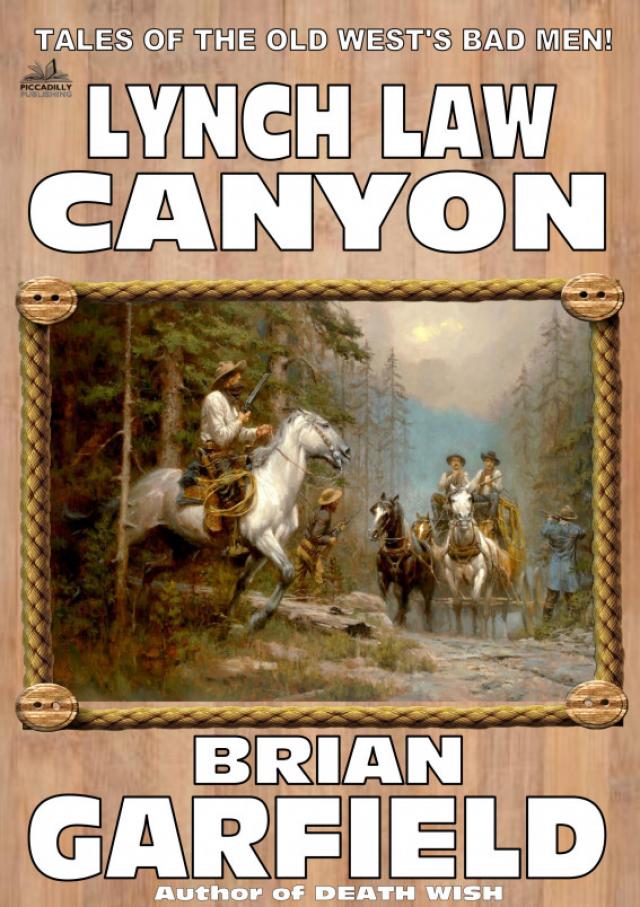
Our cover features a detail from Big Nose George, painted by Andy Thomas, and used by permission.
Andy Thomas Artist, Carthage Missouri. Andy is known for his action westerns and storytelling paintings and documenting historical events through history.
Visit www.piccadillypublishing.org to read more about our books
Chapter One
CALHOUN STEPPED OFF the stagecoach, waited for the driver to toss down his war-bag, and carried it up the street. Sunset, and a hot autumn day; heat shimmered across the desert. The Colorado lapped its banks sluggishly and a flat-bottom steamboat churned upstream, making a racket. Calhoun swung his tall frame up onto the porch of a small one-story hotel, dropped his war-bag to the floor, and turned about to have a better look at the town.
Some called it Colorado City, some called it Yuma. It was a dusty river town, gateway to the northerly deserts and the Mormon country beyond. It was a rough settlement, virile, hard.
This small hotel was on the fringe of the fandango block, and down the street he could see barkers out in front of the dance halls, hawking the entertainment to be found within.
The chandeliers in the saloons gave their windows the brilliance of daylight.
Calhoun brushed the dust of long travel from his clothes, and turned inside to the parlor desk. Signing his name in the leather-bound book, he was handed a key and directed back through a corridor by a pale thin clerk who looked tired of life. Calhoun found his room; its only luxury was a window looking out onto a weed-grown alley. A six-by-ten room of warped dry wood; a bed, washbasin, and unvarnished stand. He had money in his tote-belt but he didn’t like to spend it on frivolities, and to Calhoun, a comfortable room was a frivolity.
The past two days’ riding in a bucking stagecoach had sapped him; thoroughly idle for the first time that day, he relaxed on the cot and studied the room’s simplicity. Beside the doorjamb some transient, more optimistic than most, had carved: “John Henry Jarrett, Charleston, 1874.” The inscription was punctuated by a bullet hole. A dry smile of conjecture touched Calhoun’s firm mouth.
The room had the faint smell of whisky that had been spilled and absorbed into the floorboards. He got up and splashed tepid water from the basin into his face; stood straight and toweled dry. He had a big ragged face, homely but powerful in its structure; it looked as though it needed sorting out. His bones projected at harsh angles; his hard blue eyes were guarded by overhanging dark brows. He was a big man in a wrinkled suit of clothes, hard-knuckled, complexion wind-beaten and dark, age somewhere around thirty, perhaps a little more.
Someone knocked at the door. Calhoun’s hand folded the towel unhurriedly over the hook and fell to lie against the butt of the Colt revolver at his hip. He said, “Who’s that?”
“You don’t know me.” The voice came through the thin boards of the door as if they weren’t there. “My name’s Phil Mercy. Are you Sam Calhoun?”
Calhoun palmed the knob and pulled the door open. “I am.”
“There’s a game going on at the Oriental Palace. I heard you were in town, thought you might be interested.”
“Maybe,” Calhoun said, “maybe.” He put his eyes on Phil Mercy and studied him. The man was not tall; he carried himself in his clothes in a manner suggesting a gentleman. A slim man, Mercy appeared to have little physical strength. The face under the flat-crowned hat was long, soft, handsome in a sensual dark way; it reflected gallantry and restlessness, and perhaps unsteadiness in the heavy-lidded brown eye. His lips were wide and sensitive, always playing with something that might have been a smile or a nervous tic or perhaps a grimace.
Phil Mercy said, “Planning to stay in town?”
“I wasn’t.”
“Lot of money in this game. Maybe it’ll change your mind.”
“Why come to me?”
“I run the game,” Mercy said. “It’s gotten to be a bore.” He smiled disarmingly. “You could inject a little action.”
Calhoun shook his head. “I’ve got a stake.”
“Then take a chance on running it up.”
Calhoun drew his head back. “Who are you, Mercy?”
“Me?” Phil Mercy laughed easily. “I’m just a gamblin’ man, friend.”
“Why all the interest in me?”
“Like I told you,” Mercy said.
“I guess not—that’s not good enough.”
Mercy spread his hands, smiling. “All right—all right. One of the gents in the game heard you were in town. He asked me to invite you over. I guess he wants to look you over.”
“What for?”
“He owns a big saloon up in Mule Canyon. Maybe he thought of hiring you to run his tables for him.”
“What’s his name?”
“Calls himself Matthew Ruarke,” Mercy said.
“Well, then,” Calhoun observed, “if Matthew Ruarke wants to talk to me, I’m not hard to find.”
“All right,” Phil Mercy said, unruffled. He turned and put his hand on the doorknob.
“One thing,” Calhoun said.
“What’s that?”
“When’s the next stage to the camps?”
“Not for a couple of days. Wednesday morning, I think. You can check at the Walker and Knight office.”
“I will. Thanks.”
Phil Mercy inclined his head. “Drop into the Silver Queen sometime. I’ll buy you a drink.”
Shortly thereafter, Calhoun went out to eat. He had a solitary supper in a Chinese café; if he was troubled by loneliness, he didn’t show it. Afterward, going into the street, he found an idler against the front of a billiard hall and inquired, “Where might I find Walker and Knight’s office, friend?”
The loafer pointed along the street. “Couple blocks down and around to your right.”
“Obliged,” said Calhoun, and pushed away.
He found the Silver Queen saloon and entered, and immediately stepped aside from the main current of the doorway’s flow of men. A haze of tobacco smoke fogged the room and stung his eyes; there was a lot of noise—rough talk and laughter—and the mingled smells of whiskey and beer and smoke and unwashed bodies pressed close together in crowds: a familiar, singular aura, the smell of a saloon.
Calhoun noticed Phil Mercy at a table near the front corner; Mercy was sliding cards out of a faro-box, and there were three players at his table. Calhoun didn’t go to the table; instead he made a place at the bar, took a mug of beer, and leaned back on his elbows.
Casually, with nothing better to do, Calhoun presently moved away from the bar carrying his beer, chafing a little that he would have to wait for Wednesday’s stagecoach. He pushed toward Mercy’s table, and as he drew closer he felt something out of place. It was coming from the group seated there, and it was evident in the way onlookers were crushing back away from the table.
A heavy, squat man with the face of an ape sat next to Phil Mercy, thoughtfully chewing a mouth of tobacco, bending his handful of cards between his hammy fists. He was watching Mercy heavily and Mercy was watching him.
The squat man suddenly cursed and lifted the table, and dumped it into Mercy’s lap. Cards and chips and the faro-box cascaded against Mercy, bouncing off him and rolling around the floor. Mercy scuttled away from the weight of the table; the heavy man got out of his chair and came around the upset table, glaring down at Mercy and muttering in a slow stupid voice: “I like to play honest cards.” He reached down and yanked Mercy to his feet by the collar.
Mercy stared round-eyed at the squat man, badly shaken. Calhoun, a passive onlooker like the rest until now, came around behind the squat man and put his hand easily on the man’s burly shoulder. “Just a minute, friend.”
The squat man dropped Mercy like a lifeless sack and wheeled. He put his close-together little eyes on Calhoun and thrust at him with the weight of his angry glance; he looked at the short-gun at Calhoun’s hip and allowed his sneer to rest on Calhoun, and grunted, “There’ll come a time, tinhorn,” apparently speaking to Phil Mercy. The squat man stood his ground for a mo ment, trying to meet Calhoun’s steady gaze; then he dropped his eyes and swung away into the crowd, battering people with his shoulders and elbows. He plunged through the door and lost himself outside in the night.
Calhoun watched Mercy get up and pull his coat straight. Mercy said, “A bad loser. Thanks, Calhoun.” He set the table upright and began to pick up the fallen cards and chips. “That hurts my pride,” he said. “It’s been a good number of years since I tried to cheat a man at cards. I consider myself good enough not to have to stoop to cold-decking.”
Calhoun looked directly at him. Phil Mercy came around and clapped him on the arm and said, “Allow me to buy you that drink.”
Leroy Hamlin thrust angrily through the alleys, cursing with soft slow-headed conviction. “I’ll have that tinhorn card shark,” he promised, “I’ll have him,” and walked across a main street, a huge round-chested man, made even bulkier at the moment by the heavy sailor’s pea-jacket he wore against the night’s fall chill. Essentially a warm-weather creature, Leroy had a hatred for cool temperatures and a great fear of catching grippe. That was his only fear worth mentioning. Leroy was grotesque: short and square, bowlegged, long-armed. His bullet-round head was squashed into the shoulders without benefit of a neck. The eyes were too small, set close together, pouched in heavy flesh; his lips were blunt and his chin formed an odd contradiction, being round and sloping and not defined at all.
Leroy repeated, “I’ll have him,” and rolled along the dark streets until he reached the Drovers House; he tramped across its ornate lobby, went upstairs, and knocked against a door near the front of the hallway.
“Leroy?”
“Yeah.”
The door opened; Matthew Ruarke, long and skinny, stepped aside to admit Leroy, who wandered around like a curious bear before he leaned his wide, fleshy back against the wall. “That Calhoun feller just butted into a little argument me and Phil Mercy was having.”
“Did he,” Ruarke murmured.
“I don’t like either one of ’em,” Leroy said defiantly.
“All right.” Matthew Ruarke went to the room’s only chair and shifted his body around in it until he was comfortable. He withdrew a cigar from the pocket of his bright-colored vest, lit it without hurry, and drew slowly on the smoke, afterward inquiring sleepily, “What did you find out about Price Goodfellow?”
Leroy lifted his shoulders. “Far as I could find out, all he come down here for was to pick up his daughter.”
“I see.” Relaxed in the chair, Ruarke made a picture of a thin, sharp-nosed northeastern man with a narrow face, a high sloping forehead, thinning sandy hair. His slim hands were pale and soft-textured. He observed, “A man like Goodfellow doesn’t travel three hundred miles across the desert just to pick up a girl and take her back to a tough bucko camp.”
Leroy Hamlin grinned, showing uneven yellow teeth; and said slyly, “You ain’t seen his daughter.” Leroy laughed crudely.
Matthew Ruarke made a small gesture; he dropped the cigar to the floor and ground it under his heel, and said abruptly, “Keep your eyes open.” He turned away to pick up a leather-covered volume, plainly indicating that the interview was ended.
A man of enforced patience, Sam Calhoun sat in the lobby of the Drovers House and read a newspaper until midnight, after which he moved toward the door, headed for his own hotel and bed. But a thin man with calculating eyes caught him at the door, saying, “You’re Calhoun.”
Calhoun looked him up and down. “That gives you the advantage,” he said.
“Matthew Ruarke.”
Calhoun nodded. “I got your message from Mercy.”
“I wanted to see if you were as good as they said you were.”
“Good at what?”
Matthew Ruarke was looking directly at Calhoun’s hip gun; Ruarke said, “I hear you’re a high-roller.”
“Do you?”
“They tell me you’ve downed a few men.”
“I’m retired,” Calhoun said, smiling softly.
“Maybe. I can offer good pay.”
“For what?”
“Occasional work,” Matthew Ruarke murmured. “It wouldn’t take much of your time. You’d be in good company. Jack Holliday, for one.”
Calhoun’s lids dropped, concealing his thoughts. Ruarke said, “You and Holliday ought to work pretty well together.”
“I doubt it.”
“Why? You’re both the same kind.”
“Not the same kind at all,” Calhoun said quietly. “Ruarke, if you’ve got Holliday you don’t need me.”
“Maybe I need somebody to keep an eye on Holliday.”
Calhoun’s lips turned into a crooked smile. “You should have thought of that before you hired him.”
Matthew Ruarke made a vague gesture. “All right, then, you don’t want the job. I’ll find somebody else.”
“Do that.”
Ruarke nodded and went on.
In the morning, tired of café food, Calhoun walked down to the Drovers House to eat breakfast. He was forking eggs when Phil Mercy came into the dining room with a fresh-combed look to his hair. Mercy sat down uninvited at Calhoun’s table and said, “Morning.”
Calhoun nodded and settled down to the business of eating. He attacked it as he came at most things—squarely, deliberately. He was a solid man who showed little duplicity and little diplomacy.
Phil Mercy tried to maneuver him into a conversation, but his talk fell flat on the taciturn Calhoun. Trying to rouse the man’s interest, Mercy said: “I hear you talked to Matt Ruarke.”
Calhoun looked up but said nothing. Mercy went on, “Was it what I thought? Did he offer you a job?”
“Yes.”
“Take it?”
“No.”
“Good,” Mercy said. “He’s a crook.”
“Then why’d you shill for him?”
“I was interested to see what you’d do,” Mercy said. “I’m not Ruarke’s errand-boy, if that’s what you’re thinking. Only met him two days ago. I turned down a job dealing for him. He’s got a big new saloon up in Mule Canyon. There’s a new strike there and it promises to be a boom town. Ruarke’s recruiting men.”
“What’s your interest in it?”
Mercy shrugged. “I’m thinking of traveling up there to try the action. What about you? You asked me about stagecoaches to the camps.”
“I haven’t made up my mind,” Calhoun said. “I’ll look the place over.”
“Well,” Mercy said, “at any rate we’ll be on that stage together. I just bought my ticket.”
Calhoun nodded without evident interest. The meal finished, he settled back in his seat while Mercy ate, and had his first good look around the room. Half across the room he saw a young woman sipping coffee, smiling at the older man at the table with her. In time the woman’s glance came around to his end of the room and she noticed Calhoun’s look. She nodded; she smiled.
Her eyes were dark; when she smiled the planes of her face became prettier. She wore her hair swept away from her ears: ash-colored hair, soft-appearing. She was slim and her face was a practical one.
In a moment her casual glance left Calhoun and went on. The old man spoke to her; she turned to him and said something and gave him her smile. He looked old and blunt, a coarse man who appeared rustic and yet intelligent.
Phil Mercy said with a little smile, “Her name is Catherine Goodfellow. The man talking to her is her father. He owns the Acropolis mine at Mule Canyon. She’s been east for several years, at school and then in St. Louis with her aunt. Old Goodfellow got this new mine going and sent for her.”
Calhoun said, “You find out a lot of things, don’t you?”
“Sure.” Mercy was one of those smiling ones who made an art of easy mixing.
Calhoun got up and went out into the morning sunlight. Firing up a cigarette, he walked idly down to the river docks and watched the muddy river flow past; he said to himself, “You’ll have to make something of yourself before you get old.”
When he again passed the Drovers House, he looked in through the window and saw Phil Mercy seated on a couch, talking with the girl he had seen in the dining room this morning. Mercy saw him and beckoned. When Calhoun came into the lobby, Mercy said, “Miss Goodfellow, I’d like you to meet Sam Calhoun.” He looked up at Calhoun. “Can I get you a drink?”


