

The Erstwhile, page 1


B. CATLING
The Erstwhile
B. Catling is a poet, sculptor, painter, and performance artist. He makes installations and paints portraits of imagined Cyclopes in egg tempera. Catling has had solo shows at the Serpentine Gallery, London; the Arnolfini in Bristol, England; the Ludwig Museum in Aachen, Germany; Hordaland Kunstnersentrum in Bergen, Norway; Project Gallery in Leipzig, Germany; and the Museum of Modern Art in Oxford, England. In 2015 he was made a Royal Academician. He is the author of The Vorrh.
ALSO BY B. CATLING
The Vorrh
A VINTAGE BOOKS ORIGINAL, MARCH 2017
Copyright © 2017 by Brian Catling
All rights reserved. Published in the United States by Vintage Books, a division of Penguin Random House LLC, New York, and distributed in Canada by Random House of Canada, a division of Penguin Random House Canada Limited, Toronto.
Vintage and colophon are registered trademarks of Penguin Random House LLC.
This is a work of fiction. Names, characters, places, and incidents either are the product of the author’s imagination or are used fictitiously. Any resemblance to actual persons, living or dead, events, or locales is entirely coincidental.
Library of Congress Cataloging-in-Publication Data
Names: Catling, B. (Brian) author.
Title: The Erstwhile / B. Catling.
Description: First American Edition. | New York : Vintage Books, a division of Penguin Random House LLC [2017]
Identifiers: LCCN 2016030228 (print) | LCCN 2016037343 (ebook)
Subjects: | BISAC: FICTION / Fantasy / General. | FICTION / Historical. | FICTION / Literary. | GSAFD: Fantasy fiction. | Science fiction. | Occult fiction.
Classification: LCC PR6053.A848 E77 2017 (print) | LCC PR6053.A848 (ebook) | DDC 823/.914—dc23
LC record available at https://lccn.loc.gov/2016030228
Vintage Books Trade Paperback ISBN 9781101972724
Ebook ISBN 9781101972731
Cover design: Pablo Delcán
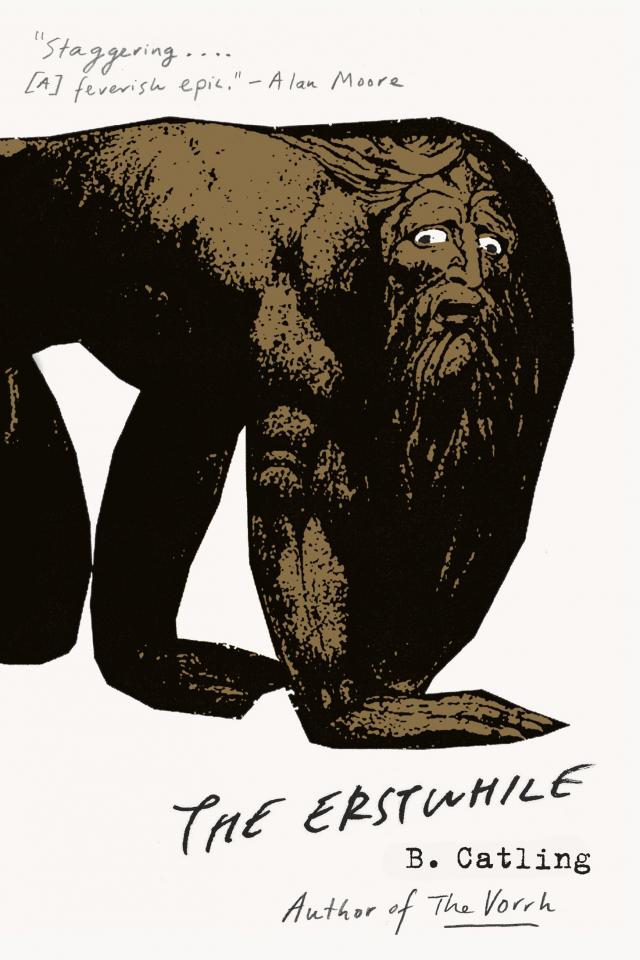
Cover image: A detail from Nebuchadnezzar by William Blake © Tate, London 2016
www.vintagebooks.com
v4.1
ep
Contents
Cover
B. Catling: The Erstwhile
Also by B. Catling
Title Page
Copyright
Dedication
Epigraph
Prologue
Part One
Chapter One
Chapter Two
Chapter Three
Chapter Four
Chapter Five
Chapter Six
Chapter Seven
Chapter Eight
Chapter Nine
Chapter Ten
Chapter Eleven
Chapter Twelve
Chapter Thirteen
Part Two
Chapter Fourteen
Chapter Fifteen
Chapter Sixteen
Chapter Seventeen
Chapter Eighteen
Chapter Nineteen
Chapter Twenty
Chapter Twenty-one
Part Three
Chapter Twenty-two
Chapter Twenty-three
Chapter Twenty-four
Chapter Twenty-five
Chapter Twenty-six
Chapter Twenty-seven
Chapter Twenty-eight
Chapter Twenty-nine
Chapter Thirty
Chapter Thirty-one
Chapter Thirty-two
Chapter Thirty-three
Chapter Thirty-four
Chapter Thirty-five
Chapter Thirty-six
Chapter Thirty-seven
Chapter Thirty-eight
Chapter Thirty-nine
Chapter Forty
Chapter Forty-one
Chapter Forty-two
Chapter Forty-three
Acknowledgments
For Alan Moore, who lit the fuse.
And for Ray Cooper and Terry Gilliam, who fanned the flames.
The tree of knowledge has been fossilised into an island of coal ready to consume our earliest historical trace (a biological fact or a mythological belief). One is old, the other is new. But both exist side by side in the present.
UNKNOWN
Woe to Europeans if they do not remain conscious of their unity of culture and race in the African bush. Woe to them.
LEO FROBENIUS, Paideuma. Umrisse einer Kultur-und Seelenlehre
PROLOGUE
To-bruized be that slender, sterting spray
Out of the oake’s rind that should betide
A branch of girt and goodliness, straightway
Her spring is turned on herself, and wried
And knotted like some gall or veiney wen.—
Dayspring mishandled cometh not againe.
RUDYARD KIPLING, “Gertrude’s Prayer”
LONDON
This is where the man-beast crawls, its once-virtuous body turned inside out, made raw and skinless, growing vines and sinews backwards through the flesh, stiff primordial feathers pluming in its lungs, thorns and rust knotted to barbed wire in its loins. Guilt and fear have gnawed the fingertips away to let the claws hook out into talons. Sharpened by digging a home in a shallow grave. It is seen on all fours, naked, and worse across the broken ground on sharp knees that are red raw from chiseling the earth to gain some purchase. Prowling inside a trench blinded by stark glares of explosions. Another bellowing flash sculpts the rippling muscle of its back and arms and the thick prophet’s hair that has become soured by warfare into itching dreadlocks, mud-filled like the beard of dribble and tangled ginger grit.
But it is the face that alarms, skinned alive by shock.
The eyes terrified in the sudden phosphorus glare. Ultimately lost and forever in a gutter of staring that has emptied its skull.
The small balding artist makes a further adjustment to their expression, widening the pupils, setting them in a squint, looking in different directions to give insight into the mind cleaving.
He then steps away from the table where the picture had been made and nods to himself, his ink-stained fingers rubbing his chin. Yes, it was almost ready to be finalised for printing. A small noise on the other side of the room made him look up and drag his thought into the open: “I say it’s almost ready to be finalised.”
Someone or something was draped against the shabby curtain that was saturated in the stink of London. The artist took the picture from the table and held it up to show his subject and emphasise his words.
“I never looked like that!” came the reply. “You have caught me between worlds, upriver before I left the great forest and downriver after. You have gone and left me here alone and all the other Rumuors have sailed over to the Dauphin’s land to be torn apart in the mud, in the first of your world wars of which there shall be many.”
It was difficult to understand the model because he had been speaking in a vocabulary of shadows. He had not yet learned language. Instead he spoke into the artist’s mind telepathically, without words, which made the artist’s mouth work unconsciously, trying to shape the sounds in his mind. For anyone else, this manner of communication could be shocking, but for this painter, it was just another day communing with the angels.
The model said he was of the Erstwhile, but this made no sense to the painter. He also referred to humans as “Rumours,” with a capital “R.” It all seemed a bit delirious and the waning day outside was blurring the edges of their meanings. The model’s statement about a French trench in a future world war had not been understood.
The night closed slower back then, the eye calibrated to dusk and all the nuances that have since been removed and exiled by electricity. The city in these days was encrusted in an ancient gloom—the small wicks of the whale-oil lamps glowed in every tarry hutch, doing little but adding a smoked glitter to the polished coral of London’s darkness. A blind man, and there were many then, could tell of night’s arrival by the change of smell, as the whale oil’s stench rose up against the departing light. The river held the tides in its deep ragged throat for a moment before reversing its might under the command of a hidden moon. On the banks of the Thames thousands of stacked wooden rooms creaked and shuddered.
The painter protested: “But it is you, exactly as you described it. As you looked before. Before you found me. It’s you leaving that forest. Fleeing that Vure you speak of.”
“V-O-R-R-H! And I did not flee.”
This was transmitted in careful curves with a new insistence in its pressures, forcing the artist to drop the picture and hold his head.
The abruptness surprised the last particles of day.
“Do not write my name on this. If you must show it to others, say it is someone else.”
“But who? What?” asked the confused artist. “Nothing else looks like this.”
“Then hide it, bury it under others, show no one, burn it.”
“But it shows another face of God,” the artist said. “God in the beast and man declining, falling from grace.”
The model maintained his clarity while dissolving in the gloom.
“An ancient king,” he thought, tossing it back in the wake of his leaving, and the wisp of it undid the pain in the artist’s temples. He took his hands down and looked at his stained fingers as if trying to match the same darkness in the pigment with that which was growing in the room.
“I will call it Nebuchadnezzar,” he quietly called out, in the way one speaks to the final closed door of
It became one of William Blake’s greatest works.
Part One
CHAPTER ONE
The old arrow was forgetting. The air had worn it thin, so many harsh landings, so many directions. It had sailed across time and place, slayed some men and saved others. The bow, however, stayed constant and vital. Its maroon-and-black curve was made of the flesh and bones of a divine woman, a priestess who had been born in the Vorrh. She had told her husband how to divide her flesh and remake it. To separate and shave the long bones, realigning their strength and grain, and how to bind their splints with her muscle fibres and tighten them with sinew and skin. Now the great Vorrh and all that dwelt within it watched as the undergrowth parted and the bow glided between the trees, twisting to avoid the hanging vines.
Any human would have seen only the bow and arrow travelling by themselves, yet they were being held by Tsungali: slayer of men, warrior of the True People. The man who had led the Possession War uprising. He who had hunted the English bowman Williams and been slain by the monster Sidrus in the process. These days Tsungali was a ghost. A battle in this very forest had made him so, but those moments felt dim in his mind, receded because ghosts have poor memories. They have only purpose, which for Tsungali was finding the final destination of the fatigued and last arrow.
He travelled now with the spirit of his grandfather, who had guided him thus far and encouraged him on. Their journey was circular throughout the Vorrh. The process had taken many months. Tsungali shot the arrow forward and they followed it to places no human, or ghost for that matter, had ever set foot. Now it had taken them to the forest’s edge.
Tsungali’s grandfather stopped before they made the next shot. He sat wheezing on a low rock. Tsungali felt him dissolving and turned towards the ancient man, who like him was a waft of his previous life. Then the old one summoned up a strong whisper, and spoke again.
“Little son, we have done our duty and I will stay now. The last part of this is yours alone.”
The grandson did not argue. He bent and hugged the great spirit who had been so much to him. The ancient man faded as they embraced. In the mottled sap-green sunlight, he was barely there. Tsungali turned and loaded the arrow and bent the bow. He let the next shot fly and felt the suction of separation as he left the Vorrh forever.
The Vorrh did not recognise or want men trespassing its vastness. And any who did suffered a dismal erasure of mind. The Vorrh had its own time, its own climate, and its own mind. It was ancient before Adam was a supposed twinkle in God’s eye. And so had few dealings with this troublesome species. The fabled monsters and ghosts that were permitted access to its core had a purpose and function that ran in opposition to the dreams and ambitions of humanity. And every other living thing inside its protection had a stronger version of the same natural distrust and suspicion of Homo sapiens that is exhibited everywhere on Earth.
He continued to shoot and follow the arrow for days and nights. Each flight and each stumble taking him farther and farther from the shadow of the Vorrh. He was moving south and a great tiredness was settling over him.
He knew his journey was nearly over because the bow was twisting in his grip, straining towards its destiny. It was late evening when he passed through a village. The honey-coloured stone of the simple houses kept the sun’s warm glow after it had set. The day’s heat was gradually released from deep inside the stone’s fossil stubbornness. The bow brightened in the warmth as it bobbed and leaned forward.
As night fell, the bow pulled Tsungali into the star-clad fields beyond the village’s perimeter. Here, he again found the white arrow. Together, they waited for the moon to rise, late and solemn, swollen and ponderous in its appearance. As the moths danced in the moon’s glare, Tsungali sent the arrow on its last flight, high in the direction of the sea, and followed in its trajectory towards dawn and the oceanic roar of the coast.
He had never experienced so much water. Among the crumbling cliffs and booming waves, he would have been afraid if he were still alive. The land felt hollow beneath his feet, he heard the deep voice of its concavities. The whole cliff full of caves and tunnels, potholes and chasms. The sea sucking air and water through them all. Breathing in resounding echoes in the first warmth of his last morning.
Perched high, Tsungali saw the remains of a house. The bow writhed, almost alive in his hand, straining, pulling, yearning to enter the small patch of domestic ruins. It seemed aware it had returned to the place of its origin, where it was made.
The fence around the plot had long since fallen and there were signs of animal intrusion everywhere. There was not the faintest trace of any personal effects. It had all been picked clean. Scavenged by thieves, weather, and wild dogs. The garden plants had overgrown and died back so many times that a thorny tangle of wiry undergrowth covered everything. Its mass had kept all recent predators and foragers at bay for many years. He passed through it with ease. He found the splintered arrow and knew the journey had ended.
He summoned and focused his last strength of being into his hands and cleared the weeds and dead brambles away to make the arrow’s grave. For that is what he knew to do. To bury the shards and splinters here in this exact spot of arid soil where it had landed. He clawed away at the yellow earth, making a shallow trench. Then he felt something under his hands, something different. He dug down, now like a dog pawing at the earth, his face almost in the hole. A bundle began to emerge. He uncovered the burrow and its occupant. He dug more carefully, pulling the roots and crawling flecks of transparent beetles away from the thin rotting cloth, revealing the tiny body of a baby. He put his black ghost hands under it and hoped he had the substance left to lift it out.
It was not dead. It was not alive. It was human, but it was both black and white. Its pale skin being mottled and patched with blue-black pigment. He lifted it into the sun and brushed the earth from its limp, naked body. He picked its ears, eyes, and nostrils clean. Its mouth was firmly shut. He estimated that the child was no more than a few weeks old. Then it opened its eyes.
There was no uncertainty in the action, no resistance…they worked perfectly. Its eyes were the colour of opals and he had seen them before. He sat down and sank deeper into the wiry undergrowth. The precious bundle in his hands. The baby looked at him. Looked with the eyes of Methuselah and told his body what to do. He cradled the child in his lap and put one hand over his head, the other over the child’s. He then made a circular rotation over both, as if smoothing something down. After a minute or two the milk started to flow. First in drips that splashed against his belly and thighs, then in rivulets running down his chest. The white lines against his black, nearly invisible body were dramatic and agile. He lifted the child to his breast and the tight mouth undid and refastened on his nipple. An enormous pleasure pumped through him as the greedy baby drank and he drained. All he had been was now converted into another substance. It was more than he could ever become, greater than his tribe and sweeter than all his gods. With an overpowering joy he was pulled inside out to nothing in a resounding pop that let the child roll down to fall quietly among the plants, its eyes glazed in delight and its mouth still sucking.
A light wind came in across the sea and woke the child. With energy in its limbs and its eyes wide open it crawled towards the broken house. The terse grasses and low thorn shrivelled in its path. Nothing dared scratch its painfully slow progress. The bow waited and squirmed in the shade where Tsungali had propped it. It slid down and gave itself up, loosening into sprung sinews and lashed shaved bone.


