

Dark All Day, page 1
part #3 of The Walking Shadows Series


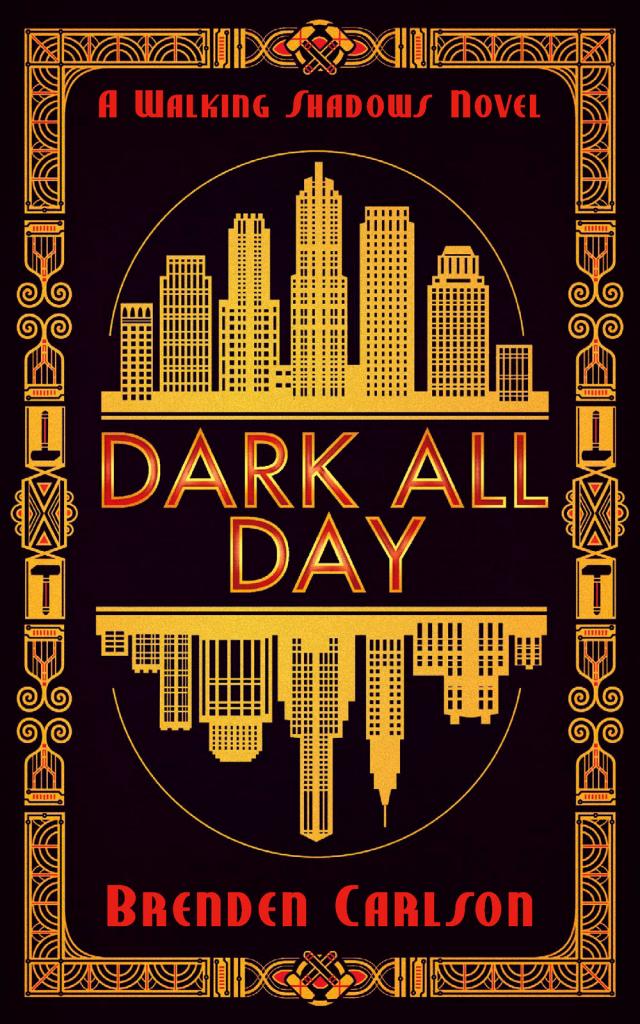
Dark All Day
The Walking Shadows series
Night Call
Midnight
A Walking Shadows Novel
Dark All Day
Brenden Carlson
Copyright © Brenden Carlson, 2023
All rights reserved. No part of this publication may be reproduced, stored in a retrieval system, or transmitted in any form or by any means, electronic, mechanical, photocopying, recording, or otherwise (except for brief passages for purpose of review) without the prior permission of Dundurn Press. Permission to photocopy should be requested from Access Copyright.
All characters in this work are fictitious. Any resemblance to real persons, living or dead, is purely coincidental.
Publisher: Kwame Scott Fraser | Acquiring editor: Rachel Spence
Cover design and illustration: Sophie Paas-Lang
Library and Archives Canada Cataloguing in Publication
Title: Dark all day / Brenden Carlson.
Names: Carlson, Brenden, author.
Description: Series statement: A walking shadows novel ; 3
Identifiers: Canadiana (print) 20220446806 | Canadiana (ebook) 20220446814 | ISBN 9781459745858 (softcover) | ISBN 9781459745865 (PDF) | ISBN 9781459745872 (EPUB) Classification: LCC PS8605.A7547 D37 2023 | DDC C813/.6—dc23
We acknowledge the support of the Canada Council for the Arts and the Ontario Arts Council for our publishing program. We also acknowledge the financial support of the Government of Ontario, through the Ontario Book Publishing Tax Credit and Ontario Creates, and the Government of Canada.
Care has been taken to trace the ownership of copyright material used in this book. The author and the publisher welcome any information enabling them to rectify any references or credits in subsequent editions.
The publisher is not responsible for websites or their content unless they are owned by the publisher.
Dundurn Press
1382 Queen Street East
Toronto, Ontario, Canada M4L 1C9
dundurn.com, @dundurnpress
For my brother, Adam.
I hope he makes smarter decisions than I have.
Like an unchecked cancer, hate corrodes the personality … destroys a man’s sense of values and his objectivity. It causes him to describe the beautiful as ugly and the ugly as beautiful, and to confuse the true with the false and the false with the true.
― Martin Luther King Jr.
Contents
Chapter 1
Chapter 2
Chapter 3
Chapter 4
Chapter 5
Chapter 6
Chapter 7
Chapter 8
Chapter 1
Chapter 10
Chapter 11
Chapter 12
Chapter 13
Chapter 14
Chapter 15
Chapter 16
Chapter 17
Chapter 18
Chapter 19
Chapter 20
Chapter 21
Chapter 22
Chapter 23
Chapter 24
Chapter 25
Chapter 26
Chapter 27
Chapter 28
Chapter 29
Epilogue
About the Author
Chapter 1
It was Wednesday, January 9, 1918, when I returned to the United States on a ship with several hundred other veterans. Most of the crew space had been used for cargo storage, seeing as less than half the men who went to Europe had come back. The Sinclair brothers, Patrick and Edward, and I were part of the Cornell Detachment, along with 572 other men who had gone to war from the same school. Now, there were less than two hundred of us left, and only one Sinclair brother had made it back.
The New York harbour was dusted in snow, the time of year finally making itself known, with people wearing furs and coats and gloves. Before I left, I saw a country so vivid and venerable and, of course, hopeful that this war and its victory that we were so sure of would bring us glory. And here I was with about 150 or so survivors, and we all just saw ancient concrete and empty promises. Victory had been grasped, but while the men and women back here could revel in it, we had borne the cost. I don’t think I ever voted again after that war.
Stepping off the ship, I spotted someone I hadn’t expected to show up: my father. I’d thought he’d disowned me as his son, like my mother did, and yet, there he was, at the end of the docks, ready to meet his nineteen-year-old son wearing military BDU. I was hesitant, freezing upon recognizing him, but soon wormed out of my shock and approached.
He was thinner back then, with his hair cut prim and proper like any other American gentleman who worked with money. You could tell he was Italian, perhaps from the way he carried himself, or perhaps because of the cross around his neck and the broad nose stuck between his tiny eyes. He stood too straight, spoke too hard, and looked too casual picking me up.
“Dad,” I greeted him, carrying a rucksack over my shoulder.
“Elias,” Gino Fera replied in a stern voice.
“Planning on telling me how I fucked up everything?”
“No, no, that isn’t why I’m here.” I could tell Dad wanted to be angry, but I was still his son. His son with a gaunt face, a malnourished figure, stubble where there had once been clean-shaven cheeks. “I’m taking you home.”
“Don’t.” I began walking, forcing Dad to catch up to me. “Just bring me back to Cornell.”
“Cornell?”
“I was part of the Cornell Detachment. I imagine they’d want surviving undergraduates to return to their studies. I still have a scholarship.”
We approached my dad’s Model T, and I climbed into the passenger seat. The silence in the car as we headed to the university was unbearable for my dad, no doubt, but for me, it was comforting; I had spent the past year surrounded by either shouting or gunfire, and so the sound of wind and calm snowfall was absolute heaven. I just wished I was enjoying the ambience in a different country.
“Son …” Gino began.
“Don’t,” I snapped back. “Just don’t.”
* * *
I returned to classes the same day. After confirming that I was alive by mentioning my real surname, I was given a schedule and told I was late for the start of the semester. An hour later, I was in a classroom for advanced chemistry, with the same professor I had been taught by more than a year before. Nothing had changed: the seats still creaked, the air was dusty, the old codger up front still acted like some military man with command over us, but the one noticeable difference about the classroom was how empty it was. Before, there had been over fifty people in this classroom — one of the largest on campus. And now there were eight, myself included.
Looking to my left, there was an empty spot where Barny Birmingham had sat. I remember how he died: skulking around the trenches, leading a squad through to get a bead on an enemy position, he’d taken a belt of machine-gun fire after prematurely jumping out of a trench. In front of me was an empty seat for Ryan Greer, who was killed piloting a Manual. He was hit by German artillery shells, splitting him and his machine open, showering me and my companions in blood and intestines and God knows what else.
Behind me was an empty seat for Devon Richardson, who was killed by his own men. He was coming back from a nighttime op, scouting ahead for an assault that didn’t get past the planning stage. A sleep-deprived and paranoid sniper spotted movement in the forward trenches and fired, putting three bullets through Devon, his screams filling the night until morning, when they realized they had shot one of their own men. To my right was another empty spot, where Edward Sinclair had once sat. I never got to see how he died.
* * *
On Wednesday, February 7, 1934, I woke up at my desk — right, not my desk, mine was a smouldering hole in the side of a skyscraper. My temporary desk at Allen’s apartment. My reflexes took over as I reached for a cigarette and my lighter, an action I was unable to complete given my missing hand. The metallic stump hit the lighter, knocking it onto its side, and I spotted the gleaming chrome prosthetic sitting nearby.
“Right,” I groaned, suddenly feeling my age and my experiences hit me like a truck.
I stuck the pack in my right armpit while my intact left hand extracted and lit a dart. The etched eye on the lighter’s base kept staring back at me, only breaking eye contact after I pushed it into my pocket.
The desk was overpopulated with stuff, just stuff. Paper receipts I had written in terrible handwriting, a pen holder, my pack of cigarettes, a phone, a small newfangled Mini-Terminal — or Mini-T, as it was marketed — that I had borrowed from Allen, a wooden mallard my brother had sculpted for me years ago, and a picture of me and the boys from the 5th. The latter two items were the only things I had taken from my old apartment after it had literally blown up in my face.
“Another day on the clock, huh?” I asked the wooden duck.
It stared back at me. I knew it was always listening, even if it didn’t react to me.
“Yeah, I feel that,” I said to its answering silence.
Pushing myself up, I turned to see the spray of Platelight shooting through the poorly drawn blinds, which meant the light and heat must have been the culprits for waking me up. The clock in here read eight o’clock, which was pretty good, considering that I was still used to waking up at nine at night.
I went to the sink in the bathroom down the hall, turning on the flickering light, and ran cold water over my metal-capped wrist. Shit, that was cold. Grabb
Washing the utensil and my hand, I wandered back to my desk, grabbing my mechanical palm. I shoved the gleaming spoke into my wrist and twisted, a click signalling the proper connection with the electrodes. My imaginary muscle movements translated once again into mimicked mechanical movements. I tested it out by opening the blinds and was immediately assaulted by more Platelight searing my corneas. I backed away from the window, hitting my desk, making papers and other items tumble to the floor.
I heard the front door open, and merely looked at my holster instead of brandishing the weapon it held — thankfully, I’d been less twitchy recently. Through the open door, I peered down the hall, seeing the main entrance occupied by a bulky figure in a light coat, carrying a briefcase in one hand and an umbrella in the other: Yuri Semetsky, former Russian Cossack and street-meat vendor, currently my secretary. He’d lost weight now that he actually had decent food in his stomach and a regular place to sleep. Plus, having to run from his apartment to here every morning gave him more exercise than standing around a cart ever did. He had cut his hair short and left his beard unruly, and while both were edging on grey, his stoic Slavic face didn’t look a day over forty.
“Mister Roche! Good morn!” Yuri, always chipper. “You look like you didn’t sleep well.”
“I didn’t,” I confirmed, groaning, my throat parched and my body aching.
I spent more days here than I’d care to admit. I looked at the calendar Yuri had pinned to the wall above the desk, seeing the date. I had an appointment for the damned wrist. Empty checkups I dumped money into for them to say all was well and good. It’s better than dying of Rustrot, whatever that was.
“Allen not here?” I called out, getting my coat and pulling my snagged mechanical hand from wherever it had gotten caught this time.
“Nyet, not here, no car outside. Must be working.”
Working, my ass. I knew the schedules of the 5th Precinct, I worked them for years, and Allen was definitely not spending every waking moment serving and protecting. I’d deal with that later.
“Yuri, I got somewhere to be. Mind tagging along?” I asked, grabbing the mallard as an afterthought.
The Russian man smiled as he stood, following me out and relocking the door to the apartment. Well, he didn’t need much in the way of convincing.
Trudging down two flights of dirty and dingy stairwell brought us onto a street that was much too bright in front of a car that was far too dirty. Everything was grey and static, the February clouds never letting up, leaving the world stuck in a purgatory-like chill. I’d almost forgotten about the yellow fluorescent lights, and looked up to see dozens of artificial suns apologizing for the real one’s absence. We were a few blocks away from the 5th, a decent morning trek, which meant I’d need to take a day trip to the city’s edge to catch a glimpse of the sky.
“Roche,” Yuri called to me, grabbing what looked like a parking ticket from the windshield. “For you.”
“Ah, great.”
I grabbed the envelope and ripped it open, expecting to see a five-dollar fine for parking in what was clearly my spot. I was disappointed to see it was instead money for me, with an address and some writing on a separate slip of paper in between the bills.
“Never a break with her,” I said more to myself than to Yuri.
We got into my Talbot and set off to the hospital, as I had previously dictated to both myself and her that my needs came first. Looking out the window as I drove, storefronts and lamppost banners still had Happy New Year, 1934, on them. Nothing ever got done in the Lower City unless there was some direct benefit, like Christmas, or a speakeasy raid.
“You seem trouble, Roche,” Yuri mentioned.
“Troubled, Yuri,” I responded. “Those English lessons going well?”
“Da. Er, yes. English is not an easy language.”
“No, it is not.”
I let silence fill the car for a moment before I answered his question.
“I’m very troubled, Yuri. Shit ain’t what I thought it was going to be.”
“What did you think it would be?”
“Not … not terribly monotonous. Not uneasy all the time. Well, a different uneasy. I ain’t worrying about people now. I’m worrying about myself.”
“Da, we should always be worrying about ourselves.”
“Not like this, Yuri.”
* * *
We arrived at the address from the letter an hour later, after I had some doctors check some boxes on a sheet and give me a sizeable bill to pay. The location was a small shipping office belonging to some members of the Maranzano Mob on the southern edge of the Meatpacking District, their central shipping hub now that Chelsea belonged to the Iron Hands cartel. Meatpacking was one of the most coveted linchpin strongholds in the city, seeing as mafias would bleed or thrive controlling this shipping giant of an area. Maranzano, an old Italian bastard from the days of the Five Families, controlled most of Midtown Lower Manhattan, save for Chelsea, which I had gifted to the Eye on a silver platter back in mid-October.
The Eye, head of the Iron Hands, and my “former” employer, had been trying to get me to mug up and threaten the mob in Meatpacking for a while now. Of course, I never did give her exactly what she wanted. I hadn’t gotten a slap on the wrist yet … but I was waiting for it. I told her I needed space, that I was done with this life, but she hadn’t taken that seriously. Neither had I.
I left the car, leaving Yuri to make sure no one tried to nab it from me, and approached the old office. Knocking on the door revealed three mafiosos on the other side. Mafiosos, Brunos … assholes, all the same. Each with a pistol trained on me as they allowed me access. I brushed past, walking into the building proper, seeing the office space adorned with wood trim, bleached wallpaper, and warm wood furnishings to mask it as some other corporate hole. Men and women of all ethnicities, ages, and walks of life were here, but the top roles were dominated by the Italians. Old habits died hard, it seemed. Still more inclusive than GE.
The goons at the front door strongarmed me to the back end of the office space to where the private offices were, revealing the director of this operation sitting behind a heavy wooden desk: Santoni, Maranzano’s personal enforcer. He ran his hand through his crew-cut hair and rubbed the tips of his handlebar moustache, equating picturesqueness to seriousness. The enforcer and some cronies were watching something on a tube TV stuck on top of a filing cabinet, no doubt enjoying themselves as the hard work was done by the drones they had running around this place. Seeing me approach, the rest of the men jumped to attention. Santoni was less on edge, greeting me with open arms, stroking his handlebar moustache as he snapped his fingers to someone. Sitting in a chair opposite him, two fresh beers were placed before us.
“Nightcaller, good to see you,” he said in his thick Brooklyn accent. “Been listening to your program?”
“Nah, not a big fan,” I responded.
“I have. Gotta say, those writers are getting better, yessir.” He grabbed his beer and sipped, urging me to do the same. “Heard you saved an orphanage, leaping in and carrying, like, ten kids to safety.” I rolled my eyes, hearing him chuckle. “Ah, best be careful, they’re making you seem like a decent member of society.”
“Maybe I am.”
“Oh-ho-ho, our Iron Hand has gotten a bit softer. Might not be scary enough for the rank and file to bend over to after all.”
Several gun safeties clicked as they saw me reach for my jacket. I retrieved the slip of paper and read it over again. I almost chuckled.
“She wants …” I started reading the paper. Should’ve skimmed more than the address. “She’s offering a trade to your boss.”
“Oh, a trade? Giving us our money and reputation and men back in exchange for nothing? It would only be fair after that cock-up of a killer ravaged the gang.”


