

Blood and Oil, page 1


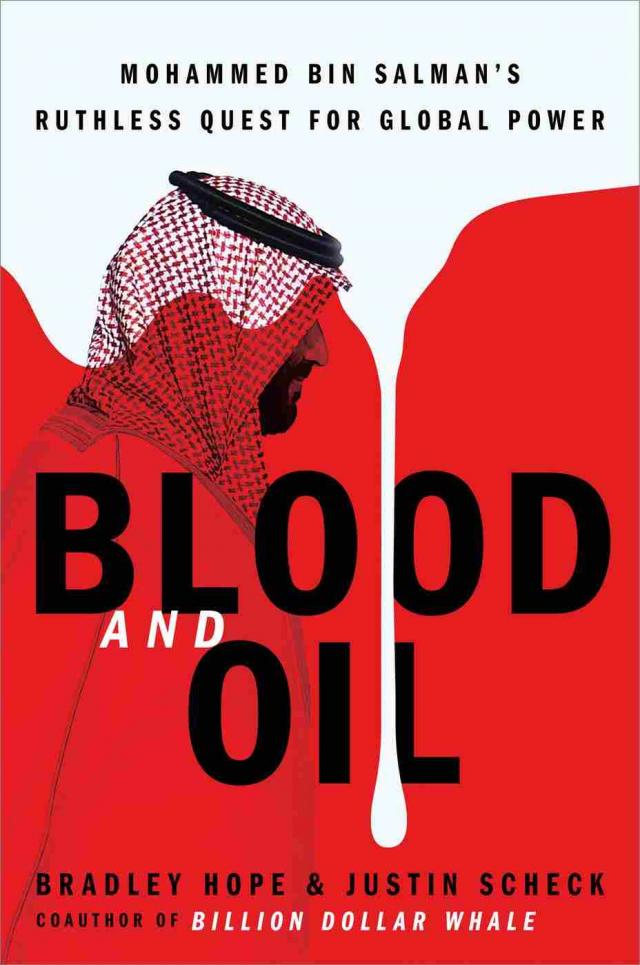
Copyright © 2020 by Bradley Hope and Justin Scheck
Cover design by Amanda Kain
Cover photographs: Oil © Tornado design / Shutterstock;
Mohammed bin Salman © Brendan Smialowski / Getty Images
Cover copyright © 2020 by Hachette Book Group, Inc.
Hachette Book Group supports the right to free expression and the value of copyright. The purpose of copyright is to encourage writers and artists to produce the creative works that enrich our culture.
The scanning, uploading, and distribution of this book without permission is a theft of the author’s intellectual property. If you would like permission to use material from the book (other than for review purposes), please contact permissions@hbgusa.com. Thank you for your support of the author’s rights.
Hachette Books
Hachette Book Group
1290 Avenue of the Americas
New York, NY 10104
HachetteBooks.com
Twitter.com/HachetteBooks
Instagram.com/HachetteBooks
First Edition: September 2020
Published by Hachette Books, an imprint of Perseus Books, LLC, a subsidiary of Hachette Book Group, Inc. The Hachette Books name and logo is a trademark of the Hachette Book Group.
The Hachette Speakers Bureau provides a wide range of authors for speaking events.
To find out more, go to www.hachettespeakersbureau.com or call (866) 376-6591.
The publisher is not responsible for websites (or their content) that are not owned by the publisher.
Library of Congress Control Number: 2020015477
ISBNs: 978-0-306-84666-3 (hardcover), 978-0-306-92381-4 (international trade paperback), 978-0-306-84665-6 (ebook)
E3-20200804-DA-ORI
Table of Contents
Cover
Title Page
Copyright
Dedication
Authors’ Note
Cast of Characters
The Al Saud Dynasty
Epigraph
Prologue
Chapter 1: The King Is Dead
Chapter 2: MBS
Chapter 3: Party in Maldives
Chapter 4: I Am the Mastermind
Chapter 5: Bring Me McKinsey
Chapter 6: Captain Saud
Chapter 7: Billions
Chapter 8: Little Sparta
Chapter 9: Golden Gambit
Chapter 10: “Blockade”
Chapter 11: Sealed with a Kiss
Chapter 12: Dark Arts
Chapter 13: Davos in the Desert
Chapter 14: Sheikhdown
Chapter 15: Kidnapped Prime Minister
Chapter 16: Da Vinci
Chapter 17: Man of the Year
Chapter 18: Cold Blood
Chapter 19: Mister Bone Saw
Chapter 20: Unstoppable
Epilogue: Decisive Storm
Discover More
Acknowledgments
Coauthored by Bradley Hope
Photos
To Wayne Hope and William LaRue—BH
To Chelsea, Owen, and Henry—JS
Explore book giveaways, sneak peeks, deals, and more.
Tap here to learn more.
Authors’ Note
We started this project because Mohammed bin Salman is one of the world’s most important new political and business figures, but he remains a mystery to those affected by the huge decisions he’s making every few months. Whether it’s Middle Eastern countries adjusting to his brusque use of power, technology companies growing thanks to billions of dollars he has invested, families of dissidents and regime critics whose lives have been upended, or people affected by his decision to start using oil as an economic weapon in early 2020, no one really has a clue what’s driving his decision making or how he was able to rise so rapidly.
We are investigative reporters who focus on money—how it’s spent, where it flows, and what it’s used for—so we entered into this project believing we needed to unlearn everything we thought we knew about Saudi Arabia and Mohammed, start from scratch, and follow the money. The further along we got in our reporting, the more thankful we were for having done that at the outset. So many things we thought we knew about him were caricatures of the truth and often spun in a way to exaggerate aspects of his personality to make him seem deranged, heroic, or out of control.
Of course, this comes with the territory of writing about a new ruler imposing rapid transformation on a country that hadn’t changed much in decades, but what’s lost is deeper knowledge of the person at the center of the storm. Without getting a better understanding of his personality, his family, his motivations, his stratagems, and the details of the battles he fought to get where he is, everyday observers won’t have the information needed to help them come to a conclusion.
That’s not to justify, apologize for, or laud decisions and actions Mohammed has taken over the past five years. This is the best account we could muster of his rise to power based on our reporting, beginning with our work at the Wall Street Journal in 2017, when we were both covering aspects of his economic reform plans from London and taking reporting trips to the kingdom.
Researching Mohammed bin Salman is a tricky task. It sounds counterintuitive, but being based in London and New York has been one of the greatest advantages in finding the revelations we were seeking. Few powerful figures based in the Persian Gulf countries would feel comfortable speaking openly about the crown prince at home, for fear of being electronically surveilled (a likely possibility) or simply observed having meetings with suspicious people like us. Those same people on trips to London, Paris, or Manhattan feel a huge weight lifted from their shoulders, and the facts slide out a little easier.
The other reason being based in these two world capitals is useful is that the story of Mohammed bin Salman from his earliest days in the Royal Court is entangled with business and finance. Few world leaders are so entranced by and involved with issues of global business as Mohammed. The Al Saud family rule Saudi Arabia absolutely, so there’s an element of everyday governance akin to running a family investment office, but from an early age Mohammed was transfixed by stories of entrepreneurs and tycoons, as well as famous strongman political figures from history. To understand him, it’s imperative to know that he’s not just the day-to-day leader of the kingdom—he’s also the CEO of Al Saud Inc.
This book is the product of years of reporting, but especially that done in 2019, when we dedicated ourselves to interviewing everyone we could find who interacted with Mohammed over the years as we traveled from country to country, unearthing old financial filings and confidential government records that document his growing personal and political empires, and read everything we could dig up that had been written about Mohammed and Saudi Arabia.
Most of our sources spoke to us “on background,” a kind of anonymity that protects them from being identified by name. That required us to be especially diligent about finding multiple people with experiences of the same events to feel certain of their veracity. Every anecdote is based on the recollection of multiple sources and, as often as possible, backed up by emails, legal documents, photographs, videos, and other records. The quotes and conversations rendered here were reconstructed from participant notes, recollections, recordings, and other supporting material. We also mined public databases, many of which held clues to Mohammed’s personal business networks in plain sight.
We hope this book brings a new understanding of one of the world’s most ambitious young leaders, one who could be in charge for decades to come.
Cast of Characters
The Al Saud
King Salman bin Abdulaziz Al Saud, son of the kingdom’s founder and father of Mohammed bin Salman
Crown Prince Mohammed bin Salman Al Saud
Prince Khalid bin Salman Al Saud, Mohammed’s younger brother and former ambassador to the United States
Sultana bint Turki Al Sudairi, King Salman’s first wife
Fahdah bint Falah al-Hithlain, King Salman’s third wife and mother of Mohammed bin Salman
Crown Prince Muqrin bin Abdulaziz Al Saud, King Salman’s half brother and briefly heir apparent
Crown Prince Mohammed bin Nayef Al Saud, King Salman’s nephew and a longtime antiterrorism official close to the US government
King Abdullah bin Abdulaziz Al Saud, King Salman’s half brother and predecessor
Prince Miteb bin Abdullah Al Saud, King Abdullah’s son and former chief of the Saudi Arabia National Guard
Prince Turki bin Abdullah Al Saud, the seventh son of King Abdullah
Prince Badr bin Farhan Al Saud, a prince from a distant branch of the family, minister of culture, and a longtime friend of Mohammed bin Salman
Prince Abdullah bin Bandar Al Saud, another prince and longtime friend of Mohammed bin Salman and head of the National Guard
Prince Sultan bin Turki Al Saud, the son of one of King Salman’s brothers, and an outspoken prince whose criticisms got him into trouble with more powerful members of the family
The Palace
Khalid al-Tuwaijri, the head of King Abdullah’s Royal Court
Mohammed al-Tobaishi, King Abdullah’s chief of protocol
Rakan bin Mohammed al-Tobaishi, Mohammed bin Salman’s protocol chief and the son of Mohammed al-Tobaishi
The MBS Entourage
Bader al-Asaker, a longtime associate of Mohammed who runs his private foundation
Saud al-Qahtani, an advisor to Mohammed who specializes in quashing dissent
T
The Region
Mohammed bin Zayed Al Nahyan, crown prince of Abu Dhabi
Tahnoon bin Zayed, Abu Dhabi national security advisor
Tamim bin Hamad Al Thani, emir of Qatar
Hamad bin Khalifa Al Thani, former emir of Qatar
Abdel Fattah el-Sisi, president of Egypt
Saad Hariri, prime minister of Lebanon
Recep Tayyip Erdoğan, president of Turkey
Residents of the Ritz
Prince Alwaleed bin Talal Al Saud, a cousin of Mohammed and Saudi Arabia’s most prominent international businessman
Adel Fakeih, a Saudi businessman who became minister of economy and planning
Hani Khoja, a Saudi management consultant
Mohammed Hussein Al Amoudi, a Saudi businessman with holdings in Ethiopia
Ali al-Qahtani, a general
Bakr bin Laden, scion of the bin Laden construction family
The Critics
Jamal Khashoggi, newspaper columnist with a long history of working for and sometimes criticizing the Saudi government
Omar Abdulaziz, Canada-based dissident who criticizes Saudi leadership in online videos
Loujain al-Hathloul, women’s rights activist who violated Saudi law by trying to drive into the kingdom from the United Arab Emirates
The US Government
President Donald Trump
Jared Kushner, Ivanka Trump’s husband and an advisor to the president
Steve Bannon, former Trump advisor
Rex Tillerson, ex-CEO of ExxonMobil, later US secretary of state
The Businessmen
Jeff Bezos, founder and CEO of Amazon.com
David Pecker, CEO of American Media, which publishes the National Enquirer
Ari Emanuel, Hollywood agent and cofounder of Endeavor talent agency
Masayoshi Son, CEO of Japanese tech investor SoftBank
Rajeev Misra, head of SoftBank’s Vision Fund
Nizar al-Bassam, Saudi deal maker and a former international banker
Kacy Grine, independent banker and confidant of Alwaleed bin Talal
A note on naming: In the Saudi convention, a man is identified through a patrilineal naming system. Mohammed bin Salman means Mohammed, son of Salman. His father is Salman bin Abdulaziz, since his father is Abdulaziz bin Saud (known as Ibn Saud), the founder of the current Al Saud dynasty. “Al Saud” denotes the family name.
The Al Saud Dynasty
A Selected Family Tree
The Al Saud is one of the world’s biggest royal families, with thousands of members descending from the founder of the current dynasty, Abdulaziz, who had dozens of sons and daughters. Every king of Saudi Arabia since his death in 1953 has come from that pool of sons, and many of those sons have in turn have had dozens of children of their own. Crown Prince Mohammed bin Salman is destined to become the first king of the country from the third generation. A note on naming: bin means “son of.” Mohammed bin Salman is the son of King Salman. The king, in turn, is Salman bin Abdulaziz, since his father was King Abdulaziz.
Source: Gulf family researcher Michael Field and interviews.
No dynasty lasts beyond the lifespan of three generations.
—Ibn Khaldun, The Muqaddimah
Seize opportunities, for they pass like clouds.
—Ali ibn Abi Talib
Prologue
The call just before 4 a.m. was urgent and unnerving. The king needed to see his nephew, Prince Alwaleed bin Talal Al Saud, as soon as possible. “Come right away,” the caller from the Royal Court said.
For decades, Alwaleed had been the world’s best-known Saudi businessman. He was the kind of person people wanted to be around, if only to glimpse life with a seemingly bottomless supply of money. With personal wealth estimated at $18 billion, he was, in the eyes of many Americans and Europeans, the ultimate Saudi: fabulously rich, debonair, and excessive to the extreme. He had a fleet of planes, including a 747 jet with a throne-like chair in the middle, and a $90 million yacht that comfortably slept twenty-two guests with thirty crew members to look after them. When he found something he liked, he’d buy ten or twenty of it—even if it was an expensive and bulky exercise machine. One for each home, pied-à-terre, desert camp, and yacht.
Alwaleed delighted in that image and in representations of his own image, showing visitors to his offices in Riyadh, Paris, and New York thick stacks of magazines with his face on the cover or long interviews about his business career. Some rooms in his homes contained more than a dozen photos or paintings of Alwaleed at different stages of his life. He liked drinking tea from a mug with his face on it.
The prince was a force in American business, buying stakes in Citibank, Apple, and Twitter. In a partnership with Bill Gates, Alwaleed’s Kingdom Holding Company owned a chunk of the Four Seasons hotel chain, famed for its luxury accommodations. When he traveled, he brought along a two-dozen-person retinue, including cooks, cleaners, butlers, and business advisors.
Yet here he was on a cool November night in 2017, feeling a chill down his spine as he got dressed at his desert retreat for the meeting with the king. Saudi Arabia was seeing huge changes, some of them obvious, like the retreat of religious police from the streets and the sound of music in cafés after decades of prohibition on anything that could arouse the senses. The country had so long been a refuge of the ultraconservative interpretation of Islam referred to by critics as Wahhabism that Saudi citizens felt truly dizzied by the fast-paced reforms: movie theaters were going up, women were walking around with more freedoms than ever before, and there was talk of shifting the economy away from oil for good.
The country’s richest and most powerful also perceived something else, a cracking sound. The very foundations of their ornate palaces seemed to be weakening. It didn’t matter that Alwaleed called heads of states and the wealthiest people in the world his friends. His unassailability as a billionaire prince was disintegrating.
After more than two years of the reign of his uncle King Salman bin Abdulaziz Al Saud, Alwaleed had heard the stories about royals summoned in the night or tricked onto airplanes only to find themselves dragged home to Saudi Arabia and put in confinement. The man behind those renditions was King Salman’s son, Alwaleed’s young cousin Mohammed bin Salman Al Saud, who was only thirty-two but had already gained a reputation for his temper and for charging ahead with aggressive changes.
Mohammed was the opposite of his uncles before him, the former kings who derived power from a royal consensus and tended toward extreme conservatism for fear of imperiling the dynasty. They had been desiccated old men by the time they took power, without the courage or energy to make big changes. But Mohammed was young and vital. He was well over six feet tall, with a smile so huge it made him squint, a big nose, and a tactile approach to conversation that could be simultaneously affectionate and menacing. He had plenty of energy, sending questions and commands to underlings at all hours of the day and night. In a short time, Mohammed had declared war on Yemen, led a boycott on a neighboring country, and consolidated more power than any member of the royal family since the founding of the kingdom.
Alwaleed reassured himself. The detained princes were fringe members of the family and often political dissidents, stirring up trouble for the Al Saud from their homes in France or the United Kingdom. He had told a visitor just months before how impressed he was with Mohammed’s agenda and how excited he was to see Saudi Arabia finally transition from an illiberal bastion of the most conservative strain of Islam to a modern Arab power with a diversifying economy and more equal rights for men and women. Mohammed had even adopted some of Alwaleed’s most aggressive ideas for financial reform.
“This is the change I’ve been waiting for my whole life,” Alwaleed told Robert Jordan, a former US ambassador to Saudi Arabia, in April 2017. CEOs, bankers, and political leaders from around the world had visited him at the retreat where he was staying, a desert site outside Riyadh full of large tents where his guests pretended to re-create an idealized version of the Bedouin lifestyle his ancestors lived up until the mid-twentieth century.


