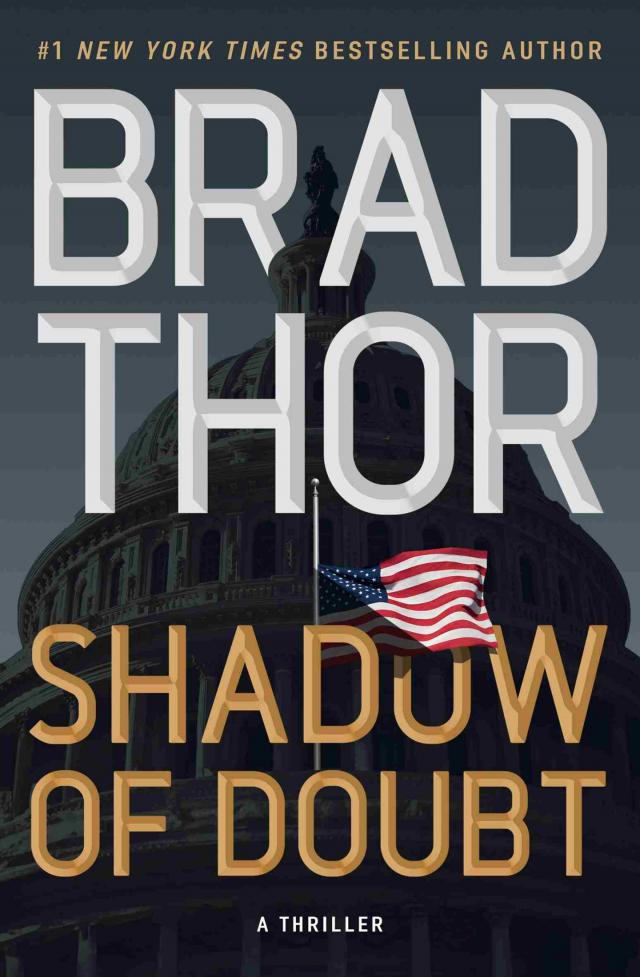
Shadow of Doubt, page 1


Thank you for downloading this Simon & Schuster ebook.
Get a FREE ebook when you join our mailing list. Plus, get updates on new releases, deals, recommended reads, and more from Simon & Schuster. Click below to sign up and see terms and conditions.
CLICK HERE TO SIGN UP
Already a subscriber? Provide your email again so we can register this ebook and send you more of what you like to read. You will continue to receive exclusive offers in your inbox.
For the magnificent Al Madocs, who has been with me more years than I can count, and who, with each book, helps me look much better than I deserve.
The truth is rarely pure and never simple.
—OSCAR WILDE
PROLOGUE
NATIONAL MILITARY COMMAND CENTER
THE PENTAGON
An airman first class peered at the message on her screen and announced, “Estonian Air Defense is tracking five Russian military aircraft launched from Soltsy air base, Novgorod Oblast. Currently heading due south.”
The watch commander set his coffee down and sat up straighter in his chair. “That’s part of Russia’s 22nd Heavy Bomber Division,” he announced. “I want a screen up in the next sixty seconds with everything we’ve got on their inventory. Also, grab whatever geospatial is live and feed it to the big board.”
As the first airman got to work on her orders, another chimed in with an update, “Latvian Air Defense is confirming the launch. Looks like an Antonov AN-124 cargo aircraft accompanied by four Sukhoi Su-57 fighters. Took off eight minutes ago.”
“57s?” the watch commander repeated.
“Yes, sir,” the second airman replied. “That’s what the Latvians are saying.”
“Destination?”
“Unknown.”
“Payload?”
“Also unknown,” the second airman stated.
The watch commander looked at the screens. What kind of cargo could that Antonov be carrying that required an escort of Russia’s newest and most sophisticated fighters?
“Ping the National Reconnaissance Office,” he ordered. “I want all the overhead satellite imagery from Soltsy air base for the last seventy-two hours.”
“Yes, sir. Right away.”
* * *
Within twenty-minutes, the NRO had uploaded the imagery to the DoD’s secure cloud. The watch commander was just about to dig in when he received another update.
“According to the Latvians, all five Russian aircraft have just entered Belarusian airspace,” the first airman stated.
“Lithuanian air defense confirms same,” said the second airman.
“All right,” said the watch commander, “let’s see where they go.”
After twenty more minutes, the planes began to make their descent and the Pentagon watch team had their answer.
The Russian aircraft were on approach for Machulishchy air base, twenty kilometers outside of downtown Minsk.
Once the planes had touched down, the team watched as the cargo aircraft taxied to a large hangar and disappeared inside. Shortly thereafter, the Su-57 fighter jets took off and headed back to Russia.
The watch commander entered everything in the logbook, wrote up a report, and submitted it to his chain of command.
* * *
Two days later, standing in front of what appeared to be some sort of military storage facility deep in a forest and surrounded by military vehicles, the president of Belarus made the following statement to the Russian state TV channel Rossiya-1 and the Belarusian state news agency’s “BelTA” Telegram channel, “The Republic of Belarus has now received from Russia shipments of both missiles and bombs three times more powerful than those dropped on Hiroshima and Nagasaki.”
With those words, alarm bells began going off around the world.
If the assertion was true, the nuclear doomsday clock had just clicked one minute closer to midnight.
CHAPTER 1
PARIS
SUNDAY EVENING
THREE WEEKS LATER
Jean-Jacques Jadot had spent a rainy weekend at his seaside cottage in Brittany, only venturing outside for a short walk along the windswept coast.
The remainder of the time, the snowy-haired, sixty-two-year-old French intelligence officer had pored over his files.
The rot can’t be this widespread, he had thought to himself. The treason this deep. Yet the evidence was all there.
Not a single agency appeared to have been untouched. Not even his beloved DGSE, France’s equivalent to Britain’s MI6 or the American CIA.
Worse still, the penetration ran right to the top, compromising a key member of the French president’s cabinet. The gravity of the situation was clear.
What wasn’t clear, however, was its raison d’être. Russia didn’t need French nuclear technology. Neither did it need France’s submarine technology. It was a rather poorly kept secret that the Russians had already stolen schematics for France’s new Barracuda-class nuclear attack subs.
So then what was it all about? Why go to such extraordinary lengths? The investment in this kind of espionage operation, not to mention the risks, was almost unfathomable. What intelligence did France have that the Russians wanted so badly?
That question had spun endlessly in Jadot’s mind over the last two and a half days.
Rising only occasionally to place fresh logs on the fire or to prepare another mug of tea fortified with cognac, he had sat in his favorite chair, trying to connect the dots and deconstruct the Russian plot.
But no matter how much of his considerable intellect he had applied, the answers refused to reveal themselves. Before he knew it, the weekend was over and it was time to leave.
While a local taxi idled in the drive, Jadot closed up the cottage and then made himself comfortable for the twenty-minute drive into Saint-Malo. There he picked up dinner from his favorite brasserie along the Place Chateaubriand, walked the rest of the way to the station, and boarded the last TGV to Paris.
As the high-speed train raced through the darkened countryside, Jadot ignored his food and stared at his reflection in the window.
He was no longer a young man. He had been with the Directorate General for External Security for over three decades. His time in the espionage game was coming to a close. This case would be his legacy.
Exposing the breach of the French intelligence community was not only his duty, it was his chance to leave a deep and indelible mark. It was critical, therefore, that he choose his steps with caution; that he get everything right. There was zero room for error.
Turning his eyes from the window, he forced himself to eat. It was important to keep up his strength. He was about to step into a minefield. Tomorrow he would meet with a colleague from the CIA’s Paris station—one of the few people he felt he could trust. Then he would put his plan, as ill-conceived as it was, into action.
* * *
Two and a half hours later, his train arrived at the Gare Montparnasse in Paris’s 15th arrondissement.
The rain, which had lashed the windows of his cottage throughout the weekend, had pushed inland and was now pouring down on the capital. Finding a cab would be impossible, so Jadot opted for the Métro.
He rode for seven stations, transferred at Châtelet, and then reemerged above ground at the Hôtel de Ville. Turning up the collar of his jacket against the elements, he headed for his apartment in the Marais.
Even though it was getting late, there were still several establishments doing a brisk business along the Rue Vieille-du-Temple. Under soft lights, patrons laughed over bottles of wine, chatted over cups of coffee, and enjoyed each other’s company over plates of food. Conviviality. Human contact.
He thought about popping into Robert et Louise—the little restaurant across the street from his apartment—just for a nightcap. The glow from its wood-fired oven, the rumble of the dumbwaiter as it shunted up and down, the heavy “neighbor’s pour” the barman treated regulars to—all of it had a way of putting him at ease. There was, however, an additional, more professional reason the idea appealed to him.
Ever since stepping off the train in Montparnasse, he had felt eyes on him, as if he were being watched.
Per his training, he had conducted multiple surveillance detection routes. He covertly scanned the faces he saw on the Métro, changed carriages several times, and literally took the long way home once he had exited the subway system. Still, he hadn’t seen anything.
Either he was being followed by someone exceptionally skilled, or his mind—and maybe even the rain—were playing tricks on him. A stiff calvados and a perch on a barstool with a view of the street would help him sort it all out.
Inside Robert et Louise, he hung his wet coat on the rack. The air was redolent with the scent of roasted pork, chicken, lamb, beef, and veal. He could practically hear the sizzling of fat as it dripped from the spits in the open kitchen.
Grabbing a seat at the end of the scarred comptoir, he didn’t even need to place his drink order.
Within seconds of his sitting down, the barman was busy uncorking a bottle filled with gold-colored liquid.
“Quel putain de temps,” the man said as he set a generously filled snifter of apple brandy in front of Jadot. Pretty shitty weather, eh?
“Plus mal demain,” the intelligence officer replied. Worse tomorrow.
They made small talk for a few moments before a waitress signaled that she needed the barman to make a round of drinks for her.
Sipping his calvados, Jadot kept his eyes on the front door of his building across the street.
Beyond a few cars and a person or two with an umbrella, no one passed. No one stopped. No one came into Robert et Louise. It was simply a rainy Sunday night in Paris. Nothing more.
When he got to the bottom of his snifter, the barman asked him if he wanted a refill. Jadot politely waved him off. If he had a second, he’d probably have a third. That wouldn’t be good. He needed to be sharp and fully focused tomorrow.
Laying a bill on the comptoir, he thanked the barman and told him to keep the change.
As he put on his coat, a waiter offered him a Styrofoam to-go box of food—roast potatoes and meats they would only be throwing out when they closed in twenty minutes.
Jadot didn’t have much of an appetite, but he was a good man, a good neighbor, and so he graciously accepted.
Stepping outside, back into the rain, he paused briefly on the sidewalk to scan up and down the street. Still nothing.
He tucked the to-go container under his arm and fished for his keys as he crossed to his front door.
Inside, he ignored his mailbox. There was nothing in it that couldn’t wait another day.
He ignored the elevator as well.
Stairs helped keep him in shape. He had spent most of his life as a rugged outdoorsman, a committed alpinist. Nothing crazy. No Kangchenjunga, no Nanga Parbat. And definitely no K2 and no Everest. Jadot was a sub-25,000 man.
Summits such as Baintha Brakk in Pakistan, Cerro Torre in Argentina, and the Eiger in Switzerland were much more his style. An intelligent, technical athlete’s climbs—with far fewer fame-seeking Instagram assholes to contend with. He had yet to see any dead bodies on his summits.
To that end, he had nothing but disdain for those who chased the biggest mountains only for the bragging rights. Climbing, in his book, was like making love. You didn’t become an expert overnight. It was something you got better at with practice.
When he reached his apartment, he kicked off his boots and hung his coat on a peg in the vestibule to drip-dry. His was the sole unit at the top of the five-story building.
Inside, the centuries-old dwelling was complete with hand-hewn wooden beams, three antique fireplaces, and original tiles. The portes-fenêtres in the living room gave onto the Rue Vieille-du-Temple, while the smaller windows in the back looked out over a hidden courtyard and a slice of the expansive National Archives complex.
The walls were covered with framed photographs from his adventures abroad—both his climbing trips as well as the far-flung locations where he had carried out assignments on behalf of the DGSE. There was no evidence to indicate the presence of a spouse or any sort of romantic partner in Jadot’s life. By all appearances, the man was unattached.
Entering the kitchen, he dropped his keys on the counter, placed the to-go container in the fridge, then pulled out his cell phone and plugged it in to charge.
As he did, he heard a noise. It sounded like it had come from the master bedroom. Jadot froze. He wasn’t alone. Someone was in the apartment.
Being careful not to make a sound, he opened the cupboard beneath the sink and retrieved the old Manurhin double-action revolver he had taped inside.
His first instinct was that maybe he was being robbed. Over the last six months, multiple apartments across the Marais had been hit. But none of them, to his recollection, were late on a Sunday night. The thieves had preferred to strike during the day—while people were at work. That could only mean one thing: someone had come for him, specifically.
Quietly cocking the pistol, he brought the weapon to the ready position and crept toward his bedroom.
He placed his steps carefully, avoiding the handful of floorboards that were guaranteed to groan and give his approach away.
At the door, he took a deep breath, applied pressure to his trigger, and then peeked around the frame. The room was empty.
Not only was it empty, but he believed he might have discovered the source of the sound he’d heard.
Lying on the floor next to his book-strewn nightstand was a large tome on European history. Could it have fallen by itself?
Anything was possible, but just to make sure, Jadot checked under the bed, and inside his closet and the master bath. They were all clear. Picking up the book, he returned it to the nightstand. Then he heard something that stopped him dead in his tracks. Out in the hall, one of the floorboards creaked.
For a fraction of a second, he was tempted to fire right through the wall. But not knowing who was on the other side made such an act incredibly reckless.
If it did turn out to be some poor kid forced to steal or some junkie just trying to support a habit, those weren’t the kinds of deaths he was prepared to have on his conscience. And if it wasn’t a thief but someone sent to attack him, he needed that person alive. Dead men were somewhat difficult to interrogate.
Taking another deep breath, he steadied his pistol and prepared to peek into the hall.
He counted down from three and then leaned out only far enough to steal the quickest of glimpses before pulling back. He didn’t see anything. There was no one there. His hands slick with sweat, he gripped the pistol tighter.
Stepping into the hall, he swung his gun toward the kitchen, but it appeared just as he had left it—empty—and he headed toward the living room, carefully clearing each of the rooms he passed.
By the time he reached the front of the apartment, adrenaline was wreaking havoc on his body. His heart was pounding so hard that all he could hear was the sound of blood thrumming in his ears. His breath came in short, shallow snatches and his hands had developed a tremor. But there was a good sign—the front door was ajar.
Whoever had been in the apartment must have made the smart decision to flee. Jadot felt his pulse begin to slow.
He wiped each of his palms on his trousers, before reacclimating his grip on his weapon. There was one last thing he needed to do.
Opening the door the rest of the way with his foot, he cautiously stepped out onto the landing. There was no one there.
He strained his ears but heard no sound of footfalls on the stairs. He then glanced over the railing, gun first, but couldn’t see anyone. Perhaps the intruder was hugging the walls on the way down or had heard him coming and paused on a lower floor. All he could be certain of was that whatever the threat had been, it had passed.
Retreating into the apartment, he closed the door behind him and made sure it was locked.
Inhaling, he filled his lungs with air and stood there for a moment, willing his body to reset, before exhaling it all out.
He needed to do a thorough, top-to-bottom search of the place to make sure nothing had been taken. But because his hands were still shaking, the first thing he was going to do was pour himself a drink.
Padding down the hallway in his stocking feet, he tucked the pistol into his waistband as he entered the kitchen.
From a cabinet above the sink, he took down a bottle of bourbon and placed it, along with a glass from the dish rack, on the countertop.
He had just opened the freezer for some ice when he heard it again—a floorboard had creaked. This time right behind him.
In one fluid motion, Jadot spun while pulling his pistol, but he was a fraction of a second too late.
The last thing he saw was the tip of a climbing axe as it came crashing down into his skull.
CHAPTER 2
MONDAY
FLIGHT 337
KRAKÓW TO OSLO
Scot Harvath hadn’t thought twice about splurging on a first-class ticket. He’d been through hell.
After fighting his way into an active war zone in Ukraine, rescuing an American hostage from behind enemy lines, and fighting his way back out, all he wanted was a nice, long chunk of uninterrupted recovery time. The more luxurious, the better. He had earned it.
Boarding his flight to Norway, he’d been accompanied to his seat by a flight attendant who asked what she could bring her handsome passenger before takeoff. His answer—three Ziplocs packed full of ice and a glass of bourbon.
He’d had the shit kicked out of him and could feel it from the crown of his head to the soles of his feet. His body was tattooed with bruises, his left shoulder felt like somebody had driven an ice pick through it, and his ears were still ringing. He probably needed to see a doctor.