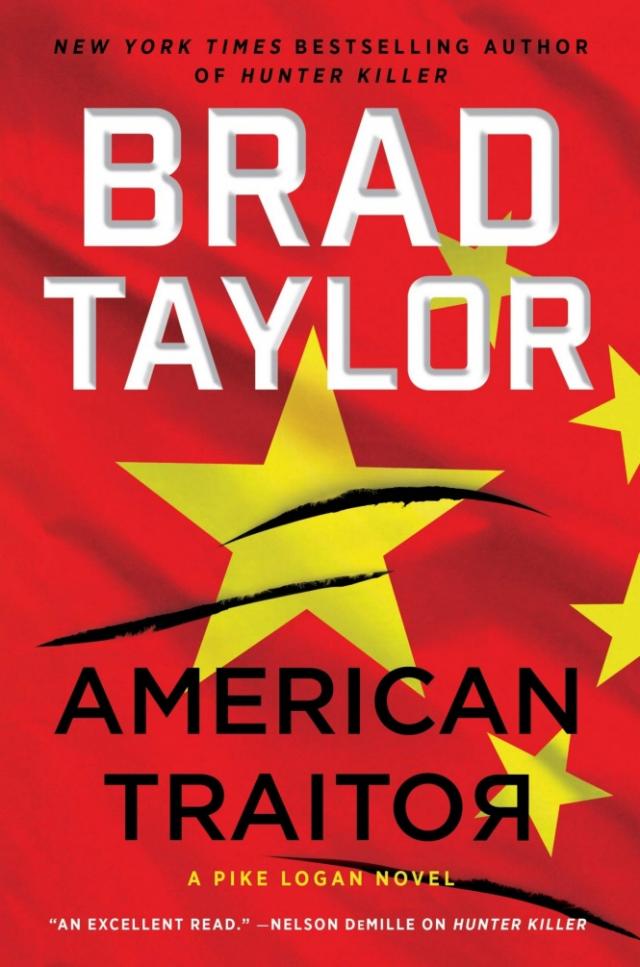
American Traitor, page 12
part #15 of Pike Logan Series


“The opera house. It’ll be full of people. It’s right on the ferry terminal, and it’ll be jam-packed. We just need to keep running. All paths to the north eventually lead there.”
Dunkin nodded, listened, then said, “Let’s go.”
They scampered across the stone path, sidling into a wooden maintenance facility, and Dunkin slowed, the darkness of the interior making it hard to find his way. He walked forward in the gloom, crouched over with his hands outstretched, and accidentally kicked a bucket, the thing falling over in a racket. He jerked upright, breathing with an open mouth, and heard the men in the fern park running toward the sound.
He grabbed her hand and they began moving faster than the darkness allowed, bumping into metal shelves and knocking over planters. He reached a door, turned the knob, and found it locked. He backed up, then ran at it, slamming his shoulder into the frame. It didn’t budge.
A man rounded the corner of the shelves and Dunkin leapt on him, throwing him into a rack of tools. They fell to the ground and Dunkin attacked like a wild man, windmilling his arms over and over like Ralphy in A Christmas Story, smashing the man’s head into the concrete until he ceased moving.
Nicole shouted, “Dunkin!”
He jerked his head at her shout, and saw the twilight spilling through the open door. He jumped up and ran toward her, saying, “How’d you do that?”
She said, “We’re on the inside, dummy. I turned the lock.”
Dunkin felt like an idiot. He smiled, then heard another man floundering in the back just like they had. There was a stab of light, the beam sweeping back and forth, and they both sprinted through the door.
Stumbling back into the park, they ran until they reached a tangle of paths like spaghetti. Dunkin said, “Which way? Which way do we go?”
Nicole took off down a path to the left, shouting, “This way!”
Dunkin followed her, hearing the slapping of feet behind him. They crossed the creek again and she took a branch to the right, him right on her heels. He jerked her up short, hiding behind a tree.
The men kept going on the other path. He patted her arm and said, “Let’s go, but not as fast. Just fast enough to get there. I need to hear.”
They did so, and eight minutes later Dunkin saw the harbor, then the iconic Sydney Opera House. Four minutes after that they were through the gate and in a plaza at the back of the giant structure, dodging tourists wandering around trying to get a nighttime selfie. Dunkin glanced behind him at the gardens and saw nothing. He breathed a sigh of relief.
Nicole led him around to the front, and they entered a swirling mass of people on a promenade next to the Circular Quay of Sydney Harbour, the Sydney Harbour Bridge framed like a postcard across the water. They disappeared into the crowd, and she said, “What now?”
He said, “We need to put some distance between us and them. I don’t want to stay here. Do you know of any other place where we can sit and think? One that’s full of people close to here?”
She thought a minute, then said, “Yeah, I do. The oldest pub in Sydney. It’ll be packed tonight.”
Chapter 26
When she heard my words on the phone with Dunkin, Jennifer leapt out of bed and began slapping kit into her pockets, saying, “Where are they? Which way did they go?”
I shoved the suppressed pistol I’d taken from the man in Adelaide into my waistband and said, “I have no idea. All he yelled was that they were there. We need to get to the apartment. Maybe he’s holding them off.”
We exited our room and ran down the indoor balcony overlooking what was once a working dock, but was now full of tourists and others living in the apartment complex that flowed out from the hotel. I’d have liked to see Russell Crowe eating some vegan appetizer as I went by, but that wasn’t going to happen.
We ignored the elevator, taking the stairs of the old wharf, bouncing down them two at a time and bursting out into the lobby. The front desk person and concierge looked at us like we were insane, but as far as I could tell, we were the normal ones, the desk clerk having dreadlocks and painted nails on his hands and the concierge pink hair and two rings through her nose. Crazy is as crazy does.
We hit the pavement outside and stayed on the wharf side, not going to the stairs that led to the upper level with the roads, but instead running next to the water toward the apartment complex. We came within fifty meters and I put a hand on Jennifer’s arm, slowing her.
Her eyes scanning the building, she said, “We never got his room.”
“Yeah, I know, but it’s a single stretch of building, one condo after another. They’re all two-story, and they all face the water. If he’s still there, we’ll see activity.”
She said, “There! On the end! Two from the end!”
I saw three Asian men come running out of a condo and jump the wall that was supposed to keep people out. The wall that was designed to force you to the front gate where you proved you belonged.
They raced around the back of the complex to the road that separated the building from the bluff of the botanical garden. I saw a pair of headlights stab the darkening twilight, and then heard tires squealing. The illumination from the headlights disappeared.
I said, “They’re not in the apartment anymore. Either those guys are going to stash a body, or Dunkin got out.”
Jennifer pulled my shirt and started jogging to the stairs that led up to the gardens, saying, “Well, they didn’t get out the front, or those guys wouldn’t have run to a car. They’d have been chasing Dunkin. If he escaped, they went out across the roof. We need to get to the gardens. If they’re on the run, that’s where they are.”
We ran to the stairs that we’d found earlier in the day and took them two at a time, reaching the top and cutting back the way we’d gone before.
We crossed a road and I said, “The park is closed now. Remember the big iron gate?”
She pointed in the twilight and said, “Gate’s still open.”
I saw a jogger exit and realized “park closed” probably meant nothing more than a sign to ward off people. I glanced around, didn’t see anyone looking to stop entrance, and fast-walked through it, entering the gardens proper. I stopped at a large tourist map on a post and said, “This place is huge. It runs all the way to the opera house. We’ll never find them here.”
She had her phone out, calling someone and pointing at me to continue on down the path. I did so, my head on a swivel. I heard her say, “Creed, hey, it’s Jennifer. I need a lock on a phone.”
And smiled. She was finally breaking the rules, all because she liked Dunkin. I was rubbing off on her.
The feeling was short-lived, because she handed me the phone, saying, “I’m getting stonewalled about ‘sanctions’ and ‘mission set.’”
Bartholomew Creedwater was also one of our “network engineers,” meaning he was a hacker just like Dunkin. He’d worked with Dunkin in the Taskforce and was a friend, but tracking a civilian phone in a foreign country using Taskforce assets was making him skittish. He wanted an official order from the command to do it. Or an ass-chewing from me.
Which is what he got.
“Creed, damn it, I need that phone lock right now. Dunkin’s on the run from some Chinese assassins. They’re going to kill him and you’re going to let them.”
Creed had been hired when he’d been caught hacking government systems as a lark while he was in grad school. Not our systems, but NSA and DIA. We’d noticed the arrest, and had intervened surreptitiously, offering him a way out. Work for us and don’t go to jail. The point being, I knew he didn’t really care about breaking the law. He just wanted to make sure it was worth it.
And Dunkin’s life was worth it.
He said, “Pike, with all the shit that’s gone on after Kurt’s death, I’m not sure about this. There’s a new sheriff in town. He might not be as amenable to your tendency to leave the reservation. I don’t want to get caught in the back blast.”
I reached the small bridge that led to the apartment complex over the road the other car had escaped from, saw nothing, and squeezed the handset like I was choking out a competitor in MMA. I said, “Get me that lock, or I swear to God I’m coming back and kicking your ass. He’s in here somewhere, and he’s on his own. I’m his only chance.”
I read out the number to the girlfriend’s phone and waited. Jennifer kept looking at our six, checking the area. She grabbed my arm and said, “There’s a team. Two guys. They’re locking down the edges.”
I looked where she indicated and said, “That’s them. And they’re still working. Which means Dunkin’s still on the loose.”
I returned to the phone and said, “Creed, I need it now. I’m running out of time. These guys are ahead of me. They have the lock, and I don’t.”
He came back and said, “Pike, there isn’t a lock. His phone is off. It’s dead.”
Shit.
“Are you sure?”
“I’m sure that number you gave me is turned off. No signal.”
I said, “Okay. Stay alert. I’m going to call you back with a new number.”
I hung up and Jennifer said, “What was that about?”
I looked north and saw the two men were gone. I started walking down the path toward the last known sighting, saying, “We don’t have any idea where Dunkin is in this maze, but those fucks do.”
“So?”
“So let’s get some answers.”
Chapter 27
Dunkin followed Nicole down the concrete path, threading his way through tables and stools full of tourists out enjoying the harbor night. He half thought about staying there due to the size of the crowds, but the entrance to the Sydney Opera House from the park was a choke point. Short of swimming in the harbor, this was the only way they could have left the park. Staying here was asking to get found.
They jogged up the path next to the water, moving around the street performers and panhandlers out front of the Circular Quay ferry terminals, and Dunkin stopped, saying, “Where do these ferries go?”
Nicole said, “All over the harbor. Come on. We need to get to George Street.”
“Wait. We should take one of these. Get all the way across the bay. They won’t know where we are after that.”
“Dunkin, I don’t know this city that well. I have no idea what ferry to take or where to go once it lands.”
Unconvinced, Dunkin said, “That may not matter. There’s probably a hotel at the far end of one of these. I think we should take one of them.”
“That’s fine, but let’s figure it out first. We can do that after we talk. I know they go to the Heads and the zoo, but not much else. No reason to run off on the first ferry.”
He nodded, realizing she was thinking more clearly than he was. All he wanted to do was run, but maybe taking a breath and coming up with a plan was a better idea. They kept moving, dodging the mass of people coming and going from the ferry terminals. She led him across a small park and up some stairs, reaching the first major road, George Street. She said, “This is what’s known as The Rocks—the first place inhabited by the original Western settlers of Australia.”
He said, “You mean the criminals?”
She smiled and said, “Yeah, them too, but that’s a little bit of a myth. They were here, but we had a lot of just plain old settlers all scrabbling for a living on the rocks of the wharf. It wasn’t pretty. This place was nothing but whorehouses and gambling dens for the sailors.”
She glanced at him and said, “Given what’s just happened, you’d have probably fit in.”
He grinned and said, “Not unless they had computer terminals.”
She shook her head. “It wasn’t a computer terminal that was shooting at me.”
He let that slide, saying, “Let’s get to the pub. I’ll tell you what I know and we can figure out a plan.”
They crossed George Street, jogging through the traffic, then passed restaurants and bars until they saw an awning proclaiming “Fortune of War—Since 1828.” As they came closer, Dunkin heard music spilling out. He began to relax. Nicole was right. This place was perfect.
They showed identification to a bouncer, and then entered pandemonium. There was a man with a guitar blaring American music from the seventies, rugby on multiple television screens, and a raucous crowd either attempting to sing along or shout over the noise. She pulled him to the back, finding a two-person high-top table and taking a seat.
Dunkin looked around, noting a back room and a stairwell leading up. He said, “Well, it looks like you found a crowded place.”
“I told you. Nobody’s going to try anything in here. No way.”
He leaned in and kissed her, saying, “Thank you for trusting me. Sorry this happened.”
She pulled back and said, “Okay, so what is happening? What’s going on?”
He felt the last twenty-four hours sap the will out of his body. He said, “I’m honestly not sure. Can we get a beer?”
She said, “Are you kidding me? No, I want to talk. Not drink. No more stonewalling like you did on the drive up here. I want to talk. Now.”
He slid off his stool and said, “I will, I will. Let me get a beer and we’ll talk.”
He stood up, not waiting on a reply, fighting his way through the crowd to the bar and going over what he would tell her. How he could explain what had just happened. In his own mind, he didn’t understand it. How was he on the run from trained Chinese killers? What had he done to get attacked? He’d already thought about every mission he’d run with the Taskforce, and knew that wasn’t it. He’d drifted to his current work, but nothing he’d done would warrant such extreme measures.
It had to be Jake. He hadn’t imagined seeing him when he left work for vacation. And he hadn’t imagined him doing something nefarious. Jake had done something bad, and had known that Dunkin would figure it out—and so Dunkin had been marked for assassination. Now he had to find a way out of this. They’d ditched the Chinese in the short run, but whatever Jake had done had been worthy enough to dedicate the team in the first place, and Dunkin was sure it had the blessing of the Chinese government. With those resources behind them, he was sure they’d find him again.
The first thing was to break Nicole away. Get her out of the line of fire. Staying with him would only put her in danger. Although she might already be in danger just by her association with him. Along with her sister now.
He put his head in his hands, overwhelmed by the odds against him and the stakes involved. He needed some help. And then he remembered Pike Logan. He jerked his head up like he’d stuck his finger in a light socket, just as the bartender came to him.
“Whoa, mate. I’m here. What’ll you have?”
“What?”
“You want a beer? Or are you just here to think?”
“Yeah. I’ll have two Four X. Draft.”
He took them, paid the tab, and fought his way back to the table, seeing Nicole on her phone. He leapt forward, spilling the beer on the high-top and causing her to jump. He said, “What are you doing?”
“Googling the ferry schedule. You said you wanted to get away from here. What is with you?”
He tried to grab the phone and she turned away from him, saying, “Quit it! It’s still loading.”
“Turn that damn phone off! Right now!”
Truculent, she did so, saying, “So how do you plan to see the ferry schedule? Brain waves? What has gotten into you?”
He set the beers on the table and said, “I’m sorry. It’s just not safe to use that phone.”
She stood up, putting the phone in her pocket and saying, “Yeah, yeah, yeah. I got it. I have to use the loo. Watch my purse. And you’d better have some answers when I get back.”
He said, “Don’t turn it on in the bathroom.”
She walked away without a word, heading to the stairs to the upper level, causing Dunkin to feel like an ass. He sipped his beer, thinking about how he was going to contact Pike. He couldn’t do it with any phone they owned. Well, maybe he could. He could use her phone for a split second—or even his—set up a meeting spot, then turn the damn thing off.
He nodded his head, then started to develop a plan about what he was going to tell Nicole. He couldn’t tell her any classified information, but he had to give her enough to make her believe him. Lost in thought, he took a few more sips of his beer, and then realized that Nicole had been gone a long time. He glanced up the stairwell, waiting to see her come back down. She did not. He looked at his watch, startled that it had been over ten minutes. Maybe fifteen. He began to grow concerned, wondering if she’d just left him here in the bar.
He saw her purse across the table and realized that wasn’t the case. Something was wrong.
Chapter 28
Jennifer caught up to me in the park and said, “Whoa, whoa, what do you mean, ‘Get some answers’? What are you looking to do?”
We entered crisscrossing paths, the foliage increasing on both sides. I said, “It means the least we can do is take out some of the opposition. The most is we use these guys to find Dunkin.”
A jogger came by us, the sun finally dropping past the horizon. She said, “I’m not sure we can do that here. It’s still crowded.”
I started moving with a purpose, looking left and right, trying to find the guys who had been searching the park. If they were gone, it was bad news. It meant they were no longer needed.
I said, “Guess we should be discreet, then.”
We snaked through displays of exotic vegetation, the growing darkness making it hard to see people on the trails. We crossed a little creek, a sign pointing the way to the Sydney Opera House, and Jennifer grabbed my arm.
To our front was some sort of fern greenhouse, but that wasn’t why she stopped me. Outside the greenhouse was a group of seven men and a woman, deep in conversation. All of them Asian. They talked for about five seconds, and then split up like a flash-bang had gone off in the center, the man and woman running down a trail, four others racing back up the path to the freeway, and a single man running back by us, toward the rear of the park.
Dunkin nodded, listened, then said, “Let’s go.”
They scampered across the stone path, sidling into a wooden maintenance facility, and Dunkin slowed, the darkness of the interior making it hard to find his way. He walked forward in the gloom, crouched over with his hands outstretched, and accidentally kicked a bucket, the thing falling over in a racket. He jerked upright, breathing with an open mouth, and heard the men in the fern park running toward the sound.
He grabbed her hand and they began moving faster than the darkness allowed, bumping into metal shelves and knocking over planters. He reached a door, turned the knob, and found it locked. He backed up, then ran at it, slamming his shoulder into the frame. It didn’t budge.
A man rounded the corner of the shelves and Dunkin leapt on him, throwing him into a rack of tools. They fell to the ground and Dunkin attacked like a wild man, windmilling his arms over and over like Ralphy in A Christmas Story, smashing the man’s head into the concrete until he ceased moving.
Nicole shouted, “Dunkin!”
He jerked his head at her shout, and saw the twilight spilling through the open door. He jumped up and ran toward her, saying, “How’d you do that?”
She said, “We’re on the inside, dummy. I turned the lock.”
Dunkin felt like an idiot. He smiled, then heard another man floundering in the back just like they had. There was a stab of light, the beam sweeping back and forth, and they both sprinted through the door.
Stumbling back into the park, they ran until they reached a tangle of paths like spaghetti. Dunkin said, “Which way? Which way do we go?”
Nicole took off down a path to the left, shouting, “This way!”
Dunkin followed her, hearing the slapping of feet behind him. They crossed the creek again and she took a branch to the right, him right on her heels. He jerked her up short, hiding behind a tree.
The men kept going on the other path. He patted her arm and said, “Let’s go, but not as fast. Just fast enough to get there. I need to hear.”
They did so, and eight minutes later Dunkin saw the harbor, then the iconic Sydney Opera House. Four minutes after that they were through the gate and in a plaza at the back of the giant structure, dodging tourists wandering around trying to get a nighttime selfie. Dunkin glanced behind him at the gardens and saw nothing. He breathed a sigh of relief.
Nicole led him around to the front, and they entered a swirling mass of people on a promenade next to the Circular Quay of Sydney Harbour, the Sydney Harbour Bridge framed like a postcard across the water. They disappeared into the crowd, and she said, “What now?”
He said, “We need to put some distance between us and them. I don’t want to stay here. Do you know of any other place where we can sit and think? One that’s full of people close to here?”
She thought a minute, then said, “Yeah, I do. The oldest pub in Sydney. It’ll be packed tonight.”
Chapter 26
When she heard my words on the phone with Dunkin, Jennifer leapt out of bed and began slapping kit into her pockets, saying, “Where are they? Which way did they go?”
I shoved the suppressed pistol I’d taken from the man in Adelaide into my waistband and said, “I have no idea. All he yelled was that they were there. We need to get to the apartment. Maybe he’s holding them off.”
We exited our room and ran down the indoor balcony overlooking what was once a working dock, but was now full of tourists and others living in the apartment complex that flowed out from the hotel. I’d have liked to see Russell Crowe eating some vegan appetizer as I went by, but that wasn’t going to happen.
We ignored the elevator, taking the stairs of the old wharf, bouncing down them two at a time and bursting out into the lobby. The front desk person and concierge looked at us like we were insane, but as far as I could tell, we were the normal ones, the desk clerk having dreadlocks and painted nails on his hands and the concierge pink hair and two rings through her nose. Crazy is as crazy does.
We hit the pavement outside and stayed on the wharf side, not going to the stairs that led to the upper level with the roads, but instead running next to the water toward the apartment complex. We came within fifty meters and I put a hand on Jennifer’s arm, slowing her.
Her eyes scanning the building, she said, “We never got his room.”
“Yeah, I know, but it’s a single stretch of building, one condo after another. They’re all two-story, and they all face the water. If he’s still there, we’ll see activity.”
She said, “There! On the end! Two from the end!”
I saw three Asian men come running out of a condo and jump the wall that was supposed to keep people out. The wall that was designed to force you to the front gate where you proved you belonged.
They raced around the back of the complex to the road that separated the building from the bluff of the botanical garden. I saw a pair of headlights stab the darkening twilight, and then heard tires squealing. The illumination from the headlights disappeared.
I said, “They’re not in the apartment anymore. Either those guys are going to stash a body, or Dunkin got out.”
Jennifer pulled my shirt and started jogging to the stairs that led up to the gardens, saying, “Well, they didn’t get out the front, or those guys wouldn’t have run to a car. They’d have been chasing Dunkin. If he escaped, they went out across the roof. We need to get to the gardens. If they’re on the run, that’s where they are.”
We ran to the stairs that we’d found earlier in the day and took them two at a time, reaching the top and cutting back the way we’d gone before.
We crossed a road and I said, “The park is closed now. Remember the big iron gate?”
She pointed in the twilight and said, “Gate’s still open.”
I saw a jogger exit and realized “park closed” probably meant nothing more than a sign to ward off people. I glanced around, didn’t see anyone looking to stop entrance, and fast-walked through it, entering the gardens proper. I stopped at a large tourist map on a post and said, “This place is huge. It runs all the way to the opera house. We’ll never find them here.”
She had her phone out, calling someone and pointing at me to continue on down the path. I did so, my head on a swivel. I heard her say, “Creed, hey, it’s Jennifer. I need a lock on a phone.”
And smiled. She was finally breaking the rules, all because she liked Dunkin. I was rubbing off on her.
The feeling was short-lived, because she handed me the phone, saying, “I’m getting stonewalled about ‘sanctions’ and ‘mission set.’”
Bartholomew Creedwater was also one of our “network engineers,” meaning he was a hacker just like Dunkin. He’d worked with Dunkin in the Taskforce and was a friend, but tracking a civilian phone in a foreign country using Taskforce assets was making him skittish. He wanted an official order from the command to do it. Or an ass-chewing from me.
Which is what he got.
“Creed, damn it, I need that phone lock right now. Dunkin’s on the run from some Chinese assassins. They’re going to kill him and you’re going to let them.”
Creed had been hired when he’d been caught hacking government systems as a lark while he was in grad school. Not our systems, but NSA and DIA. We’d noticed the arrest, and had intervened surreptitiously, offering him a way out. Work for us and don’t go to jail. The point being, I knew he didn’t really care about breaking the law. He just wanted to make sure it was worth it.
And Dunkin’s life was worth it.
He said, “Pike, with all the shit that’s gone on after Kurt’s death, I’m not sure about this. There’s a new sheriff in town. He might not be as amenable to your tendency to leave the reservation. I don’t want to get caught in the back blast.”
I reached the small bridge that led to the apartment complex over the road the other car had escaped from, saw nothing, and squeezed the handset like I was choking out a competitor in MMA. I said, “Get me that lock, or I swear to God I’m coming back and kicking your ass. He’s in here somewhere, and he’s on his own. I’m his only chance.”
I read out the number to the girlfriend’s phone and waited. Jennifer kept looking at our six, checking the area. She grabbed my arm and said, “There’s a team. Two guys. They’re locking down the edges.”
I looked where she indicated and said, “That’s them. And they’re still working. Which means Dunkin’s still on the loose.”
I returned to the phone and said, “Creed, I need it now. I’m running out of time. These guys are ahead of me. They have the lock, and I don’t.”
He came back and said, “Pike, there isn’t a lock. His phone is off. It’s dead.”
Shit.
“Are you sure?”
“I’m sure that number you gave me is turned off. No signal.”
I said, “Okay. Stay alert. I’m going to call you back with a new number.”
I hung up and Jennifer said, “What was that about?”
I looked north and saw the two men were gone. I started walking down the path toward the last known sighting, saying, “We don’t have any idea where Dunkin is in this maze, but those fucks do.”
“So?”
“So let’s get some answers.”
Chapter 27
Dunkin followed Nicole down the concrete path, threading his way through tables and stools full of tourists out enjoying the harbor night. He half thought about staying there due to the size of the crowds, but the entrance to the Sydney Opera House from the park was a choke point. Short of swimming in the harbor, this was the only way they could have left the park. Staying here was asking to get found.
They jogged up the path next to the water, moving around the street performers and panhandlers out front of the Circular Quay ferry terminals, and Dunkin stopped, saying, “Where do these ferries go?”
Nicole said, “All over the harbor. Come on. We need to get to George Street.”
“Wait. We should take one of these. Get all the way across the bay. They won’t know where we are after that.”
“Dunkin, I don’t know this city that well. I have no idea what ferry to take or where to go once it lands.”
Unconvinced, Dunkin said, “That may not matter. There’s probably a hotel at the far end of one of these. I think we should take one of them.”
“That’s fine, but let’s figure it out first. We can do that after we talk. I know they go to the Heads and the zoo, but not much else. No reason to run off on the first ferry.”
He nodded, realizing she was thinking more clearly than he was. All he wanted to do was run, but maybe taking a breath and coming up with a plan was a better idea. They kept moving, dodging the mass of people coming and going from the ferry terminals. She led him across a small park and up some stairs, reaching the first major road, George Street. She said, “This is what’s known as The Rocks—the first place inhabited by the original Western settlers of Australia.”
He said, “You mean the criminals?”
She smiled and said, “Yeah, them too, but that’s a little bit of a myth. They were here, but we had a lot of just plain old settlers all scrabbling for a living on the rocks of the wharf. It wasn’t pretty. This place was nothing but whorehouses and gambling dens for the sailors.”
She glanced at him and said, “Given what’s just happened, you’d have probably fit in.”
He grinned and said, “Not unless they had computer terminals.”
She shook her head. “It wasn’t a computer terminal that was shooting at me.”
He let that slide, saying, “Let’s get to the pub. I’ll tell you what I know and we can figure out a plan.”
They crossed George Street, jogging through the traffic, then passed restaurants and bars until they saw an awning proclaiming “Fortune of War—Since 1828.” As they came closer, Dunkin heard music spilling out. He began to relax. Nicole was right. This place was perfect.
They showed identification to a bouncer, and then entered pandemonium. There was a man with a guitar blaring American music from the seventies, rugby on multiple television screens, and a raucous crowd either attempting to sing along or shout over the noise. She pulled him to the back, finding a two-person high-top table and taking a seat.
Dunkin looked around, noting a back room and a stairwell leading up. He said, “Well, it looks like you found a crowded place.”
“I told you. Nobody’s going to try anything in here. No way.”
He leaned in and kissed her, saying, “Thank you for trusting me. Sorry this happened.”
She pulled back and said, “Okay, so what is happening? What’s going on?”
He felt the last twenty-four hours sap the will out of his body. He said, “I’m honestly not sure. Can we get a beer?”
She said, “Are you kidding me? No, I want to talk. Not drink. No more stonewalling like you did on the drive up here. I want to talk. Now.”
He slid off his stool and said, “I will, I will. Let me get a beer and we’ll talk.”
He stood up, not waiting on a reply, fighting his way through the crowd to the bar and going over what he would tell her. How he could explain what had just happened. In his own mind, he didn’t understand it. How was he on the run from trained Chinese killers? What had he done to get attacked? He’d already thought about every mission he’d run with the Taskforce, and knew that wasn’t it. He’d drifted to his current work, but nothing he’d done would warrant such extreme measures.
It had to be Jake. He hadn’t imagined seeing him when he left work for vacation. And he hadn’t imagined him doing something nefarious. Jake had done something bad, and had known that Dunkin would figure it out—and so Dunkin had been marked for assassination. Now he had to find a way out of this. They’d ditched the Chinese in the short run, but whatever Jake had done had been worthy enough to dedicate the team in the first place, and Dunkin was sure it had the blessing of the Chinese government. With those resources behind them, he was sure they’d find him again.
The first thing was to break Nicole away. Get her out of the line of fire. Staying with him would only put her in danger. Although she might already be in danger just by her association with him. Along with her sister now.
He put his head in his hands, overwhelmed by the odds against him and the stakes involved. He needed some help. And then he remembered Pike Logan. He jerked his head up like he’d stuck his finger in a light socket, just as the bartender came to him.
“Whoa, mate. I’m here. What’ll you have?”
“What?”
“You want a beer? Or are you just here to think?”
“Yeah. I’ll have two Four X. Draft.”
He took them, paid the tab, and fought his way back to the table, seeing Nicole on her phone. He leapt forward, spilling the beer on the high-top and causing her to jump. He said, “What are you doing?”
“Googling the ferry schedule. You said you wanted to get away from here. What is with you?”
He tried to grab the phone and she turned away from him, saying, “Quit it! It’s still loading.”
“Turn that damn phone off! Right now!”
Truculent, she did so, saying, “So how do you plan to see the ferry schedule? Brain waves? What has gotten into you?”
He set the beers on the table and said, “I’m sorry. It’s just not safe to use that phone.”
She stood up, putting the phone in her pocket and saying, “Yeah, yeah, yeah. I got it. I have to use the loo. Watch my purse. And you’d better have some answers when I get back.”
He said, “Don’t turn it on in the bathroom.”
She walked away without a word, heading to the stairs to the upper level, causing Dunkin to feel like an ass. He sipped his beer, thinking about how he was going to contact Pike. He couldn’t do it with any phone they owned. Well, maybe he could. He could use her phone for a split second—or even his—set up a meeting spot, then turn the damn thing off.
He nodded his head, then started to develop a plan about what he was going to tell Nicole. He couldn’t tell her any classified information, but he had to give her enough to make her believe him. Lost in thought, he took a few more sips of his beer, and then realized that Nicole had been gone a long time. He glanced up the stairwell, waiting to see her come back down. She did not. He looked at his watch, startled that it had been over ten minutes. Maybe fifteen. He began to grow concerned, wondering if she’d just left him here in the bar.
He saw her purse across the table and realized that wasn’t the case. Something was wrong.
Chapter 28
Jennifer caught up to me in the park and said, “Whoa, whoa, what do you mean, ‘Get some answers’? What are you looking to do?”
We entered crisscrossing paths, the foliage increasing on both sides. I said, “It means the least we can do is take out some of the opposition. The most is we use these guys to find Dunkin.”
A jogger came by us, the sun finally dropping past the horizon. She said, “I’m not sure we can do that here. It’s still crowded.”
I started moving with a purpose, looking left and right, trying to find the guys who had been searching the park. If they were gone, it was bad news. It meant they were no longer needed.
I said, “Guess we should be discreet, then.”
We snaked through displays of exotic vegetation, the growing darkness making it hard to see people on the trails. We crossed a little creek, a sign pointing the way to the Sydney Opera House, and Jennifer grabbed my arm.
To our front was some sort of fern greenhouse, but that wasn’t why she stopped me. Outside the greenhouse was a group of seven men and a woman, deep in conversation. All of them Asian. They talked for about five seconds, and then split up like a flash-bang had gone off in the center, the man and woman running down a trail, four others racing back up the path to the freeway, and a single man running back by us, toward the rear of the park.