

The Scenic Route, page 1


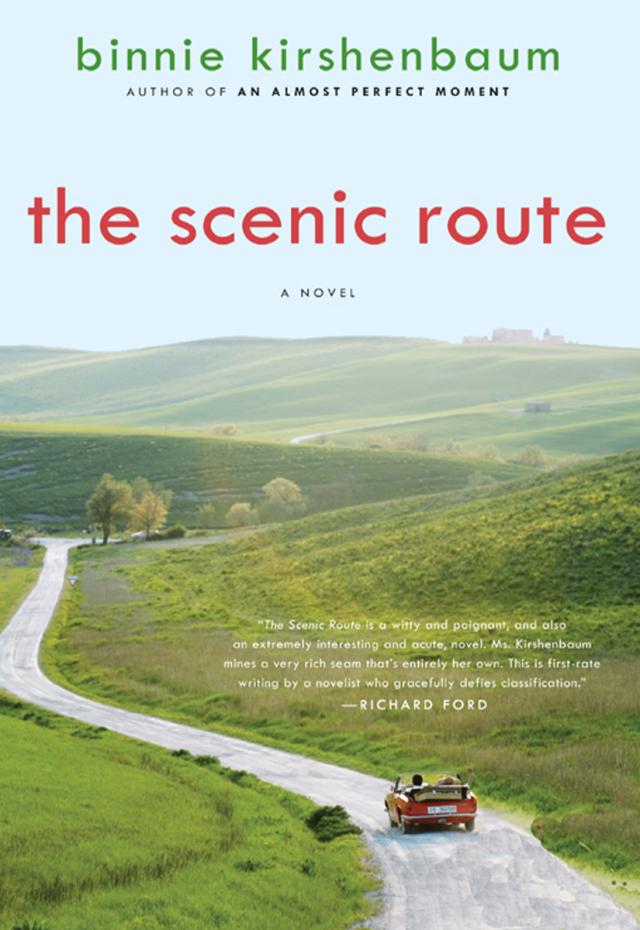
The Scenic Route
A Novel
Binnie Kirshenbaum
Tony and Susan, my bookends
O irrevocable
river
of things:
no one can say
that I loved
only
fish,
or the plants of the jungle and the field,
that I loved
only
those things that leap and climb, desire, and survive.
It’s not true:
many things conspired
to tell me the whole story.
—Pablo Neruda, from “Ode to Things”
Contents
Epigraph
1
Here is the story of Henry and me. I wish…
2
Except.
3
Almost no one marries for the sake of love alone.
4
Our room overlooked the sea, and all of the Hotel…
5
This much was probably certain: In the summer before she…
6
At a sidewalk café on the Kurfürstendamm, which is a…
7
To keep for myself, I took my mother’s black silk…
8
It was too easy to visualize my father spending the…
9
Prague was our destination, but the route we took to…
10
Such a sucker for love stories, never would my mother…
11
If sorrow is a hollow, like a bowl, then it…
12
The sun was now up, and the diner was empty…
13
The Bedtime Stories My Father Told Me: I was the…
14
The old mountain pass was as wide as wire, and…
15
Without much to recommend it except for a big lake…
16
Maybe my father tripped or maybe vertigo he had a…
17
Those stories I told my father, I tried to make…
18
Ruby was sitting on my couch, but her feet were…
19
Sailing, swimming, windsurfing, bicycling, sand-castle construction, and there was an…
20
We stopped at Contrexéville to buy bottled water, a loaf…
21
Two or three times a week, Ruby called me to…
22
As much as Henry and I ever had a fixed…
23
Charles de Gaulle Airport. With a first-class ticket in hand…
Acknowledgments
About the Author
Other Books by Binnie Kirshenbaum
Credits
Copyright
About the Publisher
1
Here is the story of Henry and me. I wish it had a different end.
It had a good beginning.
That’s what I would say. If Ruby would hear me out, I would say, “This is the story of Henry and me,” and no matter that it’s of the recent past, past is past, and to tell Ruby this story now would be to call on memory, to travel back, and, as it was, to be with Henry was never quite of our time but of another time better than all that. A time before my time. Like how it was in New York during the last days of the Automats, when there was still the Biltmore Hotel and that pink place for ice cream, the name of which escapes me, and Henry, he was not quite of our time either. “I wish it had a different end,” I would say to Ruby. “It had a good beginning.”
Also, I would apologize to her.
I would say, “Ruby, I am so sorry.”
Ruby is living some six-hundred-plus miles away at her mother’s house, which is never a good thing, a middle-aged woman living with her mother. That Ruby lives with her mother, it’s my fault. In a roundabout way, but still my fault.
Rumpelmayer’s. The pink place for ice cream was called Rumpelmayer’s. I would apologize to her not for what I did because I did nothing. I did nothing and I said nothing, and for sins of omission, such as mine was, there is no good excuse, and I’d say that, too, and again I’d say, “I am so sorry.”
And Ruby, she’d say, “You’re sorry? You’re damn right you’re sorry,” and then she’d hang up on me and I’d be standing there holding the phone with no one at the other end.
Or, who knows? Maybe she would say, “It’s okay, Sylvia. It’s over. Forget about it now.” Not likely but possible because all things are possible, and it could happen that she’d say it’s okay.
‘It’s okay, Sylvia. Really. It’s okay. It’s all behind us now.’
And I then could tell her, as I could tell Ruby and only Ruby how it is that, precisely that, that it’s all behind us now, that is what I am most afraid of, that everything good is over, and where do I go from here?
To which Ruby might say, “You give up. Or you begin.”
‘You begin.’
To begin. Florence, to begin. Florence, the one in Italy. I had not been to Europe or to anyplace else much either in how long? Eight years? Maybe six. Before I quit travel as a thing to do, I’d done my fair share of it, but then it happened that I stopped because effort expended is not always worth the price of getting there, and it’s not as if New York doesn’t offer a surfeit of art and music and theater to feed on, much the way a goose is force-fed to make foie gras, which, for the record, is something I consider to be immoral, the way geese are force-fed to make pâté. Ducks, too. In New York, we’ve got culture coming out our ears, plus the Empire State Building, the Statue of Liberty, Grant’s Tomb, and the cuisine of all nations, so who needed to pack a suitcase or fret over the decline of the dollar or worry about how, just like that—poof—a plane can vanish from the sky? Travel became something I thought of as fixed in my past, something done and over, a youthful avidity, perhaps, until I got to thinking about how I had never been to Italy, and how that fact seemed to alarm people. Coincidental to thinking about how I had never been to Italy, that is to say, right around the same time, I got a letter in the mail. A registered letter. A letter that you have to sign for, you know it’s not going to be a greeting card or a love letter either. Walking from the living room to the kitchen, I read it, the letter, the letter that exuded the same milk of human kindness as a letter that begins with “Dear Occupant.” I read the letter regretfully informing me that as a result of company downsizing, I was to be let go.
Let go.
Let go: dropped carelessly, the way an empty soda can is let go from a car window. Let go, and so what that “this decision bears no reflection on your job performance,” blah, blah, blah. The words boiled down to their essence, which was a pink slip. A pink slip that matched the pink of my face as it went hot, pink and hot from shame, which is a category of embarrassment but embarrassment entirely unlike embarrassments such as a trail of toilet paper stuck to your shoe or your dress tucked into the back of your panty hose or getting caught in a lie or in a compromising position. Those embarrassments we get over, those become funny stories we later tell, but shame is a pyric ember of humiliation, and it lodges within the core of us. The burns are searing; shame leaves scars.
My function, the letter said, was to be absorbed.
Absorbed: a spill mopped up with a sponge. Absorbed. My services were no longer needed, although if I were to be perfectly honest, it’s something that it took them, what, fourteen years to figure that one out. My services were never needed. Often I wondered, What exactly is it that I do here and why?
Oh, there would be a great display of sympathy, solidarity even, from my colleagues, and I would be sorely missed for two or three days. Then no more. Then my office would be turned into a conference room or be used for storage.
I folded the letter and put it back in the envelope and left it on the kitchen counter as if it hadn’t yet been read.
There I stood: five feet, six inches tall, forty-two years old, divorced, no children, without—for all practical purposes—any family, and now, let go. Unemployed, and think about this: how everyone always said, repeatedly said, “Sylvia does not live up to her potential.” Broken-record said how I am, how I have always been, the paradigmatic underachiever, which means I was let go from a job that was beneath me, a fact that was not a source of comfort.
Such a life was not inclined to elicit envy, although I did receive a severance package, enough money to tide me over until I could figure out what comes next. A severance package, which was not entirely an ungenerous one, although it wasn’t as if I was especially grateful for it, either.
But I took the money and I went to Florence, and on my fifth day there I got on a bus, a dark green rickety bus that went seven kilometers north, fifteen to twenty minutes up, up, uphill to the ancient Etruscan town of Fiesole, now famous, if famous isn’t pushing it, for a handful of Roman ruins. A light breeze billowed the air, but it was hot. Midday in June, in Italy, that kind of hot, and because the ruins weren’t going anywhere, rather than rush off to see the sights, I went directly to a café. Umbrellas advertising Cinzano shaded tables set with matching Cinzano ashtrays of the sort that tourists are inclined to pocket, as if a free ashtray comes with your limonata. There I had a view of the amphitheater that could knock your socks off. I ordered an espresso. The thing about a view, even one that could knock your socks off, is this: once you’ve seen it, you’ve seen it, and it’s not likely to offer up anything new while you are sitting there. Changes in the landscape are slow in coming, and my attention drifted.
&n bsp; To observe people is ornithologic in design, and throughout Europe, in cafés where tourists flock, you are likely to spot an American sparrow: ordinary, without brilliant plumage or anything much distinctive, these are solitary creatures but not by choice. In the cafés they read guidebooks, read intently about where they are, as if all experience belonged to someone else. That, or they will be writing in their journals or on the backs of postcards. “Dear Diary,” or “Dear Aunt Louise,” whichever, the words will not address the loneliness, the loneliness this trip was supposed to assuage but instead served only to exacerbate. The one desire articulated is predictable and flimsy: “I am seriously considering moving here.” That desire, to pack up the house in Portland or Amherst or Indianapolis and move to Florence or Prague or Barcelona, is a desire that, once they are home, fades the way all dreams do in the light of morning, but the man seated at the table next to mine, although unmistakably American and alone, he wasn’t reading a guidebook or writing in a diary or addressing the back of a postcard of the Ponte Vecchio. He was reading the Wall Street Journal. Without my glasses, I could not make out the date or even the headlines, but it was the Wall Street Journal that, along with the kelly-green kelly-green! Brooks Brothers polo shirt he wore, led me to peg him as a person to whom I’d have little to say and nothing to share, and that was a damn shame because he was someone rather lovely to look at, and I am not entirely beyond superficiality.
And back to the view it was. Looking out over the hills to the ruins, I brought the demitasse cup to my lips, and accidents will happen: espresso dribbled down the front of my dress. A white dress, too, so there was no pretending otherwise. He, that man at the next table, held out a handkerchief for me to take, to blot the coffee stain. A handkerchief. For real.
‘A handkerchief? He had a handkerchief? There’s an item we don’t see much of anymore.’
Yes, a handkerchief, and I’d have bet there was a seersucker suit hanging in his closet, too. He was something of an anachronism, how, in his dress and in his ways, he was nearer to that era between the wars, the world wars, when young men from America, young men of means, went off to live in Paris just as, so I came to learn, he, as a young man, went off to live in Paris. He lives there still. Someone should’ve told him: it was over; the others had long since packed up, gone home. All that remained of the movable feast were the bones on the plate, and you never want to be the last one to leave the party because that’s about as sorry as it gets. An American in Paris is a cliché, and a cliché is something no one should aspire to be, although really I’m not in a position to talk about ambitions, given that I never had any.
‘There’s that movie, An American in Paris. It starred Gene Kelly and Leslie Caron, with music by George Gershwin.’
Henry was that: an American in Paris, as American as Gene Kelly, although sometimes I kidded around and called him Henri. Kidded around because despite nearly two decades of an address on rue de Grenelle in the sixth arrondissement, and some years before that on rue Monge in the fifth, he wasn’t any kind of an Henri.
He was from North Carolina.
‘Oh, he’s one of my people.’
The South. Ruby, too, was from the South, and as if everyone born south of Maryland and north of Florida, excluding the District of Columbia and surrounding suburbs, was in some way related to her by blood or by marriage, she referred to them all as “my people,” which, she believed, gave her license to make broad and unflattering remarks about them. Which is often the case, that people feel free to criticize their own.
‘One of my people. You know, we can try to change who we are, but trying, that’s about as far as we get.’
It was true that Henry could have lived on rue de la Moon from now until forever and still, right off the bat, you’d have recognized him as a son of the Confederacy, an alumnus of William and Mary.
Tall and lanky and he had light brown hair that was going gray, light brown hair going gray that fell forward in boyish exuberance. He wore steel-rimmed eyeglasses with clip-on shades, and he favored blue jeans and those polo shirts, ordered from Brooks Brothers and shipped to him in Paris. Brooks Brothers polo shirts that sported—rather than the European-preferred Lacoste alligator—a sheep Poor little lambs who have gone astray for a logo.
I did not take the handkerchief he proffered because it was too late for that now. “Thanks anyway,” I said.
“You’re American,” he noted, and I said yes, and he introduced himself. With more than a trace of his North Carolina accent coming into play, he said, “I am Henry Stafford, and I am pleased to make your acquaintance.”
‘You know how we do that. Pile the accent on thick when talking to Yankees. We think you all are taken in by it.’
For Ruby, the Mason-Dixon Line was as concrete a divide as before and after, or an iron gate.
Henry Stafford introduced himself to me, and I introduced myself to him, and as if to commit my name to memory, he repeated it twice. “Sylvia Landsman. Sylvia Landsman.” Landsman, he said, as if it was a spondee, both syllables stressed equally. “Sylvia Landsman, I am pleased to make your acquaintance,” to which I, suddenly in possession of the social grace of a twelve-year-old girl, said, “Yeah,” but as it happens when two Americans find themselves to be two Americans in a café somewhere else, we started chatting. About what? I can’t recall precisely. Even at the time, there seemed to be no sharp definition to the talk, as if our words were made hazy by the heat of the summer afternoon, as if the present moment was happening years ago, but it didn’t take long for him to move from his table to my table, and I noted that his newspaper was ten days old. At some point in the conversation it came up that, distinct from the other Americans there and for that matter unlike the French and the Japanese visiting Fiesole that afternoon, he was not on a day trip, although maybe he was going to leave tomorrow. Or on Saturday.
“Why?” Not why was he leaving Fiesole. I wanted to know why was he there in the first place.
“Oh,” he said. “I am nursing a broken heart.”
“A clean break?” I asked. Because I did not believe him, I made light of what was not. “Or did it shatter into countless pieces?”
He paused, as if this question deserved thought. “Since you put it that way,” he said, “I’d have to reconsider. Perhaps it’s not really broken at all. Perhaps it’s just bruised. Or embarrassed.”
“So it will heal,” I said.
And he said, “I believe it just this minute has.”
‘There’s a line.’
Oh, he talked pretty, he did, in hyperbolic bloom, yet there was truth to what he said. His heart was not broken, but something else, some other part of him, was. Broken or missing, I knew because birds of a feather we recognize our own, and we are drawn to what is familiar to us.
Together he and I walked all of Fiesole, coming full circle In my end is my beginning to where we began on the Palazzo Communale, and there, the way an excuse is pulled out of thin air, not quite seamlessly, he took a Cinzano ashtray from his pocket. “For you,” he said. “A souvenir. To remember the day.”
Souvenir. From the French: remembrance, memory, something that serves as a reminder.
Back when I was a child and not exceptionally literate, I was sure, as sure as sure can be, that the word was silverneer. The etymology of it found in the “silver” part, the permanence of the metal being key. If you don’t lose it, you’ll have it always. As opposed to perishables. Perishables turn to rot and attract bugs; and the experience, the moment, the moment that you wish to remember, well, that doesn’t last at all. A photograph fixes the occasion so that you can’t remember it any other way except that which is in the picture, and memory is an unreliable narrator, selective, open to embellishment, eager to be shaded, or flat-out wrong. Silverneers were the tangible expression of a time at the Bronx Zoo, the Museum of Natural History, Rye Playland, the educational excursions to Washington, D.C., to Lancaster, Pennsylvania, to Stockbridge, Massachusetts, the vacations to Martha’s Vineyard and the Bahamas, and there was no point to going anywhere unless I got a silverneer, a thing people, places, things, a thing to rely upon to retain memory within itself, within its matter.


