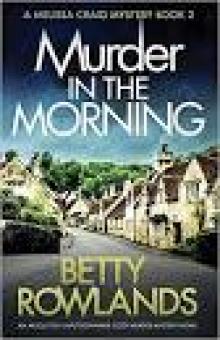
Murder on a Winter Afternoon, page 8
part #5 of Melissa Craig Series


‘Please take a seat,’ he said with a glossy smile. He indicated a chair facing him and waited for Melissa to sit down before sinking back into his own. ‘I understand from Eloise that you have assumed the mantle of the late Miss Leonora Jewell.’ His eyes swung briefly towards his assistant, who was sitting at his side, her head slightly tilted as if posing for a photograph. She responded with a grave nod and a downcast eye.
‘I’ve been commissioned to write the last three chapters of a novel she was working on at the time of her death, yes,’ agreed Melissa.
‘Such a tragedy. Eloise and I were greatly distressed to read about it.’ Hood gave a shake of his carefully-styled blond head and shot a second glance at his assistant, who responded with another solemn nod. ‘It was a great shock to us, coming so soon after we had made the lady’s acquaintance,’ he went on, turning back to Melissa. ‘Have the police charged anyone with the attack, do you know?’
‘Not that I’m aware of.’
‘A tragedy,’ he repeated, ‘and a great loss to the reading public.’
It crossed Melissa’s mind to wonder if he had ever read a line of a Leonora Jewell novel. She knew that among the literati, such a remark would be greeted with raised brows and condescending smiles. She was, however, not here to discuss the merits of Leonora’s work.
‘I know what a busy man you are, Mr Hood, and I’ll be as brief as I can,’ she said briskly. ‘There are indications that Miss Jewell had thought of a new twist to her plot. My aim is to stick to her ideas as closely as possible, but I haven’t been able to find any notes to show what she had in mind. I came across Samuel Deacon’s card and paid him a visit; he told me she’d been to see him and he’d referred her to you because you do some restoration work.’
Hood appeared taken aback at the suggestion. He and Eloise exchanged glances. ‘I don’t know what gave him that idea,’ he said slowly.
‘You mean, you were unable to help her?’
‘I didn’t say that. I was able to give her some information, but unfortunately she found it counter-productive.’
‘Why was that?’
‘She told me about the new twist, as you call it, to her plot and I explained in turn that what she had in mind was not feasible because certain techniques for detecting forgery had not been developed at the period in question.’
‘So it was the detection of forgery she was mainly interested in?’
‘That’s right.’
‘I see.’ Melissa thought for a moment before asking, ‘Were you able to suggest any alternative to what she had in mind?’
‘Not really, because she was already aware of what was generally known at the time. She said she had suddenly had an idea for a dramatic new dénouement to her story, which involved a character who had discovered a secret process, in effect, an anticipation of the discovery of X-rays. She had come across a reference to a chemist who was doing some research on similar lines to Röntgen and later claimed to have beaten him to his discovery. Fascinating stuff, but historically inaccurate.’ Hood sat back and shook his head with an indulgent smile. ‘I’m afraid she had allowed her fancy to run away with her.’
‘Are you saying that what she had envisaged wasn’t feasible?’
‘Oh, it was feasible, I suppose, but as I said, historically inaccurate, and she obviously felt that made it unsuitable for her book.’
‘She must have been disappointed.’
Hood shrugged. ‘A little, but quite philosophical, I think. All she said was, “Oh well, I’ll have to use my original idea”, or something to that effect.’
‘And that was all?’
He glanced at Eloise with raised eyebrows and she nodded. ‘So far as I remember, that was all,’ he affirmed.
‘She apologised for wasting Gerard’s time, and left,’ said Eloise. There was an edge to her voice which said, as clearly as words, ‘and I suggest you do the same’.
‘Well, that would seem to be that.’ Melissa put away her notebook, which she had – with misplaced optimism – kept at the ready throughout the short interview. ‘At least, I know what to do now.’
A flicker of something like disquiet passed briefly over Hood’s face. ‘You mean … ?’ he asked warily.
‘I mean, I shall do as Leonora intended – stick to Plan A, as she called it.’
‘I’m sure that’s the best thing.’ Almost imperceptibly, he relaxed. Melissa stood up and he half rose from his chair. Eloise remained seated.
‘Thank you for your time. There’s no need to see me out,’ Melissa said pointedly. She turned and went to the door, opened it and then thought of something else. She swung round and asked, ‘Did you happen to notice if Miss Jewell was taking notes of what you were saying?’
The question appeared to take Gerard Hood by surprise. He hesitated for a moment before replying, ‘No, I don’t think she did.’ He glanced yet again at Eloise, who compressed her lips and shook her head.
‘I’m quite certain she didn’t,’ she affirmed.
‘What a pity. She was meticulous about noting the details of her research, so it’s surprising there’s no record of her visit to you among her papers.’
Eloise shrugged and Gerard, once more at his ease, smiled and spread his hands as if in apology. ‘I’m sorry we couldn’t be of more help.’
‘On the contrary, you’ve been a great help,’ said Melissa.
It was pure chance that had made her turn back to put her last-minute question … and to catch Gerard Hood and Eloise Dampier exchanging glances of unmistakable relief.
Twelve
It was a little after eleven when Melissa rejoined her friends. She found them already settled at a corner table in the coffee shop. The room was crowded; in the half-hour since their arrival, Blackwater Hall had received an influx of visitors who appeared to have made straight for the same venue to fortify themselves with hot drinks and toasted tea-cakes before tackling the exhibition. A background of lively chatter, the rattle of crockery and a tape playing soft classical music meant that the three could talk freely without being overheard.
‘How did it go?’ Bruce asked Melissa as she sat down and took a sip from her mug of hot chocolate.
‘Very interesting indeed,’ she replied.
‘Did you find out what Leonora was after?’
‘No, but I’m pretty certain I found out what she wasn’t after.’
‘Meaning?’
‘Meaning that I was fed a load of twaddle.’ Briefly, she described the interview, including Hood’s version of Leonora’s ‘new twist’ to the plot of Deadly Legacy.
‘You’re sure it was twaddle?’ asked Bruce when she had finished.
‘Course it was,’ Iris interposed. ‘Röntgen was a physicist, not a chemist, and he made his discovery more or less by accident.’
‘Er, exactly,’ said Melissa, who had not spotted this particular flaw in Gerard Hood’s story. ‘Besides, Sam Deacon said quite specifically that it was restoration techniques that Leonora was interested in. That’s why he referred her to Gerard Hood, because – again according to Sam – he does some himself. Hood more or less denied that he does anything of the kind.’
‘Wonder what gave Sam the idea,’ mused Iris.
No one could suggest an explanation. After a moment, Bruce said, ‘So you’ve no idea what she really wanted to know, Mel, or why Hood concocted that story?’
‘Not at the moment, but it occurs to me that she might have had some sort of scam in mind that was too close for comfort to something that pair are up to. If that was the case, they’d have told her politely that it wasn’t feasible and shown her the door.’
‘You believe they are up to something, then?’ said Bruce.
‘I sense that they are. Apart from his version of Leonora’s “new twist”, what Hood said was plausible enough, but the body language said something different.’
‘Supposing it was feasible,’ said Bruce slowly, evidently thinking aloud. ‘Would the off-chance that Leonora would be unconvinced and decide to use her idea anyway represent a risk to what they’re doing?’
‘You’re not suggesting it would be a motive for murder?’
‘No, probably not. The risk of detection would outweigh that of exposure through the plot of a popular novel.’
Melissa sighed and nibbled at her tea-cake. ‘If only Leonora had made a note of her visit, or at least what she was after.’
‘It would give us something to go on,’ said Bruce. He sounded disappointed; plainly, he had expected something better from her.
‘I’m sure of one thing,’ she countered, slightly nettled by his attitude. ‘Both Gerard Hood and his glamorous assistant were relieved when I said I was going to forget about the “new twist” idea and stick with Leonora’s original plot. I also got the impression they might be an item. They were constantly exchanging glances.’
Bruce topped up his coffee cup from a white china pot before announcing, with considerable pride, ‘I can confirm that. I’ve had a long chat with Damian, the receptionist. He was very forthcoming. I think he fancies me,’ he added with a smirk.
Melissa gave him a disapproving stare. ‘I hope you didn’t lead him on,’ she said.
‘Well, maybe just a little, to encourage him to talk. He’s just broken up with his lover, so he was desperate for sympathy and I gave him some, that’s all.’
‘I think you’re quite unscrupulous,’ said Melissa coldly. ‘That poor lad …’
‘Shut up and let’s hear what Bruce found out,’ said Iris, who evidently did not share Melissa’s concern for Damian’s feelings.
Melissa glowered at the pair of them over the rim of her mug of chocolate and lapsed into a sulky silence.
‘Gerard and Eloise are very much an item,’ said Bruce, ‘and they’re doing nicely, thank you, out of the Asser Foundation. He runs a Porsche, she’s got a BMW and they both live it up in a big way. However, as reported to Damian by the lady who takes tea and coffee up to their office, they do have the occasional spat, mostly about his womanising. And that’s not all. If a visitor to the exhibition wants to buy a picture, it’s not done through the gift shop, it goes through a separate account handled by Eloise. And now and again some wealthy-looking individual, often a foreigner, gets the VIP treatment from Gerard himself; in those cases, none of the staff ever sees which work – if any – has changed hands.’
‘It probably happens when there’s a very special item on offer,’ suggested Melissa. ‘An Iris Ash original, for example,’ she added, a shade sarcastically. She was still feeling miffed at the pair of them.
‘Not necessarily.’ Bruce stabbed the air with an index finger for emphasis. ‘That’s what makes it interesting. Damian’s done an art course and knows a bit about values, and he said these characters sometimes turn up to do a deal when there’s been nothing special on offer for months.’
‘You’re suggesting that when someone donates a picture that would command a higher than average price, it’s sold under the counter and Gerard and Eloise pocket the takings?’
‘It’s a strong possibility, don’t you think?’ There was a short silence. ‘What do you say, Iris?’
While Bruce was speaking, Iris had been jabbing a spoon at the discarded herbal teabag lying in her saucer, apparently deep in thought. In response to his question, she said slowly, ‘Wouldn’t be many private donations of that order.’
‘You gave them one of yours. Other well-known artists may do the same.’
‘You’d still be talking about hundreds rather than thousands, most of the time.’
‘You mean, pounds?’
‘Or dollars. Either way, not enough to run a Porsche – or a string of mistresses.’
‘So maybe they take a cut from every deal, as well as creaming off the really valuable stuff.’ Bruce was obviously reluctant to abandon his theory altogether. ‘Damian says they sell a lot of works by local artists, especially during the tourist season. They’ve even got an “artist in residence” to satisfy the demand.’
‘Still only peanuts. Nothing in there,’ Iris jerked her mouse-brown head in the approximate direction of the exhibition gallery, ‘to raise the kind of money you’re thinking of.’
Bruce looked disappointed, but stuck to his guns. ‘I’m convinced there’s some kind of scam going on, he insisted. ‘Melissa thinks so too, don’t you, Mel?’
Iris shrugged and said, ‘Could be – can’t tell,’ pushed back her chair and stood up. ‘Think I’ll visit the artist in residence.’
‘Who is it?’
‘Chap I never heard of. Some of his work’s on sale. Looks interesting. You coming?’ As she spoke, Iris pulled out a coloured leaflet bearing a picture of Blackwater Hall on the front and a plan of the layout on the back. With a thin forefinger she traced a path from the coffee shop before setting off along a series of corridors. Bruce and Melissa followed her in silence until they came to a door on which was painted the word ‘Studio’. A sliding panel was set in the ‘Open’ position and a small framed notice requested visitors to refrain from touching anything and to close the door behind them.
The studio was a conservatory tucked into an angle of the house, so that two of the walls were of brick and the other two, and the roof, of glass. One glass wall looked out on the same panoramic view as that from the front of the building; the other faced north over an ornamental lake beyond which lay an area of lawns, shrubs and trees. Both aspects figured in a number of canvases, evidently by the same hand and painted at different times of the year, which hung around the brick walls. Old-fashioned central-heating pipes kept the temperature at a reasonable level, but after the steamy warmth of the coffee shop the air felt chilly. Melissa drew her coat more closely round her.
A young man whom she judged to be in the mid to late thirties was seated at an easel in the middle of the room. He had a high forehead, a prominent nose, a full, slightly girlish mouth and hair cropped to a half-inch stubble. His eyes, which were a clear, light amber, had an oddly penetrating quality, as if they were looking through rather than at the canvas on which he was working. He had an air of remoteness, showing not a flicker of reaction to the presence of visitors. She had the impression that he was not aware of them, as though his mind dwelt on a different plane where other humans were invisible or non-existent. A ripple of gooseflesh ran down her spine.
After casting a brief glance over the artist’s shoulder, Iris marched to the far end of the studio to study the paintings displayed there. Bruce, still subdued after her casual dismissal of his pet theory, remained just inside the door, his arms folded in an ostentatious show of indifference. Melissa ignored him and moved forward to watch the picture taking shape.
It was a view from the front of the house and was already more than half-finished. It showed the landscape menaced by an approaching storm, the distant hills partly obscured in a blur of rain, a layer of mist over the river dispersing under a rising wind. The picture had an energy and movement that was reflected in the artist’s deft, confident strokes as he applied paint to a canvas that bore no preparatory sketch.
He had just begun work on a tree in the foreground and Melissa watched, fascinated, as it took shape. It was a tree, and yet not a tree. The gnarled, twisted limbs were sinewy arms ending in twigs like bony fingers; the upper branches were shoulders hunched in weary submission under the wind that raced overhead, tearing the clouds to shreds.
‘That’s brilliant!’ she exclaimed aloud.
The artist appeared for the first time to be aware of her presence. He turned his head to look at her; she noticed that even when his eyes were not on the canvas, his brush did not cease to work, nor did it make a false stroke. He was like a man painting in a trance.
‘You like it?’ he said.
‘Oh, yes!’
‘I mustn’t give it to you.’ His voice had the toneless quality of someone speaking under hypnosis. ‘Sorry.’ With an air of finality, he turned back to his work.
‘I wasn’t asking you to give it to me,’ said Melissa. ‘I was just admiring it.’
‘The writing lady liked it and I gave it to her. He got cross. I mustn’t do it again.’
‘Who’s the writing lady?’
‘Said she liked the picture. I gave it to her. He got cross.’ The words were spoken in the same flat, slightly staccato voice.
‘It’s all right, I quite understand,’ Melissa said soothingly. ‘I wouldn’t want him to be cross with you.’
There was no further response. ‘What happened to the picture?’ she asked. ‘Did the writing lady give it back?’ Still there was no answer. ‘Who was cross with you? Was it Gerard?’
The artist leaned back on his stool and contemplated his canvas with half-closed eyes. He reached for some tubes of colour, squeezed a worm of blue paint onto his palette, added one of brown and began to blend the two together with a look of total concentration. Melissa knew instinctively that it was useless to question him further; he had retreated to his inner world where neither she nor her companions had any reality.
‘What the hell’s he on about?’ Bruce muttered in her ear as she turned away, gnawing her lower lip in frustration.
‘I’m not sure. I wish I could get him to say more.’ Random signals were chasing one another around her brain. In an effort to pull them into some sort of order, she went across to one glass wall and stood staring out at the misty landscape. Supposing the ‘writing lady’ had been Leonora? Had the strange artist really given her one of his paintings? Was it Gerard whose anger had been aroused by the gift? Why? And where was it now?
Iris called, ‘Come and look at this,’ and Melissa, glad to be diverted from questions to which she could find no answers, went to join her in front of a garden scene. It had been painted in high summer, with a mass of roses surrounding a statue of Cupid aiming an arrow at two figures in the middle distance. There was something faintly malicious on the stone face of the god, and his intended victims were looking over their shoulders in an attitude more suggestive of fearful anticipation than a welcome for love’s dart.
‘Interesting,’ said Iris. ‘All of them have something of unreality about them … underlying menace.’ She peered at the signature, almost invisible in one corner. ‘Arnie. Good mind to buy one.’
‘I’ve been commissioned to write the last three chapters of a novel she was working on at the time of her death, yes,’ agreed Melissa.
‘Such a tragedy. Eloise and I were greatly distressed to read about it.’ Hood gave a shake of his carefully-styled blond head and shot a second glance at his assistant, who responded with another solemn nod. ‘It was a great shock to us, coming so soon after we had made the lady’s acquaintance,’ he went on, turning back to Melissa. ‘Have the police charged anyone with the attack, do you know?’
‘Not that I’m aware of.’
‘A tragedy,’ he repeated, ‘and a great loss to the reading public.’
It crossed Melissa’s mind to wonder if he had ever read a line of a Leonora Jewell novel. She knew that among the literati, such a remark would be greeted with raised brows and condescending smiles. She was, however, not here to discuss the merits of Leonora’s work.
‘I know what a busy man you are, Mr Hood, and I’ll be as brief as I can,’ she said briskly. ‘There are indications that Miss Jewell had thought of a new twist to her plot. My aim is to stick to her ideas as closely as possible, but I haven’t been able to find any notes to show what she had in mind. I came across Samuel Deacon’s card and paid him a visit; he told me she’d been to see him and he’d referred her to you because you do some restoration work.’
Hood appeared taken aback at the suggestion. He and Eloise exchanged glances. ‘I don’t know what gave him that idea,’ he said slowly.
‘You mean, you were unable to help her?’
‘I didn’t say that. I was able to give her some information, but unfortunately she found it counter-productive.’
‘Why was that?’
‘She told me about the new twist, as you call it, to her plot and I explained in turn that what she had in mind was not feasible because certain techniques for detecting forgery had not been developed at the period in question.’
‘So it was the detection of forgery she was mainly interested in?’
‘That’s right.’
‘I see.’ Melissa thought for a moment before asking, ‘Were you able to suggest any alternative to what she had in mind?’
‘Not really, because she was already aware of what was generally known at the time. She said she had suddenly had an idea for a dramatic new dénouement to her story, which involved a character who had discovered a secret process, in effect, an anticipation of the discovery of X-rays. She had come across a reference to a chemist who was doing some research on similar lines to Röntgen and later claimed to have beaten him to his discovery. Fascinating stuff, but historically inaccurate.’ Hood sat back and shook his head with an indulgent smile. ‘I’m afraid she had allowed her fancy to run away with her.’
‘Are you saying that what she had envisaged wasn’t feasible?’
‘Oh, it was feasible, I suppose, but as I said, historically inaccurate, and she obviously felt that made it unsuitable for her book.’
‘She must have been disappointed.’
Hood shrugged. ‘A little, but quite philosophical, I think. All she said was, “Oh well, I’ll have to use my original idea”, or something to that effect.’
‘And that was all?’
He glanced at Eloise with raised eyebrows and she nodded. ‘So far as I remember, that was all,’ he affirmed.
‘She apologised for wasting Gerard’s time, and left,’ said Eloise. There was an edge to her voice which said, as clearly as words, ‘and I suggest you do the same’.
‘Well, that would seem to be that.’ Melissa put away her notebook, which she had – with misplaced optimism – kept at the ready throughout the short interview. ‘At least, I know what to do now.’
A flicker of something like disquiet passed briefly over Hood’s face. ‘You mean … ?’ he asked warily.
‘I mean, I shall do as Leonora intended – stick to Plan A, as she called it.’
‘I’m sure that’s the best thing.’ Almost imperceptibly, he relaxed. Melissa stood up and he half rose from his chair. Eloise remained seated.
‘Thank you for your time. There’s no need to see me out,’ Melissa said pointedly. She turned and went to the door, opened it and then thought of something else. She swung round and asked, ‘Did you happen to notice if Miss Jewell was taking notes of what you were saying?’
The question appeared to take Gerard Hood by surprise. He hesitated for a moment before replying, ‘No, I don’t think she did.’ He glanced yet again at Eloise, who compressed her lips and shook her head.
‘I’m quite certain she didn’t,’ she affirmed.
‘What a pity. She was meticulous about noting the details of her research, so it’s surprising there’s no record of her visit to you among her papers.’
Eloise shrugged and Gerard, once more at his ease, smiled and spread his hands as if in apology. ‘I’m sorry we couldn’t be of more help.’
‘On the contrary, you’ve been a great help,’ said Melissa.
It was pure chance that had made her turn back to put her last-minute question … and to catch Gerard Hood and Eloise Dampier exchanging glances of unmistakable relief.
Twelve
It was a little after eleven when Melissa rejoined her friends. She found them already settled at a corner table in the coffee shop. The room was crowded; in the half-hour since their arrival, Blackwater Hall had received an influx of visitors who appeared to have made straight for the same venue to fortify themselves with hot drinks and toasted tea-cakes before tackling the exhibition. A background of lively chatter, the rattle of crockery and a tape playing soft classical music meant that the three could talk freely without being overheard.
‘How did it go?’ Bruce asked Melissa as she sat down and took a sip from her mug of hot chocolate.
‘Very interesting indeed,’ she replied.
‘Did you find out what Leonora was after?’
‘No, but I’m pretty certain I found out what she wasn’t after.’
‘Meaning?’
‘Meaning that I was fed a load of twaddle.’ Briefly, she described the interview, including Hood’s version of Leonora’s ‘new twist’ to the plot of Deadly Legacy.
‘You’re sure it was twaddle?’ asked Bruce when she had finished.
‘Course it was,’ Iris interposed. ‘Röntgen was a physicist, not a chemist, and he made his discovery more or less by accident.’
‘Er, exactly,’ said Melissa, who had not spotted this particular flaw in Gerard Hood’s story. ‘Besides, Sam Deacon said quite specifically that it was restoration techniques that Leonora was interested in. That’s why he referred her to Gerard Hood, because – again according to Sam – he does some himself. Hood more or less denied that he does anything of the kind.’
‘Wonder what gave Sam the idea,’ mused Iris.
No one could suggest an explanation. After a moment, Bruce said, ‘So you’ve no idea what she really wanted to know, Mel, or why Hood concocted that story?’
‘Not at the moment, but it occurs to me that she might have had some sort of scam in mind that was too close for comfort to something that pair are up to. If that was the case, they’d have told her politely that it wasn’t feasible and shown her the door.’
‘You believe they are up to something, then?’ said Bruce.
‘I sense that they are. Apart from his version of Leonora’s “new twist”, what Hood said was plausible enough, but the body language said something different.’
‘Supposing it was feasible,’ said Bruce slowly, evidently thinking aloud. ‘Would the off-chance that Leonora would be unconvinced and decide to use her idea anyway represent a risk to what they’re doing?’
‘You’re not suggesting it would be a motive for murder?’
‘No, probably not. The risk of detection would outweigh that of exposure through the plot of a popular novel.’
Melissa sighed and nibbled at her tea-cake. ‘If only Leonora had made a note of her visit, or at least what she was after.’
‘It would give us something to go on,’ said Bruce. He sounded disappointed; plainly, he had expected something better from her.
‘I’m sure of one thing,’ she countered, slightly nettled by his attitude. ‘Both Gerard Hood and his glamorous assistant were relieved when I said I was going to forget about the “new twist” idea and stick with Leonora’s original plot. I also got the impression they might be an item. They were constantly exchanging glances.’
Bruce topped up his coffee cup from a white china pot before announcing, with considerable pride, ‘I can confirm that. I’ve had a long chat with Damian, the receptionist. He was very forthcoming. I think he fancies me,’ he added with a smirk.
Melissa gave him a disapproving stare. ‘I hope you didn’t lead him on,’ she said.
‘Well, maybe just a little, to encourage him to talk. He’s just broken up with his lover, so he was desperate for sympathy and I gave him some, that’s all.’
‘I think you’re quite unscrupulous,’ said Melissa coldly. ‘That poor lad …’
‘Shut up and let’s hear what Bruce found out,’ said Iris, who evidently did not share Melissa’s concern for Damian’s feelings.
Melissa glowered at the pair of them over the rim of her mug of chocolate and lapsed into a sulky silence.
‘Gerard and Eloise are very much an item,’ said Bruce, ‘and they’re doing nicely, thank you, out of the Asser Foundation. He runs a Porsche, she’s got a BMW and they both live it up in a big way. However, as reported to Damian by the lady who takes tea and coffee up to their office, they do have the occasional spat, mostly about his womanising. And that’s not all. If a visitor to the exhibition wants to buy a picture, it’s not done through the gift shop, it goes through a separate account handled by Eloise. And now and again some wealthy-looking individual, often a foreigner, gets the VIP treatment from Gerard himself; in those cases, none of the staff ever sees which work – if any – has changed hands.’
‘It probably happens when there’s a very special item on offer,’ suggested Melissa. ‘An Iris Ash original, for example,’ she added, a shade sarcastically. She was still feeling miffed at the pair of them.
‘Not necessarily.’ Bruce stabbed the air with an index finger for emphasis. ‘That’s what makes it interesting. Damian’s done an art course and knows a bit about values, and he said these characters sometimes turn up to do a deal when there’s been nothing special on offer for months.’
‘You’re suggesting that when someone donates a picture that would command a higher than average price, it’s sold under the counter and Gerard and Eloise pocket the takings?’
‘It’s a strong possibility, don’t you think?’ There was a short silence. ‘What do you say, Iris?’
While Bruce was speaking, Iris had been jabbing a spoon at the discarded herbal teabag lying in her saucer, apparently deep in thought. In response to his question, she said slowly, ‘Wouldn’t be many private donations of that order.’
‘You gave them one of yours. Other well-known artists may do the same.’
‘You’d still be talking about hundreds rather than thousands, most of the time.’
‘You mean, pounds?’
‘Or dollars. Either way, not enough to run a Porsche – or a string of mistresses.’
‘So maybe they take a cut from every deal, as well as creaming off the really valuable stuff.’ Bruce was obviously reluctant to abandon his theory altogether. ‘Damian says they sell a lot of works by local artists, especially during the tourist season. They’ve even got an “artist in residence” to satisfy the demand.’
‘Still only peanuts. Nothing in there,’ Iris jerked her mouse-brown head in the approximate direction of the exhibition gallery, ‘to raise the kind of money you’re thinking of.’
Bruce looked disappointed, but stuck to his guns. ‘I’m convinced there’s some kind of scam going on, he insisted. ‘Melissa thinks so too, don’t you, Mel?’
Iris shrugged and said, ‘Could be – can’t tell,’ pushed back her chair and stood up. ‘Think I’ll visit the artist in residence.’
‘Who is it?’
‘Chap I never heard of. Some of his work’s on sale. Looks interesting. You coming?’ As she spoke, Iris pulled out a coloured leaflet bearing a picture of Blackwater Hall on the front and a plan of the layout on the back. With a thin forefinger she traced a path from the coffee shop before setting off along a series of corridors. Bruce and Melissa followed her in silence until they came to a door on which was painted the word ‘Studio’. A sliding panel was set in the ‘Open’ position and a small framed notice requested visitors to refrain from touching anything and to close the door behind them.
The studio was a conservatory tucked into an angle of the house, so that two of the walls were of brick and the other two, and the roof, of glass. One glass wall looked out on the same panoramic view as that from the front of the building; the other faced north over an ornamental lake beyond which lay an area of lawns, shrubs and trees. Both aspects figured in a number of canvases, evidently by the same hand and painted at different times of the year, which hung around the brick walls. Old-fashioned central-heating pipes kept the temperature at a reasonable level, but after the steamy warmth of the coffee shop the air felt chilly. Melissa drew her coat more closely round her.
A young man whom she judged to be in the mid to late thirties was seated at an easel in the middle of the room. He had a high forehead, a prominent nose, a full, slightly girlish mouth and hair cropped to a half-inch stubble. His eyes, which were a clear, light amber, had an oddly penetrating quality, as if they were looking through rather than at the canvas on which he was working. He had an air of remoteness, showing not a flicker of reaction to the presence of visitors. She had the impression that he was not aware of them, as though his mind dwelt on a different plane where other humans were invisible or non-existent. A ripple of gooseflesh ran down her spine.
After casting a brief glance over the artist’s shoulder, Iris marched to the far end of the studio to study the paintings displayed there. Bruce, still subdued after her casual dismissal of his pet theory, remained just inside the door, his arms folded in an ostentatious show of indifference. Melissa ignored him and moved forward to watch the picture taking shape.
It was a view from the front of the house and was already more than half-finished. It showed the landscape menaced by an approaching storm, the distant hills partly obscured in a blur of rain, a layer of mist over the river dispersing under a rising wind. The picture had an energy and movement that was reflected in the artist’s deft, confident strokes as he applied paint to a canvas that bore no preparatory sketch.
He had just begun work on a tree in the foreground and Melissa watched, fascinated, as it took shape. It was a tree, and yet not a tree. The gnarled, twisted limbs were sinewy arms ending in twigs like bony fingers; the upper branches were shoulders hunched in weary submission under the wind that raced overhead, tearing the clouds to shreds.
‘That’s brilliant!’ she exclaimed aloud.
The artist appeared for the first time to be aware of her presence. He turned his head to look at her; she noticed that even when his eyes were not on the canvas, his brush did not cease to work, nor did it make a false stroke. He was like a man painting in a trance.
‘You like it?’ he said.
‘Oh, yes!’
‘I mustn’t give it to you.’ His voice had the toneless quality of someone speaking under hypnosis. ‘Sorry.’ With an air of finality, he turned back to his work.
‘I wasn’t asking you to give it to me,’ said Melissa. ‘I was just admiring it.’
‘The writing lady liked it and I gave it to her. He got cross. I mustn’t do it again.’
‘Who’s the writing lady?’
‘Said she liked the picture. I gave it to her. He got cross.’ The words were spoken in the same flat, slightly staccato voice.
‘It’s all right, I quite understand,’ Melissa said soothingly. ‘I wouldn’t want him to be cross with you.’
There was no further response. ‘What happened to the picture?’ she asked. ‘Did the writing lady give it back?’ Still there was no answer. ‘Who was cross with you? Was it Gerard?’
The artist leaned back on his stool and contemplated his canvas with half-closed eyes. He reached for some tubes of colour, squeezed a worm of blue paint onto his palette, added one of brown and began to blend the two together with a look of total concentration. Melissa knew instinctively that it was useless to question him further; he had retreated to his inner world where neither she nor her companions had any reality.
‘What the hell’s he on about?’ Bruce muttered in her ear as she turned away, gnawing her lower lip in frustration.
‘I’m not sure. I wish I could get him to say more.’ Random signals were chasing one another around her brain. In an effort to pull them into some sort of order, she went across to one glass wall and stood staring out at the misty landscape. Supposing the ‘writing lady’ had been Leonora? Had the strange artist really given her one of his paintings? Was it Gerard whose anger had been aroused by the gift? Why? And where was it now?
Iris called, ‘Come and look at this,’ and Melissa, glad to be diverted from questions to which she could find no answers, went to join her in front of a garden scene. It had been painted in high summer, with a mass of roses surrounding a statue of Cupid aiming an arrow at two figures in the middle distance. There was something faintly malicious on the stone face of the god, and his intended victims were looking over their shoulders in an attitude more suggestive of fearful anticipation than a welcome for love’s dart.
‘Interesting,’ said Iris. ‘All of them have something of unreality about them … underlying menace.’ She peered at the signature, almost invisible in one corner. ‘Arnie. Good mind to buy one.’