The Kill Factor, page 27


Tiger got to the top first, and lay on her back in a puddle of cold seawater, watching her breath make clouds over and over again in rapid succession. When Emerson got to the top, she lay beside Tiger, and the two of them stayed there for a full minute until they could no longer ignore the frantic buzzing of the drone as it zipped around them.
Emerson rolled over, and the pain erupted inside her all over again as if the arrows had been fired into her once more. Her muscles were stiff and cold, her joints were aching, but it wasn’t over yet.
She lurched after Kester as he led the way to the front of the ship, and to a small metal door with BRIDGE written on it. Emerson tried the handle, and it opened.
The drone went in first, followed by Tiger and Emerson.
Inside was a room of such futuristic qualities that Emerson wondered for a moment if she had set foot on a spaceship. Narrow windows encircled the entire room. Several different stations were dotted around with various screens and navigation tools—all the screens were blank, but they looked complex nonetheless. Two comfortable-looking leather chairs sat front and center, with dozens of dials and touchscreen pads and readouts.
“What do we do?” Tiger asked.
And to Emerson, the little Topsider’s voice sounded miles away.
The drone moved to the big leather chair on the left and bobbed up and down above a small metal key that was already slotted into a housing on the arm of the chair. Tiger ran to the key and turned it. Nothing happened. The drone moved to the second chair, where an identical key sat. Tiger turned that one too.
Lights came on around the ship; screens came to life; 3D maps appeared, hovering in midair.
“Is that it?” Emerson asked, her voice hoarse and quiet.
The drone moved up and down. Emerson collapsed into one of the chairs with a view through the enormous window. There was nothing to see except the inky ocean moving perpetually.
The ship began to rumble and shake as the engines came to life. Kester had control now. Emerson slumped in the seat and smiled as the ship began to move slowly, slowly.
Tiger sat down beside Emerson.
“We’re going to make it out of here, aren’t we?”
Emerson nodded. Her green dress was now almost completely red from the blood that had poured out of her, and her skin had grown pale, almost transparent.
They picked up speed with agonizing sluggishness, and Emerson wished she could see the island disappearing into the distance. As if Kester had read her mind, a new 3D display rose up in front of her with a perfect high-definition video feed of the island. It was lowering slowly down until it was in line with the water’s edge once more, and Emerson could see the people standing there, watching them go, unmoving.
A siren sounded inside the bridge, and Emerson—with great effort—turned her head to the window. There was a vast nothingness before them, a place where the waves stopped and a void began. It could only be the edge of the dome.
“This is it,” Tiger said, her voice filled with panic.
Emerson could no longer feel the pain in her shoulder, or her thigh, or her wrist, and somewhere in the back of her mind, she thought that was a bad sign.
Warning, an electronic voice said. Impact imminent. Adjust course immediately.
Tiger gripped Emerson’s hand. Emerson looked back to the image of the island. Why were they just standing there, not moving, not trying to bring their lost contestants back? Emerson didn’t know, and she didn’t have the energy to care.
Warning. Impact imminent. Adjust course immediately.
The whir of the engines grew in pitch and volume as Kester told the ship to go faster, faster! He must have been overriding fail-safe features constantly, but it was working: The ship went faster and faster, and the enormous nothingness got closer and closer.
Warning. Impact imminent. Adjust course immediately.
And then the ship hit the dome.
The sound was enormous. Tiger and Emerson were thrown from their seats, and for a brief moment, all the pain in Emerson’s body returned in lightning-bolt brightness.
The screech of metal, the crash of glass, the grinding sound of the engines fighting against the obstacle.
Emerson got back to her feet. She had almost no breath now, and sweat was pouring from her, but when she collapsed back into the seat and looked out the cracked window, she had to blink several times to believe what her eyes told her.
No more than three hundred yards away was the same dock they had left from all those weeks ago. Her own city took up the horizon: the unique skyscrapers, the famous advertising boards, the weaving, winding roads with a thousand auto-taxis moving serenely through the crowded streets.
Emerson laughed; she couldn’t help it. It was, somehow, all so funny.
The effort of that laughter, though, was the last of her energy. Her vision blurred, she felt her life slipping from beneath her, and then the world went blank.
Death was not how Emerson had imagined it. There was no bright light, no sense of floating up to the afterlife, no feelings of bliss or awe. There was only darkness.
The darkness was complete and all-encompassing. There was no sound, there was no feeling, there was no thought.
And then, a million lifetimes later, there was something. It was merely an awareness of existence, but it was something other than the darkness.
Slowly, over an impossible timeline, that sense of awareness grew into the ability to think.
Where am I? Who am I? What happened?
And with those thoughts came a feeling deep within her, an instinct to put up walls, to not allow the answers to come just yet. No, instead just exist as no one, nowhere, with no past or future. Be ignorant to all of it, because none of it could bring happiness.
The self is persistent, though. It wants to be known, and a few hundred years later, she told herself her name.
Emerson Ness.
Emerson Ness became aware of a persistent beep. That beep came over and over again in a steady, maddening rhythm. It had been there this whole time, she knew that, but once she had become aware of it, she could not let it fade away into the background again.
Beep … Beep … Beep.
Emerson Ness, she thought, and more of herself came back to life.
When, finally, she opened her eyes, a new thought entered her mind.
What kind of game is this?
Her brain felt disconnected from her body. She couldn’t make her arms lift up from the strange white bed she was in.
They’ve drugged me again, she thought. The Producer, the people in charge. They’ve drugged me, and now they want me to escape before the walls close in and I’m crushed to death, or the room fills with water and I drown, or fire engulfs the bed and burns me alive.
But her eyes began to adjust to the darkness, and she saw that she was not on the island anymore. She was in the hospital.
The last thing she remembered before falling unconscious was Tiger begging her to stay awake. They had been on the cruise ship, the Calypso. They had escaped … they had escaped.
It came back to her in fragments: the maze; the blood as she cut the capsule from her wrist; the arrows hitting her leg and her shoulder; watching the Producer die; swimming to the cruise ship as the figures on the island watched on, motionless; breaking through the dome to find out that they were back where they had started.
Relief flowed through her. They were safe now, her and Tiger. They had escaped.
She rested her drowsy head back on the comfortable pillow and whispered into the dark room, “I made it, Kodi. I made it.”
And for the first time in a very long time, she felt safe.
The news sites were filled with nothing but Kill Factor headlines.
A thousand reporters were camped outside the hospital, desperate to get a quote or a photograph of the two girls who had survived and escaped the island.
Emerson watched the TV in the hospital with Tiger lying beside her.
The authorities had found nothing on the island, and they had found nothing on the cruise ship either. All electronic files had been wiped; there were no fingerprints anywhere; there was no trace of any person who had been involved in the competition other than the corpses of some of the contestants.
There were a thousand conspiracy theories, and almost every person who commented on the articles and videos spoke of how impossible it would be to keep something of this scale secret. Hundreds of people must have been involved: engineers, mechanics, programmers, producers, directors, editors, and more, and yet no one was found, and no one was speaking out.
Companies were offering hundreds of brand credits linked to a million followers for anyone who could prove that they were involved to speak to them completely anonymously, but no one had taken up the offer so far. And Emerson was certain that no one would. Kodi had been right: This was something so big, and so clandestine, that it had to be government run.
“What do you think’s going to happen now?” Tiger asked.
“I really don’t know,” Emerson admitted.
“Well, you’re now the most popular influencer in the world, so at least there’s that.”
“I really don’t want to be the most popular influencer in the world,” Emerson replied.
“Yeah, but it gives you a kind of protection, don’t you think?” Tiger asked.
“How do you mean?”
“Well, like, you’re going to be watched twenty-four hours a day for the rest of your life, so it’s not like they can ever get you back onto another Kill Factor.”
Emerson thought of the calm faces that had watched them escape from the island, and a shudder ran through her.
“Not for the rest of my life,” Emerson said finally. “I’ve got a year in juvenile detention to get through first.”
Emerson had been told earlier that day that when she was healthy enough to be discharged, she would be serving a sentence for the crime of arson. The authority of Kill Factor was apparently never going to be recognized by the courts, and yet they were showing great leniency in reducing her sentence, citing time served and the suffering of cruel and unusual punishment. Tiger would be imprisoned too, but only for three months.
“Juvie will be nothing compared to the island,” Tiger said. “We’ll both sail through it.”
Emerson nodded. The truth was, she was glad that she would serve time for the death of Marvin Tzu. Yes, it had been Kodi who had lit the fire, but when she had turned the gas on, she had wanted the school to burn. She felt like she deserved the punishment. She would not argue or appeal; she would do her time, donate a hundred brand credits to Marvin’s family, set up a scholarship for his grandkids, and of course make sure that Never’s family were financially supported, and then … and then what?
She had made a promise to all those who followed her on that final day on the island, a promise to spend the rest of her life bringing the organizers to justice.
Now was not the time to think about it, though. She had a few more days in here with Tiger, alone, avoiding the reporters, the cameras, the questions. After that, a year of prison, where she would be safe from secretive agencies and powerful organizations that could disappear without a trace.
She would use the time to become a better person: a much easier endeavor when you had the money to back your plans.
Emerson had spoken once to her friend Never, and had asked if she thought that money would change them. Never had said, I’ve seen good people change. Give a person money and they always want more. Give a person power and they always want more. Give a person influence and they always want more.
Emerson was determined that this would not be her. She would do good things with her newfound wealth; she would invest it in the people who needed it. She would give opportunities to the forgotten, give hope to the invisible.
In an hour, visiting time would start, and she would see Kester for the first time since he had saved her from the island. That was what she was looking forward to the most, seeing her brother, and saying thank you.
Tiger had fallen asleep with her head on Emerson’s chest, and Emerson kissed the young girl’s head. She looked out the window and watched a blackbird sailing across the afternoon sky, and she smiled. Soon she too would be free, just like …
Emerson’s blood suddenly ran cold as she watched the bird. For a second it disappeared. Emerson sat up. Tiger stirred but didn’t wake. The bird had reappeared now, and was once again sailing across the blue sky without a care in the world.
I imagined it, Emerson told herself. I just imagined it.
But then the bird flickered like a glitching image.
It was a sign. A message.
The games were not over yet.
I loved writing this book. It was the type of story that just flows from start to finish. There’s so much action and adventure, and the characters seemed to come alive and make decisions for themselves. That so rarely happens for me, so I tried to enjoy every second of it.
I want to thank my wife, Sarah, for continuing to believe in my writing, and for lying around on the couch and watching nonsense on TV with me.
I also want to thank Sam Palazzi, Kesia Lupo, and Chloe Seager for once again helping one of my novels make it from my mind to reality. All of your ideas, enthusiasm, and belief make the final book so much better than I could ever manage on my own.
Everyone at Scholastic and Chicken House—it means so much to me that you champion my writing and help me make these pipe dreams a reality.
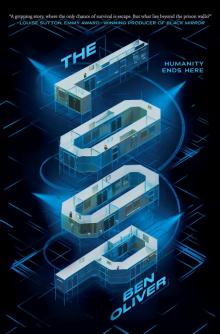
BEN OLIVER is the award-winning author of The Loop trilogy, which received three starred reviews and has been sold in twelve countries. He currently lives in Edinburgh, Scotland, with his wife and cat, where he teaches high school English.
Copyright © 2024 Ben Oliver
All rights reserved. Published by Chicken House, an imprint of Scholastic Inc., Publishers since 1920. SCHOLASTIC, CHICKEN HOUSE, and associated logos are trademarks and/or registered trademarks of Scholastic Inc.
The publisher does not have any control over and does not assume any responsibility for author or third-party websites or their content.
This book is a work of fiction. Names, characters, places, and incidents are either the product of the author’s imagination or are used fictitiously, and any resemblance to actual persons, living or dead, business establishments, events, or locales is entirely coincidental.
Library of Congress Cataloging-in-Publication Data available
First edition, April 2024
Jacket art © 2024 By Oliver Barrett
Jacket design by Cassy Price
e-ISBN 978-1-338-89187-4
All rights reserved under International and Pan-American Copyright Conventions. No part of this publication may be reproduced, transmitted, downloaded, decompiled, reverse engineered, or stored in or introduced into any information storage and retrieval system, in any form or by any means, whether electronic or mechanical, now known or hereafter invented, without the express written permission of the publisher. For information regarding permission, write to Scholastic Inc., Attention: Permissions Department, 557 Broadway, New York, NY 10012.
Ben Oliver, The Kill Factor