

Moguls, Monsters and Madmen, page 1


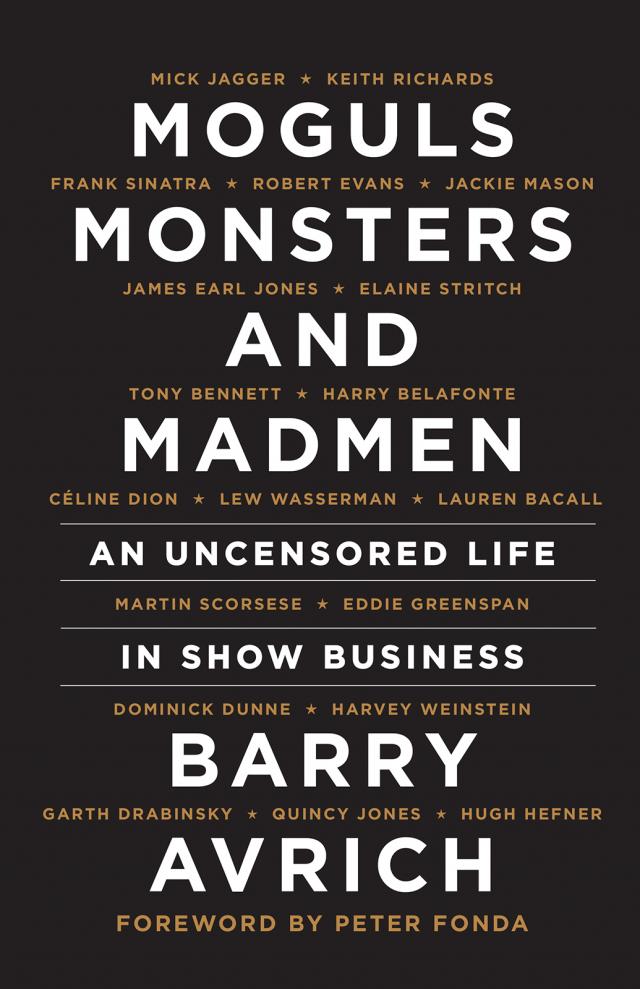
MOGULS,
MONSTERS
AND
MADMEN
AN UNCENSORED LIFE IN SHOW BUSINESS
BARRY AVRICH
FOREWORD BY PETER FONDA
To my beloved Melissa and Sloan,
who are both support and compassion personified
CONTENTS
Foreword by Peter Fonda
Prologue
PART ONE: The Warm-up Act
01. “Okay, Kid, You Can Tell Jokes”
02. Printing Money
03. Death of a Salesman
PART TWO: My Life as a Mad Man
04. Birth of a Salesman
05. This Isn’t Shoe Business, It’s Show Business
06. Garth Drabinsky: Curtain Rising
07. Garth Drabinsky: Curtain Falling
08. Surrounded by Madmen and a Few Monsters
09. Family, Mentors and other Invaluables
10. Charity Begins with a Rolodex
11. More Boldface: Name Dropping for the Love of It
12. Hot Docs: All Dressed
13. All Aboard the Titanic
14. Public Mischief
PART THREE: My Life in Film
15. Filling the Frame
16. Guilty Pleasure: The Dominick Dunne Story
17. The Last Mogul: The Life and Times of Lew Wasserman
18. A Criminal Mind: The Life and Times of Eddie Greenspan
19. Satisfaction: The Life and Times of Michael Cohl
20. Unauthorized: The Harvey Weinstein Project
21. Amerika Idol: A True Story
22. An Unlikely Obsession: The Untold Story of Churchill and the Jews
23. Show Stopper: The Theatrical Life of Garth Drabinsky
24. Filthy Gorgeous: The Bob Guccione Story
25. Quality Balls: The David Steinberg Story
26. It’s a Wrap!
Acknowledgments
Index
About the Author
Copyright
FOREWORD
Reading Barry Avrich’s book almost makes me envious. At nine years old, Barry Avrich knew exactly where he wanted to be: in show business. When I was nine years old, I was wondering what the hell was going on in life. I had little knowledge about the business and I was practically unaware of the siren song this industry wails out to the public. I was desperately trying to figure out what was going on in my family. Barry’s father, Irving, and mother, Faye, were the best coaches a young performer could ever want. Irving was a performer with great practice. When he would display the fashion he was promoting, he made sure the ambience in the showroom was just right. He placed lights in such a manner to best display his new “collection” as part of his “staged production.” In my mind, Barry’s father was a working road show, and his son states that he “inherited” his “showmanship from my father.” His mother was artistic with an elegant flair. This was a family that I could only dream about. This was Barry’s true life beginnings and it was one hell of a start.
Many of the major players in the business, I know personally. I also know about their reputations in dealing with others. Barry went out into this world of moguls and encountered the power these major players use—from Dominick Dunne’s heady, almost decadent, world to Lew Wasserman and his Spock demeanour. When Barry spoke to Lew about doing a documentary on him, Lew said, “Not while I’m alive . . . or dead, kid,” while applying the Vulcan “pinch” on his neck. I first met Barry in January of 2010. I went on one of his fabulous Floating Film Festivals in the Caribbean. We became friends, immediately. His savvy and production abilities impressed me. His innate ability to seek out the perfect people to interview is right on target. Who else can put together the late great New York Times essayist David Carr, Hollywood power player Michael Ovitz and actress Suzanne Pleshette to speak about Lew Wasserman?
When I dealt with Lew, he was a perfect gentleman, as was Jules Stein. But they had both become the most powerful men in Hollywood in part because of acquiring agent Leland Hayward’s client list, which included my father, Jimmy Stewart, and so many other top-tier actors. It is fascinating for me to read this book. It confirms so much about what I see in my industry, and it opens closets to some things I had never known. I like what I see in these hiding places Barry exposes to us all. He is an accomplished raconteur with a huge mental library of the business we both love so much. Dinners with Barry are always interesting and full of humour. I look forward to the fabulous stories, each time.
You, dear reader, will be dining on some of the great show-business stories in print today, brought to you through the eyes of someone who is so wonderfully entrenched in it, right up to his great smile and sparkling eyes.
Peter Fonda
PROLOGUE
Of course I was going to make a film about Garth Drabinsky. How could I not? We had worked together for nearly fifteen years. I had been with him through his biggest successes and his biggest failures. We had been close colleagues. I admired him for what he had achieved and was saddened by his perverse ambition and reckless implosion. I had warned him when we first met that someday I’d make this film and he was about as unenthusiastic as you would expect. He was unlikely to have warmed to the idea since his incarceration.
In March 2012, after Garth heard my documentary was actually in production, I received a note from his assistant, Adelaide Mitchell, stating, “Garth would like to see you. He’ll put you on the list.”
The list? This was an invitation to visit Garth in prison, but it was presented to me as if it were a privilege, like tickets to a Broadway opening. Of course, I accepted. I drove up to Beaver Creek Institution in Muskoka and, being a neurotic Jew, I arrived half an hour early for my 1:30 appointment. Because I was conscious that my car was somewhat fancy for a prison parking lot, I parked it about ninety-two blocks away from the gate, and then walked the rest of the way. I told the guard, “I’m here to see Garth Drabinsky.”
“Who?”
“Garth Drabinsky.”
She corrected me. “Inmate Drabinsky. What time is your appointment?”
“One thirty.”
She became testy. “Then you can’t be here until 1:30. Don’t you realize you’re on the property of a correctional institution?”
I hung out in nearby Gravenhurst, then returned at the appointed time.
The guards checked inside my car. They had dogs sniff me. They sent me through metal detectors.
“Okay, go in.”
The institution was surrounded by forest. It was dated but quite beautiful. As a medium- and minimum-security facility, it had neither fences nor bars. The inmates bunked together in little cabins with kitchens where they could prepare their own meals. It was almost like a ’70s commune, offering various activities; it was not so bad, perhaps, but it was a prison. Points of demarcation told the inmates where they couldn’t go. Cross the line and it was back behind bars.
Once inside the main building, I was placed in a communal visiting room, like a Legion hall with faded signs, well-worn picnic tables and six antique vending machines. And there I waited. Family members visiting other inmates greeted one another in a scene that was scary and weird, like The Shining meets Shawshank Redemption.
Before he was at Beaver Creek, Garth had been sent to the maximum-security penitentiary in Kingston, where prisoners were assessed after they were sentenced. I had heard rumours to the effect that Garth had been treated roughly there. Normally, the assessment took thirty days; Garth had been held for 112. I had been told stories—second-hand—about his not having a proper bed, and about his being humiliated and tormented. The guards would announce, “Drabinsky,” in a way that suggested he was about to be transferred when that wasn’t the case. They knew who he was and they made his stay painful.
In walked Garth.
I hadn’t seen him since 2012, when I was in the courtroom for his sentencing. It was a shock to see him a year later. He was wearing a Lionsgate sweatshirt, Ugg winter boots and jeans that hung loose because he’d lost at least thirty-five pounds. His hair was very long and grey. He told me he’d refused to let the prison barbers cut it. He was hoping to have his own guy in to style it, if only the authorities would allow it, whenever that might be.
We hugged, then sat down.
Garth said, “Can you get me something from the vending machines?”
I had been allowed to bring in only $3 in coins, which I had in a zip-lock bag. I bought popcorn (with fake butter), and a couple of chocolate bars, just as I would on each of my three visits. The irony of the man who reinvented the movie-going experience with “real butter,” now shovelling microwave popcorn into his mouth was not lost on me.
Even now, Garth was curious about show-business gossip and Broadway casts. He even asked for suggestions about what his post-prison comeback might look like: If I were to offer to buy the Mirvish empire, how much do you think that would cost? Eventually, he got down to the reason why I made his shortlist. “I understand you’re making a movie about my life?”
“I am.”
“I know I can’t stop you, but the story isn’t over yet. I wish you’d wait.”
“Garth, it’s better for me to make the film than someone else. I’m proud of the work we did together. It’s going to be a very honest film in which I’ll give you a fair shake.”
Gart
He was fishing for me to make him an offer, which I wasn’t about to do. After we chatted back and forth, he came out with it: “I’d like to be your partner.”
Translation: You, Barry, should raise the money and do all the work so I can control the film through final cut.
“That isn’t going to happen, Garth.”
It was a pleasant, emotional meeting. I felt torn. Part of me was witnessing the downfall of a valued mentor. Part of me was in research mode, trying to get inside Garth’s headspace for my film: Did he have any remorse or would he express any culpability for what he had done? None that I could see. It was classic Garth. His defence mechanisms were in full operation—poor me, trapped in this bad situation that isn’t my fault. Though it was hard to feel sympathy for him, I had to ask myself: was prison the best way to punish this man?
I was fascinated to see Myron Gottlieb—Garth’s court-acknowledged partner in crime—with his family several tables over from us. The two prisoners had stopped talking to each other, which was Myron’s decision. This informal prohibition was later made mandatory by a condition of their parole that forbade them from seeing each other. Unlike Garth, Myron had always been the quiet partner, content to play a backstage role. As a result he was always kind to me and to this day I still have affection for him and his lovely wife Bonnie.
Back in my car, on the long drive back to Toronto, I had much to brood about. No way did that involve dropping the film. Garth’s story was compelling and I intended to tell it.
I didn’t have to goad people into being interviewed about Garth, as I did with the other moguls I made films about. Far from it. Many of Garth’s associates and acquaintances emailed me, volunteering to sit for the camera. Not that Garth cooperated. When he told Eddie Greenspan, the attorney who had defended him, that he was going to prevent anyone from speaking to me the same way he had stopped journalists from writing stories in the past, Eddie repeated to Garth what I’d already said: “Barry is the only guy who will be fair with you.”
When I made my second visit to Beaver Creek, two months later, Garth had had his hair cut. Apparently, his prison roommate had styling skills. Garth told me his roommate was in for accidentally killing his wife. Three accidents, according to Garth—the guy’s wife had been shot three times.
Garth’s tone was more aggressive on this occasion. Now our conversation was all about the film, without any insider’s gossip as foreplay. “Barry, to whom have you spoken?” he asked.
Since the interviews were in the can, I told him: Chita Rivera and Diahann Carrol, Tony- and Emmy-winner Elaine Stritch, and so on. “Some talked kindly about you, and a couple, like Christopher Plummer, wouldn’t be interviewed out of loyalty.”
Garth actually enjoyed hearing what had been said about him. I had the impression that he was proud to learn that Sid Sheinberg, who was Lew Wasserman’s right-hand man at MCA Universal, had agreed to be interviewed. Garth’s response surprised me, because Wasserman had eviscerated Garth in their Cineplex Odeon deal, and Sheinberg’s comment was hardly flattering: “Lew and I woke up to realize we were in bed with a madman.”
The warden walked by as we were talking and Garth broke off our conversation to call out, “Hi, Warden! Can I speak to you?”
The warden stopped. “Inmate Drabinsky, hello.”
Garth turned anxious and supplicating. “Warden, I don’t know if you received my request. I’d like to go home for Passover. It’s a Jewish holiday.”
“Yeah, I got your request.”
Garth started to beg. “Let me explain the significance of this holiday in the Jewish tradition.”
The warden cut him off. “Look, I’m a religious man. I know what Passover is. I’ve told you, Inmate Drabinsky. The Department of Corrections has asked that you receive no personal preference. I’ll review your request and I’ll get back to you.”
It was clear the warden didn’t give a shit about Garth and I found out later that Garth didn’t receive his Passover leave. I felt badly to see him humiliated in that cringe-inducing way.
At length, Garth revealed why I had made his visitor’s list for the second time, even though he knew the documentary was pretty much a done deal. “Barry, you have to promise that you won’t release the film until I get out on parole. The attention it attracts might affect my parole situation.”
“Garth, TIFF is in September. Your parole won’t happen until later in the fall at best. If TIFF selects the film, I’m going to let them have it. If not, I’ll make you that promise.”
Even saying that much worried me. I knew Garth would use his strong relationship with TIFF to lobby, even from prison, to prevent the film’s selection. I decided to do my own lobbying. When I submitted my rough cut to TIFF, I told them, “You may get a call from Garth Drabinsky wanting you to reject this. I’m asking you to judge the film on its merits.”
For the pre-festival screening, TIFF called in more people than usual—programmers and board members—to make the right decision: Was the film salacious? Was it unfair? Was it going to be a problem for TIFF?
Show Stopper was accepted. I was elated. Garth . . . well, Garth was upset.
Some people are glad to be the subject of a documentary film. Bob Guccione, the man who as much as anyone took pornography mainstream, would have loved the attention. Others are aggressively hostile. There were times when I was working on my film about Lew Wasserman, who had close connections with seriously dangerous people, when I wondered if I really had gone too far. The subject’s cooperation can be helpful but it’s often not necessary, and I never let either their willingness or resistance get in my way. I just loved making films.
I got my love of culture from my mother, my showmanship and sense of style from my father. I loved the limelight and sought it from an early age—it never made me nervous to be the centre of attention. I would have been a singer if I could sing or an actor if I had the looks. But I couldn’t sing or act so I told jokes instead. For a few weeks when I was nine years old I was the youngest member of a vaudeville-style show playing in Montreal. I wasn’t born into money but my stage presence and sense of humour were the cards I played to get access, to hang out with the in-crowd. I wanted to be with the people who had the power to change the world, learn their secrets and possibly enjoy their kind of lifestyle.
I was bored at school but I had a knack for marketing—my father’s influence again—and I soon understood that I could always make a living. I sold meat in a butcher shop for one uncle, worked in a printing plant for another. And then I discovered filmmaking. If I couldn’t be on the stage myself then I would put others on the stage—or screen—and manage the production, the sets, the lights, the scripts. And the marketing! If marketing and promotion was my vocation, then film became my passion. It was Uncle Manny who told me to keep it that way, and while Manny had rather a sad life, he was wise and gentle and I still have a soft spot for him. As he suggested, I’ve been an ad man for most of my life and made documentary films simultaneously.
And through it all, I’ve hung out with people who had the power to change the world—who did change the world. Garth Drabinsky was one. Another was Dusty Cohl, the man who, more than anyone, was responsible for making Toronto a power in the world of film. His cousin, Michael Cohl, concert promoter for some of the greatest rock acts of all time, was another, as was the novelist and crime reporter, Dominick Dunne, who topped Truman Capote’s capacity for celebrity access. I met and worked with A-list stars. And I was fortunate to have as a friend, mentor and father figure in Canada’s foremost criminal lawyer, Eddie Greenspan.
It’s been a fun ride. If there’s a moral to it, it’s that a kid from Montreal who was nothing extraordinary could have so many dreams come true.
PART ONE
THE WARM-UP ACT


