The Godmother, page 1


Praise for
THE GODMOTHER
“Meet ‘Lady Camorra,’ one of the first female mafia bosses, as she sips coffee and drums her black-lacquered fingernails on her kitchen table. The Godmother takes the reader into the little-known role of the women who underpin Italy’s most ruthless mob families and who are forced to reckon with the social and sexual codes governing the violent reality of mafioso rule.”
—Sara Gay Forden, New York Times bestselling author of The House of Gucci
“An unflinching portrait of one of the original divas of organized crime.”
—Clare Longrigg, author of Mafia Women
PENGUIN BOOKS
THE GODMOTHER
Barbie Latza Nadeau is an American journalist and author who has lived in Rome, Italy, since 1996. She has worked as the Rome bureau chief for Newsweek and currently holds that position for The Daily Beast. She is an on-air contributor for CNN and a writer for Scientific American. Nadeau’s first book, Angel Face, about the murder of Meredith Kercher and the criminal trials of Amanda Knox was adapted for film in 2011. Her current book, Roadmap to Hell: Sex, Drugs and Guns on the Mafia Coast, chronicles the tragic journeys of Nigerian women trafficked for sex in Italy.
ALSO BY BARBIE LATZA NADEAU
Roadmap to Hell: Sex, Drugs and Guns on the Mafia Coast
Angel Face: Sex, Murder, and the Inside Story of Amanda Knox
PENGUIN BOOKS
An imprint of Penguin Random House LLC
penguinrandomhouse.com
Copyright © 2022 by Barbie Latza Nadeau
Penguin Random House supports copyright. Copyright fuels creativity, encourages diverse voices, promotes free speech, and creates a vibrant culture. Thank you for buying an authorized edition of this book and for complying with copyright laws by not reproducing, scanning, or distributing any part of it in any form without permission. You are supporting writers and allowing Penguin Random House to continue to publish books for every reader.
library of congress cataloging-in-publication data
Names: Nadeau, Barbie Latza, author.
Title: The Godmother: murder, vengeance, and the bloody struggle of Mafia
women / Barbie Latza Nadeau.
Description: [New York] : Penguin Books, [2022] | Includes bibliographical references.
Identifiers: LCCN 2022001193 (print) | LCCN 2022001194 (ebook) | ISBN 9780143136118 (trade paperback) | ISBN 9780525507727 (ebook)
Subjects: LCSH: Maresca, Pupetta, 1935–2021. | Women and the mafia—Italy—Biography.
Classification: LCC HV6452.5 .N34 2022 (print) | LCC HV6452.5 (ebook) |
DDC 364.106/6082—dc23/eng/20220118
LC record available at https://lccn.loc.gov/2022001193
LC ebook record available at https://lccn.loc.gov/2022001194
Cover design: James Iacobelli
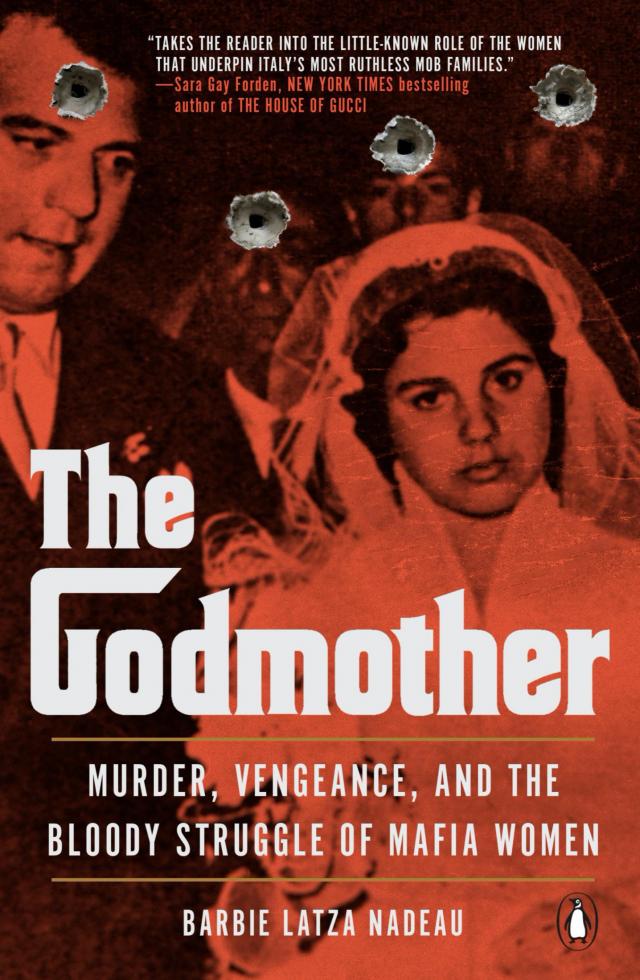
Cover photograph: Bettmann / Getty Images
Designed by Sabrina Bowers, adapted for ebook by Estelle Malmed
pid_prh_6.0_140847917_c0_r0
Dedicated to my friend and mentor Chris Dickey, who I wish had lived long enough to read this book he inspired me to write.
Contents
1. Pupetta’s Kitchen
2. Crime School / Naples’ Notorious Prison
3. The Strong and the Sweet
4. Sex and Honor
5. ’Til Death Do Us Part
6. Toxic Parents
7. Drugs, Guns, and Vats of Acid
8. The Sin of Confession
9. Dying to Escape
10. A Few Good Women
Acknowledgments
Reporting Notes
Notes
1
Pupetta’s Kitchen
Pupetta claims not to remember pelting Big Tony with what police claim was twenty-nine bullets, insisting that it was just “one or two shots” from the back of the car that she delivered out of fear.
CASTELLAMMARE DI STABIA, Italy—It was a warm summer afternoon and Assunta “Pupetta” Maresca was tapping her manicured jet-black fingernails on a white marble tabletop that was stained with what looked like red wine or blood. We were sitting in the kitchen of her fluorescent-lit apartment in a coastal town of questionable character south of Naples where she was born into a crime family in 1935, and where she died December 29, 2021. The heavy wooden shutters were closed to keep out the heat, and a ceiling lamp swayed in the breeze created by a flimsy plastic fan perched on the counter.
It was months before the COVID pandemic changed the world, and Pupetta’s biggest health fear was suffering a stroke, despite doing nothing to prevent it. A pack of menthol cigarettes in a gilded case sat neatly next to an ornate ashtray and matching lighter in the center of the table. A bedazzled vape pen on what looked like a rosary hung on her chest like a necklace. She puffed on it between cigarettes and blew smoke directly into my face. More than once she told me she shouldn’t smoke. “These will kill me,” she said between puffs. “I should stop.”
The crepey skin on the backs of her small hands was too smooth for a woman in her eighties and looked as if it had been surgically stretched around her swollen joints. Her age spots had been bleached and looked like fading bruises, as if someone had clutched her hand too hard. She briefly put her cigarette in the ashtray and picked up a strand of her crimson-dyed hair that had fallen onto the table and stretched it between her fingers, lifting her pinkies ever so slightly before brushing it off to the tile floor for her maid to eventually sweep up.
It was impossible to look at Pupetta’s hands without imagining them wrapped around the silver Smith & Wesson .38 pistol she once fired in the defining moment of her life. More than sixty years before I sat with her, she used that gun to take down the man who ordered the fatal hit on her husband. Surely her husband’s rival was dead after her first blasts knocked him to the ground. But she still grabbed her thirteen-year-old brother Ciro’s revolver and sent another round of bullets—twenty-nine in all—in the direction of the bleeding corpse. The killing took place outside a busy coffee bar in Naples in broad daylight. She was eighteen years old and six months pregnant at the time.
Pupetta claimed she still kept the pistol in the nightstand next to her bed. I once asked her if I could see it, but she insisted that she would only take it out to use it. I never asked again. Of the many things I grew to admire most about the woman nicknamed Lady Camorra was her dry sense of humor. She was a cunning liar and a cold-blooded killer, but if you could look beyond that, she was genuinely delightful.
The first time I sat in Pupetta’s kitchen—after stalking her at her usual coffee bar and vegetable market until she agreed to grant an interview without charging me for it—she offered me bitter espresso served in a chipped demitasse cup, clearly saving the fine china for better company. I stared into the dark, steaming liquid, hesitant to take a sip out of concern that she could have slipped something into it. In a brief bout of egotism, I envisioned that perhaps I could be a last-hurrah killing. No one even knew where I was, and for someone with her connections to the underworld it would be reasonably easy to get rid of my body. Covering crime and murder and death—essentially trafficking in tragedy—for the many years I’ve been in Italy has jaded my perception of my own mortality. Over the years, I have evolved from thinking that nothing bad will ever happen to me to expecting it. I see the worst first, as I am often reminded by friends and family. I am generally a voice of doom.
In my defense, the paranoia was bolstered by the fact that Pupetta was not drinking any of the espresso herself. Too much caffeine in the afternoon made her nervous, she answered when I asked if she was joining me. I drank it in one gulp, as is the custom in Italy. She watched me closely, enjoying my fear—or at least that’s how I choose to remember it. Every time I saw her after that, she also drank coffee with me no matter what time of day.
As we spoke that first afternoon, a radio station played Neapolitan folk songs peppered with advertisements for private home-security services. When the news bulletin came on, she touched her ear to signal me to be quiet so she could listen to see if anyone she knows had been caught up in something unseemly.
Pupetta was wearing a dark purple tank top that pushed her enormous soft breasts together to create wrinkly, freckled cleavage over which the vape pen perilously dangled, at times threatening to fall inside. She was sitting on a squeaky wooden chair on a faded Thulian pink floral pillow that made her seem much taller than she is. Every time she fidgeted, the chair let out a tired groan, prompting the old French bulldog sleeping at her feet to growl in his sleep.
Everything that was not covered in plastic in Pupetta’s adjacent living room was instead draped with crocheted lace doilies. Pretty hand-painted blue-and-yellow plates from Sicily hung on the walls and elegantly framed pictures of her twins at various stages of their lives were lined up on a polished chest of drawers against the dining room wall. There were no pictures of her first son, Pasqualino, to whom she gave birth in prison while serving a sentence for murder and who mysteriously disappeared when he was eighteen years old.
Outside the window, the beaches of Pupetta’s hometown are littered with fuel canisters and discarded fishing gear washed in from the polluted Mediterranean Sea. Signs warn swimmers to avoid the water, but there are at least half a dozen elderly men digging for clams out there on any day of the year. In the winter, they we
Castellammare di Stabia sprung from those ashes and is synonymous with moral decay—so much so that in 2015 a local priest performed an exorcism by helicopter, symbolically spraying out gallons of holy water high above the 65,000 inhabitants to make sure he didn’t miss a single sinful soul. Crime didn’t stop, though the aerial blessing did miraculously make the town’s calcium-clogged fountains spring back to life, or so the legend goes. The Neapolitan Camorra’s criminal roots run too deep here for a clerical cleansing, and Pupetta is emblematic of all that is wrong about this crime-ridden backwater.
The first time I stayed in Castellammare, I rented a rooftop Airbnb that gave me clear views of the city, sea, and menacing volcano. The woman who let it to me wanted to be clear that I understood that I wasn’t on the Amalfi Coast, the tony luxury resort area just across the Sorrentine Peninsula where organized crime is relegated to the background, not as blatantly out front as it is in Castellammare. Though the town is no more than half an hour from splendorous Sorrento itself, Castellammare is simply another world—a sinister one where criminality has permeated every corner of society. When I explained that I was a journalist chasing a mafia-related story, she seemed relieved. She wouldn’t have to apologize for the rampant delinquency of the city that was easily witnessed from her terrace. At any given time of the day or night, people were huddled together on the streets below, trading in any manner of contraband. During the many times I visited, I saw little bags of drugs being handed over for cash and from the rooftop terrace a large box that could have easily held a substantial weapon. The nervous seller seemed ready to get rid of it and the buyer ran immediately to a waiting BMW with dark windows and sped away.
Every time I left the apartment, I felt like I was being watched. The streets of Castellammare are lined with normal-seeming shops, but on close observation they seemed like fronts for other businesses. No one ever appeared to be carrying a bag as they walked out, not even as they were still standing at the cash register. People gave strange nods to each other, almost as if there were lookouts posted on corners. Expensive cars were as prominent as rusted Fiats, and the harbor was lined with extravagant yachts even though the average reported income in this town hovers slightly above the poverty line. I visited many times, but could never quite figure out the heart and soul of the city. Perhaps because it didn’t have one. The pet shops sell small mice to feed pythons and other exotic reptiles that are popular among residents for reasons that don’t seem entirely clear. The lingerie shops have whole sections of red apparel, samples of which find their way into window displays even when it’s not Valentine’s Day—an exhibition that long perplexed me.
It is hard to explain why the mafia is still so powerful in this country, a wealthy nation that often trips over its bureaucracy and gets tangled up in its laborious judicial system. The mafia exists not in spite of this country, but so many of the country’s failings have been created by the enduring existence of organized crime. Like other terrorist organizations, including many who use Italy’s organized crime syndicates to enter Europe illegally or rely on them for fake documents or weapons, the mafia derives its strength from a combination of fear and complacency. It is so often said that the mafia is part of Italy’s DNA, and while anti-mafia forces have done a great deal to fight the three main groups—the Cosa Nostra (Our Thing) in Sicily, the ’Ndrangheta in Calabria, and the Neapolitan Camorra in Campania—historically speaking, the only real Mafia is the Sicilian Cosa Nostra (the historical American Mafia families are all tied to Sicily, though the Camorra and ’Ndrangheta have more recently spread across Europe and the Americas, too).
Despite the Cosa Nostra being the original and most well-known of the major Italian organizations, the Italian criminal-justice system refers to crimes committed by other known groups as “mafia-related” under its law Article 41-bis, which was developed specifically to aid Italian law enforcement in the fight against organized crime. In 2018, the term Mafia Capitale, or Capital Mafia, was christened, used to describe the local mafia-style group in Rome. Italy also recognizes several Nigerian mafia-style groups and have charged their members with “mafia” crimes.
To truly understand Italy’s organized-crime culture—if that is possible, given its secrecy and the fact that what we know about these organizations comes mostly from those who betray them and have an ax to grind with them—you need to understand how the culture has been allowed to prosper here for so long. Anti-mafia prosecutor Alessandra Cerreti is the only person who has ever explained the continuation of the mafia’s influence on this country to me in a way that truly made sense.
The mafia—in the most general meaning of the term, encompassing all of the organized crime groups in Italy—is what she calls a “parallel state” and remains to this day “politically protected” because of the success these groups have had infiltrating every layer of Italian life. They have allies and fellow mobsters in every sector, from the highest levels of government on down to the city-park gardeners who prove useful when it comes to finding places to hide drugs or relay overheard conversations. These men and women don’t act like petty criminals who might nab a wallet from a tourist on the Amalfi Coast or steal gas in some backwater in Sicily; they are indistinguishable from law-abiding citizens, often working as civil servants who should have been—and maybe were—vetted. Full city councils have been dissolved to purge local government of deep infiltrations. But mafiosi normally act more like spies than infiltrators, relaying information that could be useful to exploit, or fixing contracts and bids to make sure they go to mob-tied companies.
Almost like schools of fish, the criminal groups are large but agile enough to escape or hunt depending on the circumstances. Their strength is not just in numbers, but in the fact that they are more represented in the top echelons of power than any force trying to defeat them. “It is not surreal,” Cerreti says. “They operate in the real world.”
And that real world is everywhere in Italy. Pupetta’s father was not a top boss, but a notable criminal gang leader whose territory included Castellammare di Stabia and the neighboring hamlets that dot the winding roads between the tourist haven of Sorrento, overlooking the stunning Amalfi Coast to the south and the gritty backstreets of Naples to the north. He was a known and respected criminal among his peers, specializing in contraband cigarettes, which was a lucrative enterprise in postwar Italy.
The Maresca family clansmen were known as Lampetielli, or lightning strikes, named so for the deadly efficiency of their signature switchblades, used in equal parts to threaten and kill.[1] As happens to be the case, Pupetta’s first trouble with the law came in primary school, when she knifed the daughter of another local criminal. The charges were dropped when the victim suddenly refused to testify. When I asked her about it, she called the whole incident “blown up” and merely a childhood spat, despite the fact that she knew how to wield a weapon before she had her first menstrual period.
Pupetta’s four brothers tried to protect her honor and keep her away from the untoward advances of suitors who approached with something other than honorable intentions. It proved a daunting task. From a very young age, Pupetta knew how to exploit her beauty for whatever she wanted, and she continued to try to do so long after it had faded.
At its rawest, most nubile, she used her attractiveness, confirmed by a local pageant title, to lure emerging Camorra boss Pasquale “Pasqualone” Simonetti. Pasqualone ’e Nola—Big Pasquale as everyone called him—was a mountain of a man with wiry black hair and a round chin that melted into his thick stubbled neck. At more than six feet tall, he towered over his “little doll,” from which the nickname Pupetta derives. Italians often use the suffix -one to describe things that are larger than normal. Christmas dinner is not a cena but a cenone, and a big kiss is not a bacio but a bacione. Pasqualone fit the customary use perfectly.