

Facing the Enemy, page 1


Text copyright © 2023 by Barbara Krasner
All rights reserved. Copying or digitizing this book for storage, display, or distribution in any other medium is strictly prohibited.
For information about permission to reproduce selections from this book, please contact permissions@astrapublishinghouse.com.
Library of Congress Cataloging-in-Publication Data
Names: Krasner, Barbara, author.
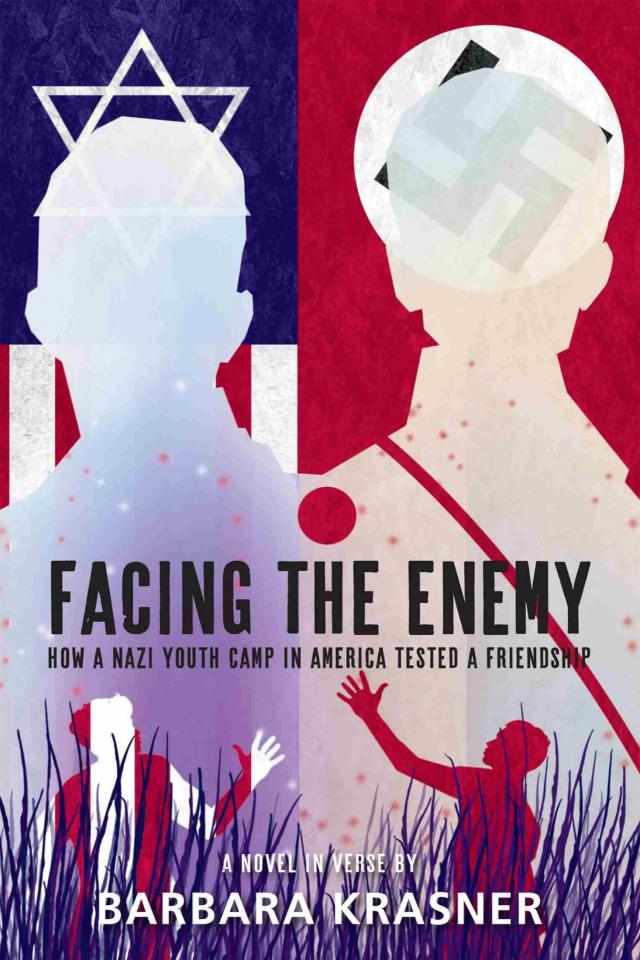
Title: Facing the enemy : how a Nazi youth camp in america tested a friendship / Barbara Krasner.
Description: First edition. | New York : Calkins Creek, 2023. | Includes bibliographical references. | Summary: In 1930s Newark, NJ, best friends Tommy and Benny are torn apart when Tommy attends a Nazi youth camp for German Americans, and Benjy forms an anti-Nazi vigilante group.
Identifiers: LCCN 2022060063 (print) | LCCN 2022060064 (ebook) | ISBN 9781662680250 (hardcover) | ISBN 9781662680267 (ebk)
Subjects: CYAC: Novels in verse. | Best friends--Fiction. | Friendship--Fiction. | Radicalism--Fiction. | Toleration--Fiction. | German Americans--Fiction. | Jews--United States--Fiction. | LCGFT: Novels in verse.
Classification: LCC PZ7.5.K74 Fac 2023 (print) | LCC PZ7.5.K74 (ebook) | DDC [Fic]--dc23
LC record available at https://lccn.loc.gov/2022060063
LC ebook record available at https://lccn.loc.gov/2022060064
Calkins Creek
An imprint of Astra Books for Young Readers, a division of Astra Publishing House
astrapublishinghouse.com
ISBN: 978-1-6626-8025-0 (hc)
ISBN: 978-1-6626-8026-7 (eBook)
Library of Congress Control Number: 2022060063
First edition
Design by Barbara Grzeslo
The text is set in Frutiger LT Std 45 Light.
The titles are set in Mader Regular.
This is an ebook conversion from a print edition. Page numbers in the text reference page numbers in the print version. For the best reading experience, please reference our print edition to view the design as intended.
For my Krasner ancestors who settled in Newark, New Jersey, from Russia —BK
CONTENTS
Part I: Fanfare, 1937
Part II: Push and Pull, 1938–1939
Part III: The Door Closes, 1940–1941
Epilogue
Author’s Note
Acknowledgments
Glossary
Timeline of Events
Source Notes
Bibliography
For Further Reading/Viewing
Picture Credits
PART I:
FANFARE, 1937
INTRODUCING BENJY PUTERMAN
It’s late spring, almost summer, 1937. Just four months and I can officially say I’m a freshman at Weequahic High. Rumors of a Nazi camp for kids opening in Sussex County somewhere are littering Newark streets like candy wrappers. My pop’s a member of the Newark Minutemen, he and a bunch of other former prizefighters—they’ve been going around to meetings of these so-called Nazis in Newark, Irvington, and other parts of New Jersey and busting them up. The meetings and the people, I guess. Sometimes help comes from (shh!) gangsters like Longie Zwillman. But Longie’s one of us, and he’s been good to the Jews of Weequahic.
President Roosevelt is gearing up for a second term. His New Deal has been successful, from what I can see from my perch. He’ll get us out of the Depression entirely. Hard to believe he took office just a couple of months after Herr Hitler (I’ve been taking German) took over Germany as Führer (leader) of the Third Reich (empire). He’s gunning for an empire to last a thousand years. He’s pals with Italy’s dictator, Benito Mussolini. I think they’re both nuts. At least Hitler and the Soviet Union’s dictator, Josef Stalin, are sworn enemies. The papers say Hitler insists there will not be war, that no country wants war, and no country can afford war. I don’t believe a word he says. After all, things are not going well for the Jews in Germany. A couple of years ago, Hitler put a decree in place to strip Jews of German citizenship. He dictated who Jews could marry and who they couldn’t. They’ve lost their jobs. They’re outcasts. Can’t somebody do something about Herr Hitler?
Here in New Jersey and I guess elsewhere in the country is a new group who call themselves the German-American Bund. It’s a club, a league. Pop tells me they used to be called the Friends of New Germany until a congressman from New York, Sam Dickstein, shut them down. Rumor has it the Bund is behind this Nazi camp in New Jersey.
I know exactly how this summer will go. My best pal, Tommy Anspach, and I will sip sodas at Sol’s while reading comics, play ball at Weequahic Park, and catch lightning bugs under the streetlights with mason jars. We’ll celebrate our summer birthday (we’ll both be fourteen on August 27!) in sleeping bags under the stars in my backyard. It’ll be great—our last hurrah before we buckle down to a year of classes and homework in the number one high school in the state!
EXPECTATIONS
THOMAS ANSPACH
April 1937
Father no longer allows me to call him Vati.
Father no longer allows me to read comic books.
Father no longer allows me to be me.
Sometimes he calls me Rudi, the older brother
I didn’t know, the one who died from scarlet fever
in Germany when paper money was so worthless
Mother used it as fuel to keep everyone warm.
But it didn’t help Rudi or Germany,
and Mother and Father came to America
and had me.
I will never be their beloved Rudi.
I’m an American of German heritage.
Father sends me to learn German
in a special school on Saturdays.
He tells me I’m going to a special camp
to embrace my German heritage
as if I were growing up
in Germany itself. I will go to this camp.
I will prove to Father that Thomas
can be the son Rudi promised he would be.
FATHER TAKES ME TO A GERMAN-AMERICAN BUND MEETING
THOMAS
The head of the German-American league
stands on a platform in a belted shirt,
military-like. He speaks slowly, his eyes
peering, searing, leering
into mine. He says:
“To be and remain worthy of our Germanic blood,
our German Fatherland, and ancestral German blood
That means he wants us Americans
to remember we belong to Germany.
“Our German brothers and sisters fight for their existence, their honor
to cultivate our German language, customs, and ideals from shared blood
That means we all have our German heritage
in common. We need to come together.
“To stand up and be proud of all this,
to always remember in unity is strength, our blood.”
That means there’s strength
if we bond together.
Before I realize I’m doing it,
my arm is raised in salute and my voice
booms, Sieg Heil.
I NEVER KNEW
THOMAS
I never knew so many German-Americans lived
outside Newark. The people in this hall
have come from Irvington, that’s right outside
Newark. But Haledon is near Paterson
and Paramus not far from there, Garfield too.
It is the first time I hear “Camp Nordland.”
A new camp for kids like me with German parents
out in the New Jersey countryside, away
from the city. A place to bridge the old
and new, Germany with America.
As we stroll out of the meeting, Father
says, “Ru—Thomas, we’re sending you
to Camp Nordland.”
At least this time he only spoke
the first syllable of my dead
brother’s name.
READ ALL ABOUT IT
THOMAS
Father thrusts his
German-American Bund
newspaper into my face.
“See here, this man
will be your camp director.”
August Klapprott.
He looks
just like Fritz Kuhn, leader
of the Bund, holding
on to his leather holster across
his chest, fingers anchored
on his belt. Camp Nordland
opens on July 18. Just one
of many Bund camps across
the country to connect
American kids with our German
heritage. I wonder if that means
we’ll get to drink the beer
that Father loves so much.
I WANT TO TELL BENJY, BUT FATHER STOPS ME
THOMAS
“Where do you think you’re going?”
Father asks.
“To tell Benjy all about Camp Nordland.”
(My hand is on the doorknob.)
“No, this you must not do.”
“Why not?”
(I open the door.)
“The Putermans are Jewish.”
“I know.”
“You can’t be friends with
Benjy anymore.”
(He stands and closes the door.)
“We don’t concern ourselves
with Jewish people. You’ll find
new friends, German friends,< br />
at Nordland. Boys like yourself.”
“But, Benjy and I have been friends forever.
We like to do the same things.”
“Not anymore.”
BECAUSE
THOMAS
May 1937
Because you give me no choice
Because I like the special attention
Because I want to know more about where you came from
Father, I’ll go to Nordland.
Because your eyes light up with pride
Because you write my name in shirts, shorts, and socks
Because I know you really want a cabin in the woods away from the city
Mother, I’ll go to Nordland.
Because I’m now your only child
Because I’m all you have
Because I never want to disappoint you
Dear parents, Camp Nordland, here I come.
MALE CALL
THOMAS
“A letter for you,” Mother says.
“It’s from your new section leader
at Camp Nordland.” It’s addressed
to Thomas Anspach, not Tommy.
I open it. It’s completely in German.
“I told you that you’ll have
to speak German all the time
at camp,” she says.
I roll my eyes. Slipped in
with the letter are the lyrics
to the German national anthem:
Deutschland, Deutschland über alles,
Germany, Germany above all,
über alles in der Welt,
above all else in the world,
wenn es stets zu Schutz and Trutze
when always for protection and defense,
brüderlich zusammen hält,
brothers stand together.
I am still singing the song to myself
as I fall asleep.
LET ME AT ’EM
BENJY
“Let me at ’em,” Pop says
at the dinner table. That’s what Mr. Nat Arno
said, Pop says, when they heard about
a Nazi club meeting in Irvington. Pop
is one of Mr. Arno’s Minutemen. Just
the sound of that makes Pop stand up
straight, like he’s a colonist fighting
against the British.
When Mr. Arno says, “Let me at ’em,”
he means business, Pop says. Mr. Arno
started boxing at fourteen,
his first match and first win at fifteen. His pop
didn’t want him fighting so Mr. Arno
hitchhiked to Florida. Won a ton
of fights. Now, a bunch of years later,
he’s back in Newark.
Jeez, even Newark’s mayor, Meyer Ellenstein,
was a Jewish boxer, too.
So why the Minutemen? Why not the Boxers?
Pop’s proud of his fights. He won’t let
Mom touch the gold satin shorts
he wore in his last match. He gave up
boxing when I was born. But
he hasn’t given up fighting—he just
doesn’t use a ring anymore.
I’m going to box someday, too, just
like Benny Leonard, Newark’s
most famous Jewish boxer.
I check my meager muscles
in the bathroom mirror. I have
a long way to go for anyone
to believe me when I say,
“Let me at ’em.”
WHAT TOMMY WON’T BE DOING
BENJY
July 1, 1937
“I won’t be playing ball with you
at Weequahic Park,” Tommy says.
“I won’t be hanging out after dinner with you
or having a Coke,” Tommy says.
“I won’t be opening up the fire hydrants
to cool us off,” Tommy says.
“My parents have signed me up for camp
in the country. A lake, trees, fun,” Tommy says.
“I’ll talk to my parents so I can come, too!” I say.
“You can’t come with me,” Tommy says.
“No Jews allowed.” He turns toward his house.
“And I’m Thomas now.”
TOMMY DOESN’T NEED TO LEAVE NEWARK
BENJY
If Tommy wants to escape the city,
he could go, like we always do,
to Weequahic Park, throw a few balls around.
If Tommy wants to breathe fresh air
and the scent of grass, there’s always my backyard,
narrow but deep.
Or the grassy median that divides Goldsmith Avenue
where we played hide-and-seek in the shrubs.
We’ve got a few trees, too, lining the curb,
next to the garbage cans.
It may not be Camp Nordland,
but it’s home and it’s ours.
A LESSON IN US CITIZENSHIP FROM MY FATHER
THOMAS
Citizenship noun: a way to cover up one’s past in a foreign country. To be legally recognized as a new subject in a new country hides any evidence of wrongdoing or continued allegiance to the old country (in this case, Germany).
Naturalization noun: cements a person’s loyalty to the new country, no matter how he really feels about the old country (in this case, Germany).
Allegiance noun: only to one’s self.
An added bonus:
Remember that Fritz Kuhn is an intimate friend of Adolf Hitler.
A NEW DAY
THOMAS
July 18, 1937
Mother and Father squeeze our sedan
into one of the last parking spots. My parents
haven’t stopped smiling since we left Newark.
We snake our way through the throng
to the Bund Hall. A path has been
made for the opening ceremony parade.
Girls in blue skirts and white blouses
strut down the center lane, faces
and posture disciplined, purposed.
Boys in brown shirts and ties
march up a grassy slope
playing tubas, trumpets, drums.
I am one of you, I want to shout.
I am selected among German-Americans
to attend Camp Nordland.
The swastika and eagle of Germany’s Third Reich
flap alongside the Stars and Stripes,
although I’ve never before seen
the American flag hung vertically.
Director Klapprott takes his position
on the raised platform.
that is decorated with green garlands.
A radio speaker stands ready
to broadcast his words.
We begin a new day. I’m not one of them yet.
Next year, I’ll be in the parade.
I am one of the chosen.
I FOR YOU AND YOU FOR ME
THOMAS
July 18, 1937
Mother and Father stand at attention
while Fritz Kuhn takes the podium,
his face red-hot with heat and purpose.
“We designed Camp Nordland to teach
the spirit of New Germany on this small
German piece of soil in America.”
I’ve never been to Germany, not yet,
but Leader Kuhn says
the fields and forests
of Andover are just like Germany.
We’re all brothers,
joined in song and racial ideals,
Leader Kuhn says, without Jews.
Without Benjy and the Putermans?
But before I can even think
about that, Father pokes me
to pay attention.
“I for you and you for me!”
Leader Kuhn says like a pledge, like
the Three Musketeers, “All
for one and one for all!”
It seems like he’s talking only
to me. Like he wants only me
to hear his message. Like
I’m the only one who can
achieve his mission. You bridge
the gap, his face tells me,
between America and Germany.
His look is so intense I almost
take Father’s hand.
Almost.
HOMAGE
THOMAS
This is a pageant
unlike any I’ve seen
before. A New Jersey
senator is here. So is the leader


