

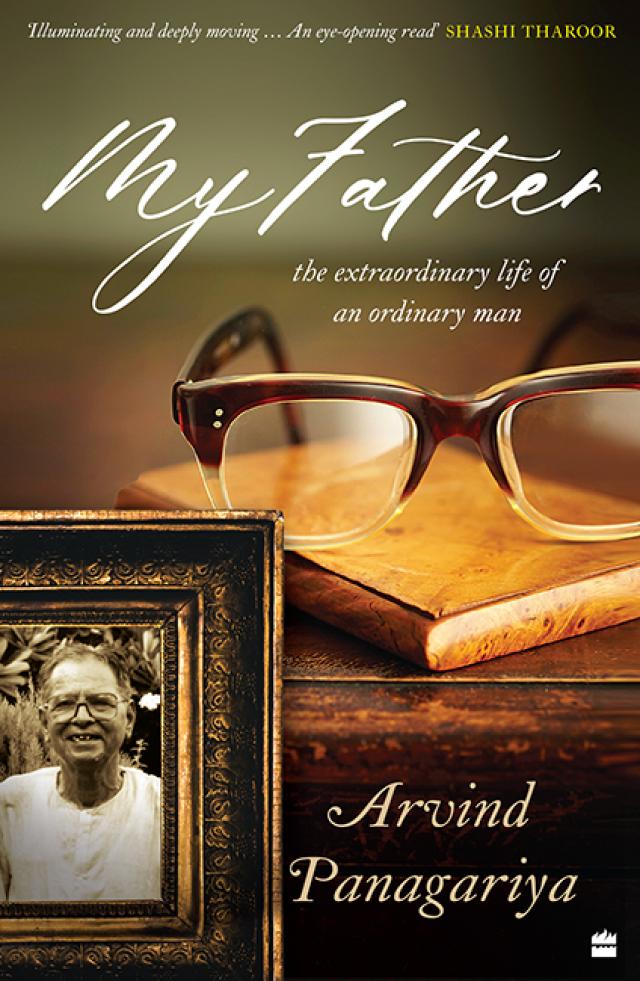
My Father, page 1


To
Dhapubai
The grand grandmother who made it all possible for us
Contents
Preface
1. A Grand Grandmother
2. My Father – On His Own at Fourteen
3. Yearning to be Part of the Freedom Movement
4. The Fall of the Ancient Régime of Mewar
5. In the Service of the People of Rajasthan
6. Building Post-Independence India
7. New Horizons: An Author and a Historian
8. Reflections on a Father Extraordinaire
9. In Retrospect
Footnotes
Index
About the Book
About the Author
Copyright
Preface
AS THE TITLE OF the book makes amply clear, this is a biography of my father, Baloo Lal Panagariya. The question many readers would ask is why they should be interested in it. I can imagine that at least some readers would have an interest in my autobiography, or a memoir by me covering the period of my close association with Prime Minister Narendra Modi. But what could possibly be the case for a biography of my father, who retired as a deputy secretary in the Government of Rajasthan in 1976 and was barely known outside his own state? I believe I owe the reader an answer to this question at the outset.
First and foremost, the generation born during the 1920s, to which my father belonged, was a special one. It straddled pre- and post-Independence India in a way like no other. It was too young to be at the forefront of the freedom movement, and yet old enough to be inspired by its foremost leader, Mahatma Gandhi, and to join him in his endeavours. Importantly, it was also a generation that came of age just as India was becoming independent and was thus positioned just right to help build the country post Independence. Born in 1921, my father was twenty-six years old at the time of Independence. Therefore, he witnessed Mahatma Gandhi lead India to independence from the British during the formative years of his life and still had many years ahead of him to help build a new nation. Did he rise to the occasion? I will explore this in my book.
India is a vast country; a few well-known national political figures and handful of distinguished members of the civil service in the central government alone could not have built it. Ultimately, the country was the sum of its constituent states, and each state had to be shaped and built. What role did ordinary citizens like my father play in building their states? In many states, the local political leadership was not fully equipped to govern them. At the same time, the number of officers helping run the state governments was small. Those facts empowered even junior officers to exert influence on outcomes. If they were able and motivated to promote the public interest, as my father was, they could influence outcomes in ways that could contribute to the welfare of many generations to come.
The lives of ordinary citizens can also provide a window to the social, cultural and political ethos of their times. What was life like for ordinary citizens in rural India of the 1920s and 1930s? What opportunities existed for them? How did they relate to the national movement, in which Mahatma Gandhi had tried to involve every Indian in one way or the other?
Answers to these questions become particularly interesting when probed through the life of someone who came from a state like Rajasthan, as Rajasthan was formed by merging a large number of independent princely states that local hereditary kings, rather than the British government, ruled. The British government had maintained control over these states through an agent of the governor general, but left their day-to-day administration to the local kings.
The cause of misery of the people in the princely states was often poor governance and exploitation by the local kings. But both Mahatma Gandhi and the Indian National Congress were reluctant to turn the freedom movement into a movement against the local kings. As such, until as late as 1938, they had an explicit policy of limiting the freedom movement to the eleven provinces that the British ruled directly. This fact made it difficult for young men like my father, who grew up in a princely state, to participate actively in the freedom movement. Even in 1938, when the Congress changed its policy, it forbade local movements in the princely states from using its name. Instead, it encouraged each state to form its own Praja Mandal (public association) under whose auspices it could conduct its movement against local misrule.
Apart from these considerations, my father’s life would likely interest and, indeed, inspire many young readers, simply because of its unique trajectory. He was born in a remote village in Rajasthan, in a family so poor that it could not scrape together two square meals a day. The village did not have even a primary school until after he was twenty-one years old. He lost his father at the age of five. At fourteen, he lost his mother. What are the odds that a young man with this history would manage to land up in Jaipur at twenty-five years to serve on the editorial board of Lokvani, the only newspaper in the city, so that he could fulfil his desire to contribute to the freedom movement as it approached its logical conclusion? And who could have predicted that two of his sons would become so successful that the President of India would honour them with Padma awards, one with the Padma Shri and the other with the Padma Bhushan? Yet, that in a nutshell is my father’s story.
I confess that I began this work as my own autobiography. I had known of the extreme hardships my father had faced during his early life from a short autobiography that he had written for circulation among family members. My plan was to include this family background in my autobiography. Therefore, I began with a chapter on my grandmother, whom I had never seen but who had greatly fascinated me from the bit I read about her in Father’s autobiography. After completing the chapter on her, I began the second chapter, which was on my father. I had expected to summarize a few key facts of his life in twenty or twenty-five pages and then turn to my own. But as I progressed, this second chapter kept getting longer and longer, until I realized that the document was turning into my father’s biography. At that point, I also realized that the story of my father’s life was infinitely more interesting than mine. The result of that realization is this volume in the reader’s hands.
Much of the source material for this biography comes from my father’s unpublished autobiography. Having retired at the relatively young age of fifty-five, he had revived his interest in writing from the time he had helped edit Lokvani in Jaipur. He wrote several books, among which was the definitive work on the freedom movement in Rajasthan titled Rajasthan Main Swatantrata Sangram (The Freedom Movement in Rajasthan). The autobiography was among the last two books that remained unpublished. Instead, Father got his sister’s son, who owned a printing press, to print one hundred copies of the autobiography and shared them with the extended family. Therefore, while this biography has my words, the story is as told by my father.
Writing this volume has been a family enterprise. Apart from the members of my immediate family, wife Amita and sons Ananth Hirsh and Ajay, my brothers, Ravi and Ashok, have contributed to it, directly or indirectly. Ravi read the entire manuscript and helped make several factual corrections. My bhabhi, Ashok’s wife, Meena, enthusiastically collected many of the photographs. My friend Pravin Krishna, professor of international economics and business at Johns Hopkins University, read the penultimate draft in its entirety and provided some extremely useful suggestions. Given that this is the first time I have undertaken a project of this nature, his encouragement at a critical time proved extremely valuable. Petal Dhillon of the Ministry of Railways in the Government of India and Rajeev Mantri, managing director, Navam Capital also read an earlier version of the manuscript and provided extremely helpful comments. For the final extensive edits to the manuscript, I am deeply indebted to Kripa Raman and Amrita Mukerji, my editors at HarperCollins. However, none of those who have helped in the writing of this book is to be blamed for any indiscretions or errors in it, which remain solely my personal responsibility.
1
A Grand Grandmother
IF A HIGHER POWER were to grant me the wish to spend a few hours with a person of my choosing from amongst the living and dead, without a shred of doubt that person would be my paternal grandmother. Dhapubai, as she was known, lived no more than thirty-five years. She was long gone before any of my siblings or I was born. The family has no photograph, painting or sketch of her – they were simply too poor to afford such a luxury during her lifetime. But going by the few facts that I gathered from the short autobiography my father wrote, she must have been an amazing woman. I can say without hesitation that she is the fountainhead of all the good things that eventually happened to my father, mother, their children and their children’s children. No doubt, my father’s perseverance, diligence and foresight were critical to the good lives we, his children, could have, but none of that would have been possible had Dhapubai not made the supreme sacrifice of her life to nurture and educate him, against all odds, during the first fourteen years of his life.
Before I tell that story, however, let me describe in brief some early history of the family. It is necessary to go into this to give the reader a sense of how humble the origins of the family are and how ordinary its status had been throughout its known history. The only modest prosperity that the family experienced – and that too, only by the prevailing standards of those times in rural India – was during the lives of my father’s great-grandfather and grandfather. By the time my father was born, its fortunes had sunk deep once again to the point of abject poverty. My father had had to rebuild life from scratch, aided only by his elementary-school education, for which his mother could pave the way, literally at the cost of her own life.
We belong to the Oswal community, whose origin traces back to the fifth century BCE in the small town of Osian near Jodhpur, in the Marwar region of Rajasthan. Legend has it that Jain Acharya Ratna Prabha Suri came to Osian in 457 BCE and successfully persuaded its king and people to give up meat and alcohol and embrace Jainism. These converts came to be known as Oswals. Starting some time in the tenth century CE, many of the Oswal families migrated to Sindh and to various parts of Rajasthan and Gujarat. If legend is to be believed, my ancestors came from one of these families.
According to the story passed on to my father by his elders, who in turn had got it from their elders, our ancestors first migrated to Panagarh, a village to the east of Osian in Nagaur district of Rajasthan. Unfortunately, the truth of this story cannot be verified. A source of some scepticism is that though a village by the name of Panagarh exists near Chittor in the Mewar region, no such village can be found on any of the maps in the entire Marwar region, let alone Nagaur district.
Be that as it may, sometime in the sixteenth century, my ancestors are said to have left drought-prone Panagarh and moved further east and south, into Mewar. They first went to Taswaria, then to Sindri, on to Sanganer, and finally settled in Suwana. All four of these villages are in Bhilwara district of Rajasthan. The last three are within a three-to-four-mile radius of the town of Bhilwara. All four villages exist today and can be found on maps readily available on the Internet. All appear on the rosters of the 2011 Census of India as well.
Once out of Panagarh, the family came to be known as Panagariya. Nangashah, the first ancestor known by name, initially lived in Sindri. All we know about him is that he was a devotee of Balaji (Hanuman) of Sindri, whose idol, in the form of a simple rock, stood on a raised but open platform made of solid stone until about forty years ago. Subsequently, the platform has been converted into a full-fledged temple, with four walls around the idol and a dome at the top. Even the idol has been given a makeover and now looks like a traditional idol of Hanuman. Nangashah’s devotion to Balaji has been passed on from generation to generation and remains intact among nearly all family members up to the present day. It may have been greatly strengthened by an episode relating to the birth and survival of my father, which I will narrate later.
Sometime in the second half of the eighteenth century, Nangashah migrated from Sindri to Sanganer, a town founded by the legendary warrior Rana Sanga in the sixteenth century. Nangashah had one son, but all we know about him is his name and that he died in 1810 CE, leaving behind one male child. The child, named Heeranand, had five male children, of whom two died before reaching adulthood. A family document suggests that Heeranand lived a life of poverty.
Heeranand died in 1850, after which two of his sons migrated to Suwana in search of a better life. Their families and mother accompanied them. One of these two sons was Budhsingh, my father’s great-grandfather. The third son remained in Sanganer, but his branch of the family ended with his great-grandson.
The great-grandson was a contemporary of my father’s, and I remember visiting his place in Sanganer with the family during my childhood. There is at least one other Panagariya family in Sanganer that did not descend from Nangashah. Three male children from this family are my contemporaries; two of them are now settled in Bhilwara and the third in Jaipur.
Suwana, where Budhsingh, his brother and their families arrived around 1850, is located approximately three miles east of Bhilwara, a major town that serves as the headquarters of the district of the same name. Being located on the banks of the River Kothari, the village had a high water table, at least until the late 1950s, which allowed the residents to reap two crops a year. But after the construction of the Meja dam in 1958, the river dried up. Since then, only the fields falling in the command area of the Meja dam are able to produce two crops a year.
Agriculture was the mainstay of the bulk of the population. The farmers here, especially from the Jat community, which is dominant in the village, were sturdy people and were prosperous. During the 1920s and 1930s, when my father was growing up, the village had a population of approximately 3,000. It did not have a school, however, until as late as 1942. That year, the Mewar government opened the first primary school, with a single teacher.
There was a well in the heart of the village. Residents took water out of it and carried it home in pitchers on their heads for their daily use. On the outskirts of the village, there was a good-sized pond where people had their baths and also brought their livestock for a drink of water. This pond almost never dried up. I remember passing by both the well and the pond on my numerous visits to the village during my childhood. In the old days, there also existed a giant banyan tree on the banks of the pond. Legend has it that it was more than 500 years old. Hundreds of traders, with their bullock carts hauling goods for transport between Bijolia and Bhilwara, broke their journey here to rest under the shade of the tree and escape the heat, especially during the early part of the afternoon when the sun was intense. Sadly, the tree fell prey to old age several decades ago and exists no more.
A short distance from the well stands the temple of Charbhuja, dedicated to Lord Vishnu. According to a stone inscription in the temple, the village had existed as early as the tenth century CE. During my father’s childhood, there was a place called ‘garh’, meaning ‘fort’, in the heart of the village. Having seen its ruins, he was convinced that it did exist at one time, although no fort stood there even at the time of my father’s birth. According to a story floating around during his childhood, there was a big treasure hidden under the debris of the fort. As a result, many adventurous people had dug up the place but found nothing. During the last seven or eight decades, several houses have come up on the land, and the memory of the ‘garh’ having been there has been entirely wiped out.
According to the Census 2011, Suwana has 977 houses, a population of 5,158 and a literacy rate of 72 per cent.1 During my father’s childhood, the vast majority of dwellings were kuchcha houses (fragile dwellings made of mud, wood and straw). But today, such houses are rare, with nearly all those dwellings having been replaced by pucca houses (houses made of sturdier materials, such as brick and cement). Internal pathways used to be mud roads even during my childhood. Pucca roads have come to replace them in recent years.
Budhsingh did well upon coming to Suwana. For the first time in its known history, the family experienced some measure of prosperity. According to family documents, Budhsingh engaged in the lucrative trade of opium and in the banking business, apart from agriculture. By 1870, he had accumulated enough wealth to construct a well-planned three-storeyed pucca house straight across from the Charbhuja temple.
This is a spacious house. The rooms on the ground floor served as storage space for opium, raw cotton and other commodities. There was an open yard in the middle, with an underground storage space for food grain, for emergencies such as drought. The family lived on the first floor, while the top floor was reserved for special guests, including newly-weds. The house is so strongly built that it has required no major repairs during its 150 years of existence. During many summer vacations, my mother would visit this family house, inevitably dragging us, the reluctant city children, with her.
The house is located centrally in the village. Two of the main pathways of the village meet directly outside the house in an L-shaped intersection. As you come out, there is a row of houses on the left, with the first house making a perpendicular with ours. As you cross the road and walk straight ahead, there are houses on both sides and the pathway leads you to the outer periphery of the village. Alternatively, if you turn right after coming out of the house and continue to walk, you pass the Charbhuja temple on your right and, after a short walk, arrive at the main well, where I would witness village residents drawing water and taking it home during my childhood. Our house and the Charbhuja temple are separated by another pathway, which makes a T-intersection with the one leading to the well. Therefore, ours is a corner house, and its windows on multiple sides allow ample flow of light as well as air.


