I Remain in Darkness, page 3


Wednesday 31
She’s been on my mind these last few days because it’s one year since “things started happening,” in other words since her health began to deteriorate.
I dreamt of our house in Cergy which has become public property (a common occurrence). A cleaning lady dressed in a raincoat (my mother’s double?) was walking through the garden. She appeared before me and I told her: “Stop being crazy!”
Fleeting memories: my mother’s cousin, a butcher near Rouen, who would say to her in jocular tones: “I’ll whip you under your blouse!”
N O V E M B E R
Sunday 4
As I walk through the door, the little old lady sharing my mother’s room is standing behind her bed, relieving herself onto the floor. Then she bursts into tears: “I’ve wet my panties.” In the dining room, one of the women is always singing, describing what she does in the third person singular: “She’s putting away the laundry la la la.” So much pale flesh.
Saturday 24
I feel like throttling my mother’s roommate because of her continual high-pitched whining. I had bought some slippers for my mother, explaining to the salesman that I needed several pairs for her to try on. His mother too is suffering from Alzheimer’s; he talks about it in a low voice, he is ashamed. Everyone is ashamed.
I shaved her face and clipped her fingernails. We tried on the slippers. She seemed terrified, afraid that I would get mad at her for not understanding my instructions, “push your toes in” and so on.
It was my mother’s illness, and later my affair with A, that reconciled me to humankind, flesh and pain.
One image haunts me: a big window wide open and a woman (myself) gazing out at the countryside. A springtime, sun-drenched landscape that is childhood. She is standing before a window giving onto childhood. The scene always reminds me of a painting by Dorothea Tanning—Birthday. It depicts a woman with naked breasts; behind her, a series of open doors stretch into infinity.
D E C E M B E R
Sunday 2
My mother has a sort of dark shadow over her face. Yes, it’s coming back to me now—it’s the same expression I saw on the men from the old people’s home where my schoolmates and I would go bawling carols a few days before Christmas. She won’t sit down but collapses sobbing into my arms.
She often speaks of the dead as though they were still with us but she never says a word about my father.
Sunday 9
There are clocks all over the place, in the hall, the dining room and the bedrooms; none of them gives the right time: six o’ clock instead of four o’ clock... Do they do it on purpose?
My mother’s color is fading. To grow old is to fade, to become transparent. Zacharie the cat, aged twelve, is colorless too. Today she imagines there are other people in the room: “Don’t worry, they’re only customers, they’ll be gone in a few minutes; half of them don’t even pay their bills.” Words from the past, words from our life.
The little old lady has gone, her shelves are empty. I dare not ask what has happened to her.
Christmas Day
When I received the Prix Renaudot, a literary award, she said to the nurses (they have just told me about it): “She always had the gift of the gab.” Then she added: “If her father knew, he’d tell everyone about it. He positively doted on her!”
I clipped her fingernails; she moaned, despite the fact that I always take great care not to hurt her. I can feel the sadistic streak in me, echoing her behavior toward me a long time ago. She still loathes me.
I remember she used to say: “I never asked anyone for anything in life.”
Monday 31
She remarked: “They haven’t said anything about discharging me. I wonder if I shall ever leave this place. Maybe I’ll stay here...” She paused and didn’t say, “until I die.” But that was the meaning. It breaks my heart. She is alive, she still has desires, plans for the future. All she wants is to live. I too need her to be alive.
At one point: “Claude never goes to see his mother. She doesn’t live far, though, she’s only at Sainte-Marie.” After a short pause, she reflects: “She must be out of her mind.” The equation fills me with guilt: Claude = me. Claude, Marie-Louise’s only son—both alcoholic, both dead.
This morning I read an article on motherhood and infertility in the newspaper Le Monde. The maternal instinct is tantamount to a death wish.
1 Village in the Val-d’Oise departement where my mother was sent to a private home.
2 A Sunday afternoon program in which kids are invited to the studio to imitate their favorite pop singer.
1 9 8 5
J A N U A R Y
Sunday 6
On New Year’s Day my mother and the other patients had been dressed in their former clothes, a skirt and blouse. They were given a glass of champagne. A parody of real life. Just imagine that morning. The nurses whipping out slips and dresses from drawers and clothing the weary bodies, shouting, “Happy New Year! Let’s celebrate! Come on, Granny!” All day long, they pretended to be having fun. The women seem to be vaguely waiting. There is nothing to wait for. Come evening, off go the skirt and blouse. Like when you’re a child, and you dress up in costume to go to a make-believe party. Here, it’s all in the past; there are no more real parties to look forward to.
She used to say: “You must fight to survive.” And also: “If you’re not strong, then you’ve got to be smart.” Everything in life was seen as a struggle. I speak of her in the past tense. Yet the woman who stands before me today is the same one I knew in the past. That’s what is so terrible.
Saturday 19
All her energy is channeled into eating. Passionately, voraciously.
In early January, I had that dream in which I am lying in a stream, caught between two currents, with long tapering plants floating beneath me. My loins are white; I have the impression that they are also my mother’s, it’s the same body. Shall I ever dare to analyze that?
“Who’s that singing?” one of the women asks time and again. Yet she probably hears her every day; only one of them sings, always the same one, singing away her life.
F E B R U A R Y
Friday 1
As I enter the department store Les Galeries Lafayette, I catch sight of a woman talking to herself, maybe asking me for something. I hurry past but glance at her, she glances back. Blue-gray eyes. Afterward, I think, that’s my mother, that’s the way she used to look at me before. Stirrings of guilt.
Saturday 2
It’s one year day for day since I met A and I find my mother tied to her armchair. “I thought you’d never come.” I untie her, we walk up and down the corridor, I tie her up again before leaving (we have no alternative, the nurses insist). Just like I used to strap my kids into the stroller.
One of her favorite sentences: “After all, you only live once” (to eat, to laugh, to buy things). And, to me: “You expect too much from life!”
Saturday 16
She was at the far end of the corridor, feeling the rail running along the wall, unaware of my presence. Later, in the bedroom, she searches through her neighbor’s belongings (yet another woman, the fourth since she was moved here). The bathroom floor is sticky with dried urine. Urine is everywhere, impossible to get rid of that sweet, cloying smell. Before leaving, I take her back to the dining room (I was about to write “refectory,” like at boarding-school). A nurse with a cheery smile hands her a sweet: “Go on, have one, it’ll give you something to do.” Sheer compassion.
Museum of Fine Arts, Lille, a few days ago. A contemplative atmosphere, empty rooms guarded by an attendant. We tend to think of attendants as crazy people (they spend all day cooped up there on their own, with no one to talk to). Saw Time and the Old Women by Goya. But that’s definitely not my mother. Neither is the main character in Lolleh Bellon’s play Tender Relations, which I went to see the other night.
My mother went through menopause the same year in which her own mother, my grandmother, died, one month or two weeks before that “fearful Sunday,” the Sunday when it happened—June 15, 1952. Around June 25, she gets back from the doctor’s. My father alluded to a possible pregnancy: “So, maybe it’s not the last time we’re celebrating Communion?” But she knew. No, I’ve gotten the dates mixed up, it was in late May, after the renewal of the vows, that she went to see the doctor. So, she had stopped menstruating for at least two months. She was forty-five years old. What happened that Sunday occurred afterward and may be ascribed to the fact that she had stopped having her period. I can still see my father’s smile and contentment at the thought that my mother might be expecting. A huge disappointment, to be sure. In those days, people would talk about a “change of life;” they would say, “I’m through with that” or “that’s all over now.” It seemed that everything had come to an end.
After my grandmother’s death in July 1952, she invariably dressed in black or gray. It was only eighteen years later, in Annecy, that she took to wearing colors again, red suits and so on.
Saturday 23
She has lost the lower half of her dentures. The nurse on duty remarks: “It doesn’t matter, she only eats blended stuff!”
Today she was in high spirits. (It’s worse.) We walked up and down the two corridors. In one of the rooms, an old lady was holding up her skirts; you could see the garter and stockings. Later on, when I walked past the same room, she was standing in profile. Her buttocks were all shriveled. Another old lady called me over and asked me to pick up her mentholated drops, which she had scattered all over the floor.
M A R C H
Saturday 2
The elevator door slides open: she is standing right in front, next to an old lady. They are all the same, forever seeking out each other’s company.
In such circumstances, how could she possibly find her dentures.
Every time I leave the hospital, I need to listen to music at full blast as I drive along the highway. Today, amid exhilaration and despair, I chose Léo Ferré’s hit C’est Extra. I need to feel sexy because of my mother’s body and her life in the hospital.
She would often say, “Caught you!” doing this or that. Watching me all the time.
Sunday 24, Paris Book Fair
I went to see her before going up to Paris. I feel absolutely nothing when I am with her. As soon as the elevator door snaps shut, I want to cry. Her skin is getting more and more cracked, it badly needs cream. Now she has lost the upper half of her dentures. Without her teeth, she looks like the elderly nurse from the old people’s home in Yvetot, old father Roy, in his blue coat. So weak she can hardly walk. Yet she still shows an interest in my clothes; she always feels the fabric, “it’s lovely.” Pointing to my black swallowtail coat: “When you’re through with it, have a thought for me!” Words she used to say, words from the past.
Sunday 31
She loves and hates the same way as before, fiercely, has made “friends” and “enemies.” All the patients here recreate a “civilized” world: a woman is seated at the entrance, greeting people who go by with a chirpy “Good Day!” as though she were sitting on her doorstep in the street. Another old lady says to my mother: “You’re far prettier than me, you’ve got youth on your side!”
A P R I L
Monday 15
Her face has changed. The space between her mouth and her chin is growing longer, her lips are becoming obscenely thin. All she thinks about is leaving this place.
In the dining room, the television is on, continuously (is it less tedious for the staff?). One woman had removed the waxcloth and was folding it up like a linen tablecloth. Another patient was being lowered down in the hoist.
Friday 19
I can’t bring myself to give away her clothes or sell them off at the flea market. Today I sold a set of Restoration armchairs and a sideboard table which my husband and I had acquired after taking out a loan. Parting with these objects means nothing to me. Like my mother, I am letting go of things. The people who bought this antique furniture are young “executives,” like we were at the time.
Sunday 21
Confined to her wheelchair once more. She vainly tries to eat her dessert, an apricot mousse: her hand can’t find her mouth, her tongue keeps darting toward the inaccessible treat. I fed it to her, like I used to feed my own children. I think she realized this. Her fingers are stiff (are they overprescribing Haldol?). She began tearing up the cake box, trying to eat the cardboard. She tore up everything—her napkin, a slip—struggling to twist things, oblivious of her own strength. I look at her sagging chin, her gaping mouth. I have never felt so guilty; I felt that I was the one to have induced her present condition.
Saturday 27
She is looking much better although she can walk only short distances. She doesn’t need any help with her cake. Afterward, she wants to wash her hands. I take her to the bathroom. “I might as well use the toilet too.” She has difficulty removing the stretch panties, encumbered by diapers: “They put on too many of them.” I help her to take off her panties and to put them back on. A child. Period. She says, “You’ll have to bring some old rags for me to wipe my bottom with.” Adds: “I went to see Dad’s grave but I never made it, they were driving in the wrong direction” (naturally, she wants to live, she doesn’t want to be reunited with him). “There wasn’t a speck of dust on his tombstone, it’s a marble slab.”
Shouts from the adjoining rooms. An old man keeps repeating, “hello, hello.” It might well be the same guy who was always trying to call people from the phone in the hall downstairs. A woman gives a curious squawk, mimicking an exotic bird, tacatacata. Today it was like a concert, life fighting to go on, breathing more fiercely than usual.
I remember the first days of my affair with A last year, when my mother’s health began to slip. Back then, her face was not puffy like it is today. One evening, I watched her fall asleep: it was early evening, the sun was still out. I cried but somehow I felt I wasn’t unhappy.
M A Y
Saturday 4
She hadn’t been able to walk for days. I had a hard time lifting her out of the wheelchair. After that, she had no problems making her way along the corridor. Guilty feelings: she starts walking again as soon as I’m with her. I gave her some doughnuts and a bar of chocolate; she stills snaps the pieces into two (so that they last longer, she would say). At one point: “How long will I be staying here? I’ll be dead before then!”
Her neighbor, who is suffering from the same condition, but in the early stages, walks around with her toiletry bag all day. She lays it down on her bedside table, carefully puts it away into a drawer, then takes it out again. That’s exactly what my mother used to do at my place. Having something to connect one to the real world, something of one’s own.
When I was twelve, I would spend hours lovingly admiring and touching a manicure set made of black patent leather. We had so few possessions: every one of them was a dream.
She never wanted me to spend the school holidays with friends of hers. Was she afraid they might find fault with me? Or might not like me? Or—this has never occurred to me before—might she have been jealous? I would be furiously jealous when she addressed my cousin Colette or my friend Nicole as “my lollipop” or “my sweetie.” Those girls weren’t her daughters, she had no right to speak to them like that.
It’s almost one year since she lost her glasses.
Saturday 18
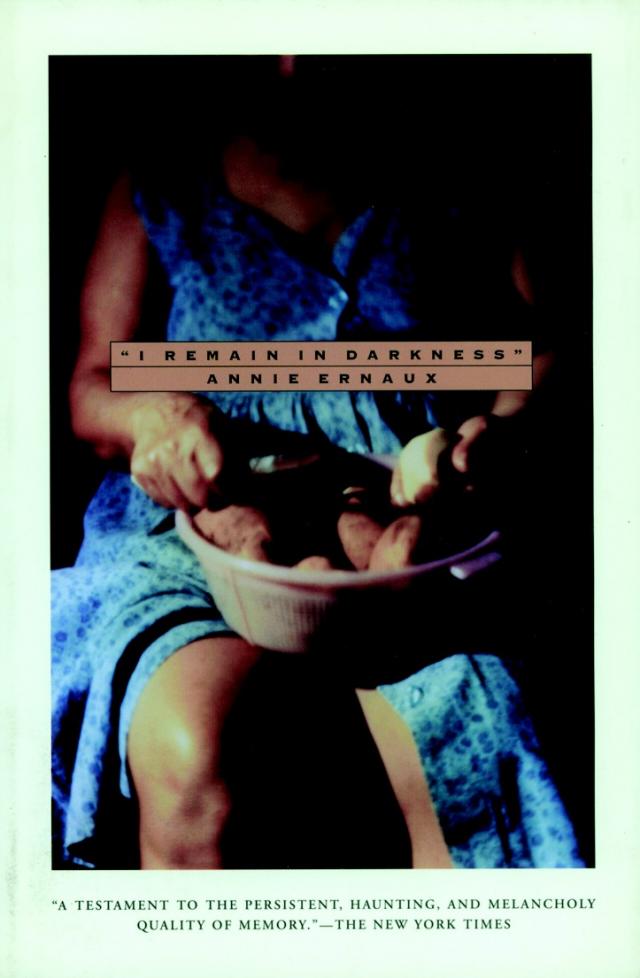
Today she was in a state of total apathy, refusing to see me. It was a lovely day; we went downstairs into the garden, with me clumsily pushing her wheelchair. I realize that I have come to accept her degradation and her new, distorted features. I recollect that terrible moment when she began “going downhill.” She kept going round in circles, searching the house for imaginary objects. (Later on, I was reminded of the tortoise we had in our garden at Annecy, who would scuttle along the gravel paths and barbed wire fence in early fall.) It was then that she wrote: “I remain in darkness.”
Pentecost
As I park the car, I notice quite a few patients sitting outside in wheelchairs and some other people whom I assume are visitors. I go upstairs, my mother is standing in the corridor, she recognizes me, I wheel her downstairs into the garden. I realize that the old people are all patients from the geriatric unit, sporting ridiculous straw hats and minded by the nurses. My mother’s chin seems to sag a little more every week, wrinkles have started to radiate from the corners of her mouth. We just sit there on a bench. She eats her cake. It strikes me that I never bring her the “right sort of cake”; today it’s a brittle slab of shortbread oozing with jam which she gets all over her fingers. I shouldn’t bring her anything except fruit jellies and almond buns. Some of the women are talking to themselves. An old man is vigorously shaking his head beneath his straw hat. My mind goes blank.
J U N E
Sunday 2
Mother’s Day. I have brought along the straw hat she used to wear. We went down into the garden, sat on a bench. She didn’t need a wheelchair today. Maybe, for other people, she has come to resemble a witch—her gradual metamorphosis since she came here one year ago. She is bent double, she who walked so straight. Her skin, spared wrinkles for so many years, is a crisscross of lines. Today she is holding a corner of her gown, clutching it. In the elevator, she stood facing the mirror. I am sure that she could see herself.
Sunday 9
She was waiting for me in her wheelchair, opposite the elevator.
She talks about suicide, money and church mass, which she can no longer attend. “I’m afraid I may have to stay here for years.” Sometimes I leave my sentences unfinished. “You know what I mean,” she would say when she was trying to find the right turn of phrase.