Thula-Thula (English Edition), page 1
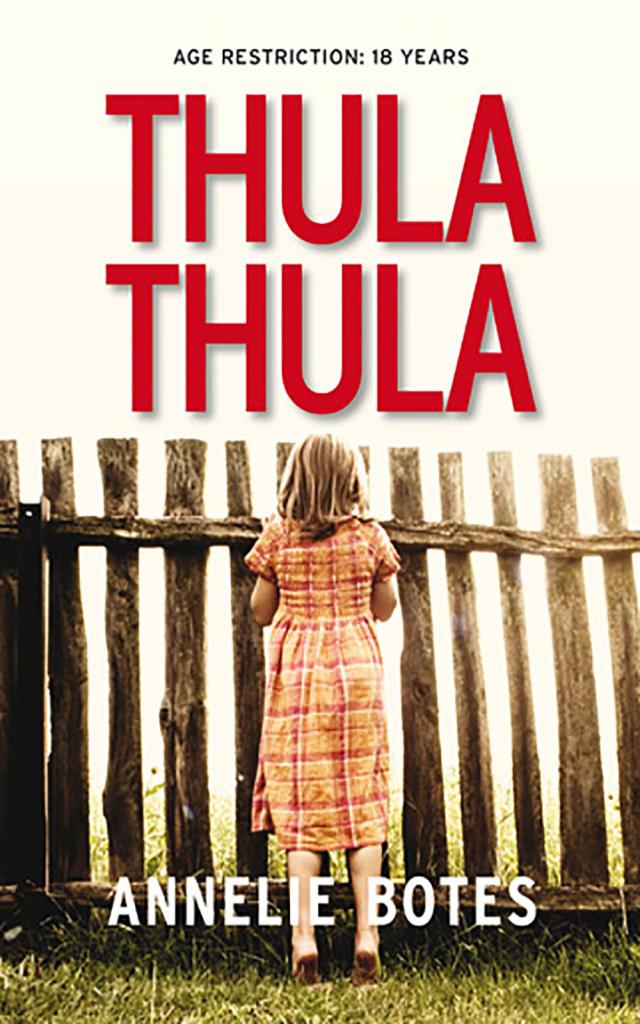


THULA THULA
Annelie Botes
Tafelberg
Wednesday, 27 August 2008
◊◊◊
She stands back to study the sign on the gate, rain dripping from her hair. The sign is green, the capital letters white.
UMBRELLA TREE FARM
GERTRUIDAH STRYDOM
NO ENTRY
TRESPASSERS WILL BE PROSECUTED
The pliers feel cold in her hand. She’s glad she made the sign yesterday and painted it. Put it up as soon as she returned from the funeral in town.
She gathers the cut-off bits of wire and puts them and the pliers in the pocket of her black funeral pants. Walks through the gate and pulls it shut behind her. Slips the loop over the hook. Drapes the chain around the frame and the gate post. She clicks the lock into place, her eyes fixed on her bony hands. They seem older than twenty-six years, an old woman’s hands.
Umbrella Tree Farm. Hers and hers alone. No one will come through the gate without her permission. She wants to be alone. For the greater part of twenty-six years she was nothing, with no say over her boundaries. No place was hers alone except for the stone house she’d built deep in the mountains on the overgrown southern slope. And the corner table behind the maidenhair fern in The Copper Kettle, where she and Braham Fourie used to meet for coffee before she cut him off.
She walks slowly to the house, ignoring the drizzle. Inhales the scent of the lavender hedge that borders the garden path. Even in the late winter the garden is lush, flourishing.
It had always been her job to close the gate and keep the Bonsmara cattle out of her mother’s precious garden. When she was small her father turned it into a game. He’d let her out at the gate, then place a peppermint in her hand as he drove through. She always held out her left hand because her right hand was sticky and stank of piss and rotten fish.
When she was older getting out at the gate and away from him was a release. She no longer held out her hand. ‘Take your peppermint, Gertruidah, it’s your reward for the pleasure along the way.’ She stood like a pillar of salt. ‘If you don’t take it, we’ll melt it inside you tonight and then I will be the one eating it. Are you going to take it …?’
She’d take the peppermint and toss it among the agapanthus beside the gate.
At eighteen, when she was in grade eleven, she got her licence and manipulated him into buying her a car. Then she never went anywhere with him again. On Mondays she drove to boarding school alone, returned alone to the farm on Fridays.
And she never ate anything tasting like peppermint again.
When she was small it took seventy steps to reach the bottom stair. Seventy steps of praying: Gentle Jesus, meek and mild, look upon a little child. The steps became fewer as her legs grew longer. By the time she was seventeen she counted fifty and that’s how it stayed.
It’s been fifty steps for nine years now.
The slate stairway fans out gracefully in the distance, a stone column on either side of the bottom step, each topped with a brown clay pot with gypsy roses spilling out from it. For the first time in her life the stairway holds no terror. Because beyond the stairs, behind the teak front door, there’s no one who can possess her body or penetrate or destroy it. No one to trample her boundaries or make her dance naked in the moonlight. The rider who claimed her for his mare is dead.
Respected Bonsmara farmer. Outrider. Bareback rider. Abel Strydom. Her father.
Ten steps. Another forty and she’ll be there.
Also gone from behind the teak front door, the woman who could turn her hand to anything and ought to have known better than to pretend to be deaf and blind. She’s dead too.
Green-fingered gardener. Stalwart of the Women’s Agricultural Union. Pillar of the community. Sarah Strydom. Her mother.
Fifteen steps. Another thirty-five and she’ll arrive at the stairs.
They died four days ago on their way to the Communion service. An accident on the farm road – Abel was never a man to take his time. Judging by the wreck they’d hit the kudu at full speed, its horn piercing Sarah’s heart and pinning her to the back of her seat.
Abel broke his neck.
When police brought the news she pretended to cry.
This morning she buried them in the town cemetery. She’d refused to have their corpses on her land. ‘Bury them in town,’ she told the undertaker after she identified their bodies on Sunday morning.
‘Gertruidah, your grandmother and brother are both in the family graveyard …’
‘I will decide where they’re buried.’ He raised his hand in protest but she silenced him. ‘I want to finalise the arrangements right now – it’ll be at eleven on Wednesday morning.’
She was dying to get back to the farm. To be on her own, to feel joy, to cry over twenty-two broken years. To reach back into the safety she remembered from when she was a little girl who still believed in fairies and the tooth mouse, before she’d begun to fear the turning of the doorknob at night. ‘Do anything you like, just as long as everything goes smoothly. Tea, cake, ribbons, wreaths, caskets, anything.’
‘At least choose the caskets.’
‘Choose them yourself.’
‘But, Gertruidah, the different styles and prices …’
‘You heard me, you choose.’
A large crowd turned up for the service. She knew what they were whispering to each other: So tragic that the Lord called them so soon. Still only in their fifties, with so much to offer the community. The big question now was who would farm on Umbrella Tree Farm and keep an eye on Gertruidah?
She watched dry-eyed as the caskets were lowered into the ground. All she could think of was the chain and lock she’d buy at the co-op before driving back to the farm. Stop at the store for some food. Don’t forget cough medicine for Mama Thandeka. Sugar and jelly babies for Johnnie.
Twenty steps. Only thirty remain.
At the funeral no one but she knew the truth about Abel and Sarah Strydom. Then she looked up and saw Braham Fourie in the crowd on the far side of the grave, his eyes fixed on her. So there were two people present who knew the truth.
She pretended she hadn’t seen him. Once, in her grade eleven year, she’d allowed him to glance inside her secret room – now, like countless times since then, she regretted it.
Twenty-five steps. The halfway mark.
The funeral-goers scattered flowers onto the caskets. But when the basket with light pink wild chestnut flowers reached her, she demurred. She would not offer them a flower. She locked her fingers behind her back, kept her hands away from the grave. Hands that had been too close to Abel Strydom too many times.
‘Go on, Gertruidah,’ the minister’s wife whispered, ‘take a little flower …’
‘I don’t want to.’
‘Now come on, Gertruidah …’
They all thought she was stupid. They used to whisper that lightning struck beside Sarah’s right foot the day before she was born. That it had made her slow. After a while they grew tired of the lightning story. Then they said she’d never recovered from her brother Anthony’s death. Later still the story went round that she’d been born with a bladder defect.
Covering up, that was all it was. Let the minister’s wife believe what she liked.
‘Maybe a little flower later on, when everyone’s gone …’
‘I won’t want to.’
The woman sighed and moved on with the basket.
Forty steps. Rain drifts down gently onto the slate stairs.
Looking around her she decided it was best if they believed she was stupid. Better stupid than a slut who shared a bed with her father. Who’d believe her if she told them he’d raped and sodomised her for twenty-two years? There she goes again, they’d say, Gertruidah making up silly stories. Because if there was ever a man of impeccable integrity, a man who’d never do that to his daughter, Abel Strydom was that man.
Then she felt someone behind her pressing something into her hands. A wild chestnut flower. When she looked around Braham stood behind her. She dropped the flower, crushed it under her foot.
‘I’ll wait in The Copper Kettle until two.’
She said nothing, looked at him coldly.
‘Let me know if you need me, Gertruidah.’
Fifty steps.
She removes the pliers and bits of wire from her pocket and sits down on the glistening stairs. She hasn’t been inside the house since she came back from the undertaker on Sunday. She didn’t want to feel the lingering breaths of the dead on her skin, or smell their unwashed clothes. She preferred to sleep in the stone house, although the walk there was long and cold and wet.
The sound of frogs in the distance reminds her that before it’s dark she must go tell the river that the graves have been covered and twenty-two years of torture have ended.
She’d ignored Braham Fourie on purpose. She didn’t need his help, doesn’t need any man’s help. Not now, not ever.
She lies down on the bottom step, feels the drizzle carried by the southeaster spray her face. It is cold but healing.
It’s been a while since it rained.
The first drops started to fall just as the minister was crumbling a clod of soil over the caskets. By the time the closing hymn was sung it was pouring. ‘Nearer, my God, to thee, nearer to thee …’ If she’d hated Sarah and Abel less she might have cried. But she couldn’t cry any more. For twenty-two years she steeled herself against feeling. Feeling hurts, and she’s been hurt enoug
It hurts when your father shoves a tin canister up inside you. It hurts when the children at school mock you and say you stink. It hurts giving birth to a child of shame under a full moon. It hurts when Braham Fourie goes to a school function with another woman.
After a while you stop hurting. It’s as if you’ve grown scales on your skin and inside your heart.
She rolls onto her side and supports herself on one elbow, licks the rain from her lips. Her pants cling to her legs, icy cold.
She’s never felt this fearless. Or this directionless at the same time. Her head is swirling, like feeling carsick on a dirt road in summer. Muddled thoughts are all she knows. Being told off for being forgetful or for slipping away into her own world – that is normal.
She was in grade one and Miss Robin was calling to her softly. ‘Gertruidah? Look at me, Gertruidah …’
She didn’t want to be brought back to the classroom where she had to colour in and listen and stand in line. Far better to imagine she was on Umbrella Tree Farm playing among the reeds on the river bank with Bamba. Bamba barked and gulped at the water and chased after the Egyptian geese. She picked a reed and drew a house in the sand. The sand room that was her bedroom had no door. No bed, either. She called Bamba to her and they sat in the sand-house bedroom eating crackers. Dry, because butter turned to snot in her mouth.
‘It’s your turn to read, Gertruidah. Go on,’ Miss Robin said and placed a finger on the first word.
‘I’ll read later.’
The other children laughed. They pinched their noses and with their lips formed silent words so Miss Robin wouldn’t see or hear them. Taunts. She stank, they said, and she was stupid. She wanted to kill them.
‘No, Gertruidah, we’re reading now.’
She dropped her head onto her arms, shut her eyes. She wouldn’t read because she knew the book off by heart. She wanted to go back to the river and her sand-house bedroom. Besides, it felt good when Miss Robin talked to her that way. It made her feel that Miss Robin loved her more than the other grade ones. When she listened, or read when it was her turn, Miss Robin didn’t sit down beside her or rub her back or talk to her in a nice quiet voice. But when she refused to read Miss Robin pleaded with her.
At the end of the year when her report arrived her mother stood in the kitchen and cried so her tears fell into the chocolate cake batter. Because she’d failed.
‘I didn’t fail! I’m clever, Miss Robin said so!’ she tried to argue. ‘We just have to go over the reading books again. Andrea, too, Miss Robin says …’
‘I’m ashamed of you, Gertruidah! You’re a naughty girl! Even Matron complains that you pull your nose up at the hostel food and you wet your bed. You’re a big girl, now, but you behave just like a baby who …’
‘It isn’t true! It’s because there’s a leguan who walks down the corridors at night, I saw him myself, he kills children with his tail and eats them.’
‘Nonsense, Gertruidah! There you go making up stories again! I swear, the next time Matron complains I’m going to buy disposable nappies she can put on you at night …’
She plugged her ears with her fingers and ran out of the house so she wouldn’t hear any more. To the river. She would tell no one about the leguan who left the farm at night to walk to town and enter the hostel. Lying quiet as a mouse in her bed, she could hear his guttural sounds outside the room. Matron said it was the hot water pipes, but Matron lied. She would tell no one she was glad she’d failed because it meant she wouldn’t be with the children who mocked her with their silent words. And if she didn’t want to read Miss Robin would sit down beside her and ask her nicely, please won’t you read. She liked Miss Robin.
One Monday in her second year in grade one she had to go to the school library where a man she’d never seen before asked her to draw pictures and build puzzles and make sums. Miss Robin called him the school psychologist, Mr Noman. She’d never heard of a name like that. How could a man be Noman?
She wasn’t scared that Mr Noman would push his finger up inside her because her mother was there all the time. On the way to town her mother had told her not to say anything about the bed-wetting and the nightmares. ‘You should never talk about things like that, Gertruidah. Not even to your best friend.’
‘I don’t have a best friend. I don’t have any friends at all.’
She often asked her parents if she could invite a classmate home for the weekend. Maybe then at least someone at her school would like her. But her father always said no. If she asked her mother, she said, listen to your father, he’s the head of the house and he knows best.
At night, when she said it hurt, her dad said the same thing, that it was all for her own sake.
She enjoyed her time with the psychology man. She wished Miss Robin could hear how well she read or the way she knew the answer to every sum, straightaway. She wanted to show him how quickly she could build a puzzle but every time he got up from his chair she could see the zipper in his pants, the library smelt of sardines and she’d hear someone rattling the doorknob. Then she couldn’t count or colour in. She lay down on her arms until he sat down again. It was Anthony’s death that had made her this way, her mother told the psychology man.
That was a lie.
She didn’t understand everything her mom told the man but it sounded as if she was on her side. Her mother talked about wanting to protect her child from digging up things unnecessarily, about time healing everything and not wanting her child to become a target.
Target? Was someone trying to shoot at her? And her mother was protecting her – she felt relieved.
They had guests for lunch that Sunday. She sat in the dark beneath the tablecloth in the breakfast nook. Unseen, she could listen to the grown-ups talk. Her mother was sitting at the kitchen table with Andrea’s mom, grating carrots and cutting pineapples into cubes. Her mother was saying the psychologist had said Anthony’s death was the problem.
That was a lie, the man never said that.
Her mother was telling Andrea’s mom a bunch of lies about what the man had said. But she knew he never said it. Never said she shouldn’t drink green or red cooldrink because it would keep her awake at night. Never talked about a bladder infection or her imagination running away with her. And her mother wasn’t saying a word about how well she’d read or that she’d never once coloured outside the lines.
‘Yes, Sarah,’ Andrea’s mom sighed. ‘We’ll never understand how Anthony’s death affected her. She worshipped him. Andrea’s problems are because of a difficult birth. Forceps delivery. Too little oxygen. She was a ten-pound baby, you know.’
She loved words and saved the difficult ones inside her head. Oxygen. Forceps delivery. Ten-pound baby. There were even bigger words she didn’t understand. Allergic, therapy, genetic, trauma, masturbation. It didn’t matter as long as she saved them. At times she took them out, repeated them silently, so only her tongue moved inside her mouth. At night while ugly things were happening inside her bedroom, she said them over and over. Then she forgot a little about the hurt and the sardine smell, she disappeared from her body and turned into someone else.
It felt good to be someone else. Then she wasn’t like Mr Noman who was no one. When she was Allergic Strydom she had transparent wings and could fly right up to the clouds. Therapy Strydom made a little red-and-yellow wooden boat and oars and rowed right past the crocodiles and river monsters all the way to the sea. Genetic Strydom was Goldilocks’s best friend. Together they picked poisonous mushrooms in the forest and fed them to Snow White’s stepmother. Trauma Strydom was a chambermaid who brushed Sleeping Beauty’s hair while she dreamed. Masturbation Strydom always wanted to be the boss. She didn’t like Masturbation Strydom because he hurt her.
Leaning on her elbow she sees smoke curl out of the chimney at Mama Thandeka’s house across the river at the foot of the mountain. They and Johnnie and poor slow-witted Littlejohn are the last people left on Umbrella Tree Farm: the other labourers’ cottages have stood empty for years. Abel always said the new laws made it impossible to employ permanent workers. But Mama Thandeka and Mabel and Johnnie and Littlejohn have life interest, so they’ve stayed.
Johnnie helps in the yard with Sarah’s flowers and the vegetable garden, the chickens and the evening milking. But he’s old and nearing the end of his life. Littlejohn is already in his late forties and the only things he’s good at are eating jelly babies and singing. What would become of him after Johnnie died used to be Abel’s problem. Now it’s hers. Johnnie mustn’t die. He’s more a father to her than Abel ever was. When she was small she’d go with him to fetch eggs every evening. At milking time she’d carry her little mug to the kraal and he’d fill it with warm milk – although later on milk made her stomach turn.