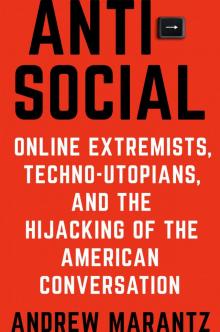
Antisocial, page 1


VIKING
An imprint of Penguin Random House LLC
penguinrandomhouse.com
Copyright © 2019 by Andrew Marantz
Penguin supports copyright. Copyright fuels creativity, encourages diverse voices, promotes free speech, and creates a vibrant culture. Thank you for buying an authorized edition of this book and for complying with copyright laws by not reproducing, scanning, or distributing any part of it in any form without permission. You are supporting writers and allowing Penguin to continue to publish books for every reader.
Portions of this work were previously published in slightly different form in The New Yorker as “Trolls for Trump” (October 2016), “Trump and the Truth” (November 2016), “Trump Supporters at the DeploraBall” (February 2017), “Is Trump Trolling the White House Press Corps?” (March 2017), “An Awkward Right-Wing Dance Party” (May 2017), “Behind the Scenes With the Right-Wing Activist Who Crashed ‘Julius Caesar’” (June 2017), “Birth of a White Supremacist” (October 2017), and “Reddit and the Struggle to Detoxify the Internet” (March 2018).
“Housekeeping Observation” from Can’t and Won’t: Stories by Lydia Davis. Copyright © 2014 by Lydia Davis. Reprinted by permission of Farrar, Straus and Giroux.
ISBN 9780525522263 (hardcover)
ISBN 9780525522270 (ebook)
Penguin is committed to publishing works of quality and integrity. In that spirit, we are proud to offer this book to our readers; however, the story, the experiences, and the words are the author’s alone.
While the author has made every effort to provide accurate telephone numbers, internet addresses, and other contact information at the time of publication, neither the publisher nor the author assumes any responsibility for errors or for changes that occur after publication. Further, the publisher does not have any control over and does not assume any responsibility for author or third-party websites or their content.
Some names and identifying characteristics have been changed to protect the privacy of the individuals involved.
Version_1
For LBG and the Gid
Morality, if it is to remain or become morality, must be perpetually examined, cracked, changed, made new. . . . Not everything that is faced can be changed; but nothing can be changed until it is faced.
James Baldwin, “As Much Truth As One Can Bear”
Under all this dirt
the floor is really very clean.
Lydia Davis, Can’t and Won’t
Contents
Title Page
Copyright
Dedication
Epigraph
Prologue
PART ONE
DeploraBall
CHAPTER ONE This Is America
CHAPTER TWO Pride
CHAPTER THREE The Contrarian Question
CHAPTER FOUR To Change How We Talk Is to Change Who We Are
INTERLUDE: MOVABLE TYPE
PART TWO
A Human Superpower
CHAPTER FIVE The Gleaming Vehicle
CHAPTER SIX Viral Guy
CHAPTER SEVEN Basically My Nightmare
CHAPTER EIGHT Eating the World
CHAPTER NINE Brainwreck Politics
CHAPTER TEN The Sailer Strategy
CHAPTER ELEVEN The Invisible Primary
PART THREE
Too Big to Ignore
CHAPTER TWELVE Beyond Good and Evil
CHAPTER THIRTEEN A Filter for Quality
CHAPTER FOURTEEN Attention Is Influence
CHAPTER FIFTEEN Reductio
CHAPTER SIXTEEN The Media Matrix
CHAPTER SEVENTEEN Fitness and Unfitness
CHAPTER EIGHTEEN The Transplant
CHAPTER NINETEEN Poise Is a Club
CHAPTER TWENTY “Meta Post Script”
INTERLUDE: TRUST NOTHING
PART FOUR
The Swamp
CHAPTER TWENTY-ONE The News of the Future
CHAPTER TWENTY-TWO The Narrative of Public Life
CHAPTER TWENTY-THREE Very Professional and Very Good
CHAPTER TWENTY-FOUR Success and Empire
CHAPTER TWENTY-FIVE The Bright Day That Brings Forth the Adder
INTERLUDE: THE PAST IS ABSOLUTE
PART FIVE
The American Berserk
CHAPTER TWENTY-SIX The Emptiness
THE AMERICAN BERSERK II
CHAPTER TWENTY-SEVEN The Mountain
PART SIX
A Night for Freedom
CHAPTER TWENTY-EIGHT Common Sense
Epilogue
Glossary
Acknowledgments
Notes
About the Author
ANTISOCIAL, ADJ. (1797)
unwilling or unable to associate in a normal or friendly way with other people (He’s not antisocial, just shy)
antagonistic, hostile, or unfriendly toward others; menacing; threatening (an antisocial act)
opposed or detrimental to social order or the principles on which society is constituted (antisocial behavior)
Psychiatry: of or relating to a pattern of behavior in which social norms and the rights of others are persistently violated
Dictionary.com Unabridged
Based on the Random House Unabridged Dictionary, © Random House, Inc. 2019
Prologue
I landed at the Bob Hope Airport in Burbank, rented a Ford sedan, and asked Google to send me southward on a semiefficient route, scenic but without too much traffic. As I drove, I listened to a nationalist motivational speaker delivering far-right talking points via livestream. I was deprived of the full effect, being unable to see his facial expressions and the comments floating up the left side of my phone’s screen, but I figured that the full effect was not worth dying for. “Are you gonna be a passive observer in these extraordinary times, as we fight to save Western civilization, or are you gonna step up?” he asked. “I’ve decided that I’m stepping up.” The 2016 presidential election was approaching, and the institutional gatekeepers in government, business, and media all agreed that the result was inevitable. The nationalist was urging his listeners to question the prevailing narrative, to think the unthinkable, to bend the arc of history. Through my windshield I could see a sliver of the Pacific, picturesque but not all that pacific.
On the Hermosa Beach boardwalk there were longboards and mirrored sunglasses and poke bowls and matcha smoothies. A small film crew from Women.com was shooting a series of woman-on-the-street interviews about sex positivity. On the beach, a crowd had gathered around a drum circle. “Can you feel the Earth’s rhythm?” one of the drummers asked, passing around a bucket for donations.
I spotted about a dozen beefy white men, dressed in T-shirts and shorts, milling around near an outdoor bar. In the middle of the scrum was the nationalist motivational speaker. Most people on the boardwalk didn’t recognize him, but to his followers, both in person and on the internet, he was something of a hero, or maybe an antihero—an expert at injecting fringe ideas into mainstream discourse. A few months earlier, he had decided, based on no real evidence, that Hillary Clinton was suffering from a grave neurological condition and that the traditional media was covering it up. He turned this conjecture into a meme, which gathered momentum on Twitter, then leaped to the Drudge Report, then to Fox News, and then into Donald Trump’s mouth. The nationalist had told me, “All the people at each step may or may not know my name, but I’m influencing world history whether they know where their ideas are coming from or not.”
He was hosting what he called a free-speech happy hour—a meetup for local masculinists, neomonarchists, nihilist Twitter trolls, and other self-taught culture warriors. About sixty people showed up over the course of the afternoon. Some refused to call themselves alt-right, which had become, in their words, “a toxic brand”; others were happy to own the label. Most were white, most were nationalists, and some were white nationalists—not the old skinhead type but the more polished, just-asking-the-question variety. For years, they’d been able to promote their agenda through social networks like Twitter and Facebook, with almost no restrictions. Now those networks were starting to crack down, banning a few of the most egregious trolls and bigots. “It’s straight-up thought policing,” one person at the meetup said. “It’s 1984.”
A pudgy guy with oversized sunglasses sat at a table by himself. On his T-shirt was a drawing of Harambe, a gorilla who’d recently been shot to death at the Cincinnati Zoo. The incident had resulted in real internet outrage, followed by satirical internet outrage, followed by absurdist metacommentaries on the phenomenon of internet outrage. All afternoon, I saw people pointing at the guy’s T-shirt and laughing as they passed by. “Fuck yeah, Harambe,” they’d say, or “Dicks out for Harambe.” The guy wearing the T-shirt would nod knowingly, as if in solidarity. That was the extent of the interaction.
I sat down next to the guy and asked him to explain the joke. “It’s a funny thing people say, or post, or whatever,” he said. “It’s, like—it’s just a thing on the internet.” Harambe, of course, was a real animal before he became a meme. Still, I knew what it was like to experience much of life through the mediating effects of a screen. It wasn’t hard for me to imagine how anything—a dead gorilla, a gas chamber, a presidential election, a moral principle—could start to seem like just another thing on th e internet.
* * *
• • •
For as long as the United States has been a country, there have been Americans handing out pamphlets declaring taxation unconstitutional, or standing on soapboxes railing against papist sabotage, or calling C-SPAN to demand that every member of Congress be investigated for treason. (C-SPAN’s screeners, if they were doing their jobs, did not put those callers on air.) The First Amendment protected this minority’s right to speak, and for a long time it seemed as if the majority were not inclined to listen. “There have always been those on the fringes of our society who have sought to escape their own responsibility by finding a simple solution, an appealing slogan, or a convenient scapegoat,” President John F. Kennedy said in 1961. “But in time the basic good sense and stability of the great American consensus has always prevailed.”
In 2004 and 2005, a few young men wrote the computer code that would grow into a vast industry called social media—“social” because people could receive information horizontally, from their friends, rather than waiting for gatekeepers to impart it from on high; “media” because information was information, whether it came from a stilted broadcaster, a kid procrastinating during study hall, or a nationalist on a boardwalk. The social media entrepreneurs called themselves disrupters, but they rarely described in much detail what a postdisruption world would look like. When pressed, their visions tended toward hazy utopianism: they expected to connect people, to bring us all closer together, to make the world a better place.
Their optimism wasn’t entirely misguided, of course. Millions of people—whistleblowers, citizen journalists, women resisting abuse, dissidents under despotic regimes—did use social media to organize, to reveal abuses of power, to advance the aims of justice. And yet, when the same tools were used to sow disinformation or incite hatred, the disrupters usually responded by saying something vague about free speech and then changing the subject.
The disrupters aimed to topple gatekeepers in dozens of industries, including advertising, publishing, political consulting, and journalism. Within a decade, they had succeeded beyond anyone’s expectations. Their social networks had become the most powerful information-spreading instruments in world history. Many traditional media outlets were being dismantled, and no one seemed to have any idea what might replace them. Instead of taking over where the old gatekeepers had left off, the disrupters—the new gatekeepers—refused to acknowledge the expanding scope of their influence and responsibility. They left their gates unguarded, for the most part, trusting passersby not to mess with the padlocks.
Right away, the national vocabulary started to shift, becoming both more liberated and more unhinged. The silent majority was no longer silent. Long-standing fissures furrowed into deep rifts. The disrupters weren’t solely responsible for all of this, of course. Like every epochal shift, this one had many preconditions. Political movements mattered; economic structures mattered; geography and demography mattered; foreign wars mattered. Still, only a few years into the unprecedented experiment that was social media, it suddenly seemed quaint to recall that there had ever been such a thing as a great American consensus.
This much was shocking but not quite unthinkable. Then, swiftly, came the unthinkable: smart, well-meaning people unable to distinguish simple truth from viral misinformation; a pop-culture punch line ascending to the presidency; neo-Nazis marching, unmasked, through several American cities. This wasn’t the kind of disruption anyone had envisioned. There had been a serious miscalculation.
We like to assume that the arc of history will bend inexorably toward justice, but this is wishful thinking. Nobody, not even Martin Luther King Jr., believed that social progress was automatic; if he did, he wouldn’t have bothered marching across any bridges. The arc of history bends the way people bend it. In the early years of the twenty-first century, the internet was full of nihilists and masculinists and ironic neo-Nazis and nonironic neo-Nazis, all working to bend the arc of history in some extremely disturbing directions. Social media feeds were algorithmically personalized, which meant that many people didn’t have to see the lurid ugliness online if they didn’t want to. But it was there, more and more of it every minute, whether they chose to look at it or not.
* * *
• • •
In 2012, a small group of former Ron Paul supporters started a blog called The Right Stuff. They soon began calling themselves “post-libertarians,” although they weren’t yet sure what would come next. By 2014, they’d started to self-identify as alt-right. They developed a countercultural tone—arch, antic, floridly offensive—that appealed to a growing cohort of disaffected young men, searching for meaning and addicted to the internet. These young men often referred to The Right Stuff, approvingly, as a key part of a “libertarian-to-far-right pipeline,” a path by which “normies” could advance, through a series of epiphanies, toward “full radicalization.” As with everything the alt-right said, it was hard to tell whether they were joking, half joking, or not joking at all.
The Right Stuff’s founders came up with talking points—narratives, they called them—that their followers then disseminated through various social networks. The memes were tailored to the medium. On Facebook, they posted Photoshopped images, or parody songs, or “countersignal memes”—sardonic line drawings designed to spark just enough cognitive dissonance to shock normies out of their complacency.* On Twitter, the alt-right trolled and harassed mainstream journalists, hoping to work the referees of the national discourse while capturing the attention of the wider public.* On Reddit and 4chan and 8chan, where the content moderation was so lax as to be almost nonexistent, the memes were more overtly vile. Many alt-right trolls started calling themselves “fashy,” or “fash-ist.” They referred to all liberals and traditional conservatives as Communists, or “degenerates”; they posted pro-Pinochet propaganda; they baited normies into arguments by insisting that “Hitler did nothing wrong.”
When I first saw luridly ugly memes like this, in 2014 and 2015, I wasn’t sure how seriously to take them. Everyone knows the most basic rule of the internet: Don’t feed the trolls, and don’t take tricksters at their word. The trolls of the alt-right called themselves provocateurs, or shitposters, or edgelords. And what could be edgier than joking about Hitler? For a little while, I was able to avoid reaching the conclusion that would soon become obvious: maybe they meant what they said.*
In October 2018, a white terrorist carried three Glock handguns and an AR-15 into a synagogue in Pittsburgh and started shooting. He had been active on a small social network called Gab, a hermetic bubble of toxicity that billed itself as “the home of free speech online.” Two weeks before the shooting, he’d reposted a countersignal meme featuring two stick figures. The first was labeled “Me one year ago” and the second was labeled “Me today.” The first stick figure, in a speech bubble, said, “I believe everyone has the right to live how they want and do what makes them happy.” The second one said, “We need to overthrow the government, implement a clerical fascist regime, and begin mass executing these Marxist degenerates.” The caption above the drawing: “The libertarian-to-far-right pipeline is a real thing.”
* * *
• • •
This is not a book arguing that the fascists have won, or that they will win. This is a book about how the unthinkable becomes thinkable. I don’t assume that America is destined to live up to its founding ideals of liberty and equality. Nor do I assume that it is doomed to repeat its founding reality of brutal oppression. I can’t know which way the arc will bend. What I can offer is the story of how a few disruptive entrepreneurs, motivated by naïveté and reckless techno-utopianism, built powerful new systems full of unforeseen vulnerabilities, and how a motley cadre of edgelords, motivated by bigotry and bad faith and nihilism, exploited those vulnerabilities to hijack the American conversation.