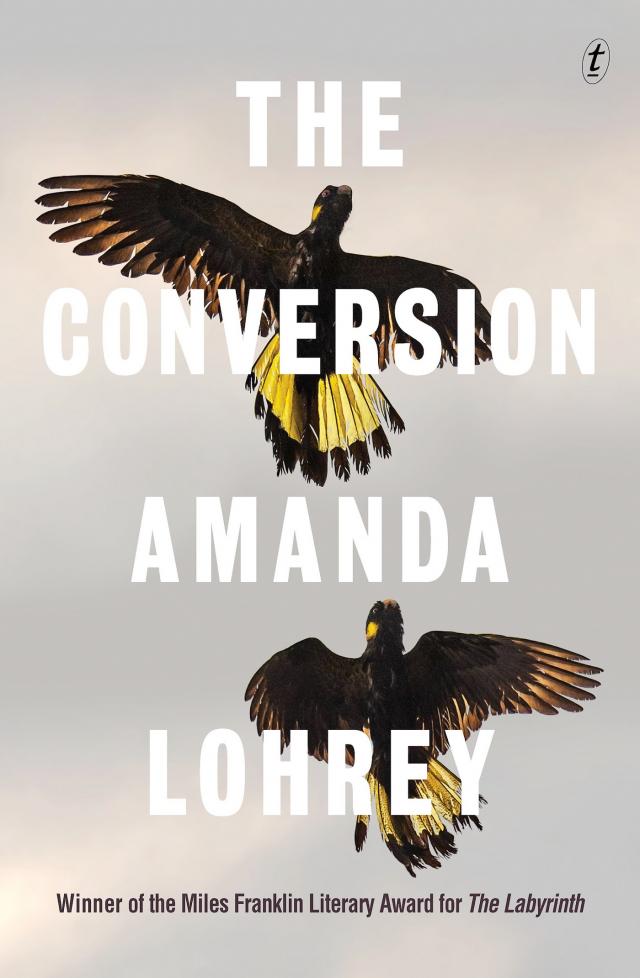
The Conversion, page 1


ABOUT THE BOOK
The conversion was Nick’s idea.
Nick: so persuasive, ever the optimist, still boyishly handsome. Always on a quest to design the perfect environment, convinced it could heal a wounded soul.
The conversion was Nick’s idea, but it’s Zoe who’s here now, in a valley of old coalmines and new vineyards, working out how to live in a deconsecrated church.
What to do with all that vertical space, those oppressive stained-glass windows? Can a church become a home or, even with all its vestiges removed, will it remain forever what it was intended to be?
For Zoe, alone and troubled by a ghost from the recent past, the little church seems empty of the possibilities Nick enthused about. She is stuck in purgatory—until a determined young teacher pushes her way into Zoe’s life, convinced of her own peculiar mission for the building.
Melanie has something of Nick’s unquenchable zeal about her. And it’s clear to Zoe that she won’t take no for an answer.
The Conversion is a startling novel about the homes we live in: how we shape them, and how they shape us. Like Amanda Lohrey’s bestselling The Labyrinth, it is distinguished by its deep intelligence, eye for human drama and effortless readability.
CONTENTS
COVER PAGE
ABOUT THE BOOK
TITLE PAGE
EPIGRAPH
PART 1 THE WINDOWS
1
2
3
4
5
6
7
8
9
10
11
12
13
14
15
16
17
PART 2 THE CONVERSION
18
19
20
21
22
23
24
25
26
27
28
29
30
31
32
33
34
35
36
37
ABOUT THE AUTHOR
COPYRIGHT PAGE
‘Nothing important comes with instructions.’
JAMES RICHARDSON, ‘VECTORS 3.0’
PART 1
the windows
1
They were almost at the edge of the town when they saw the FOR SALE sign planted in front of a tall hedge. Nick pulled over to park on the verge and leaned across her to peer up at the old church, his chin close to her cheek, his left hand resting on her thigh. How warm that hand felt, how firm and secure, how strong the current of his energy.
‘Well,’ he said, ‘it’s even more picturesque than it looked online.’
They climbed out and pushed at the iron gates that swung open with a resistant creak, and there it stood at the top of a steep driveway: a small, handsome edifice of sandstone and granite with a tin roof and an empty belltower. The grass around it was dry and trim, and they thought they might as well try the door, but as they drew close they saw the snake, coiled and sleeping on the worn sandstone steps of the porch.
‘We could throw a rock at it,’ she said.
‘No,’ he said, ‘leave it be.’ The interior could wait.
They began their inspection on the southern side, where there were three separate stained-glass windows mounted with sturdy iron grilles. While Zoe tried to make out the figures in the glass, Nick stood back, gazing up at the stonework, his hand cupped over his eyes against the sun. She remembers thinking that he still had it, a man of sixty-three with a certain charisma. He was slim and fit, and his cropped grey curls gave him a Roman look, like one of those busts in a museum. After all these years she still took a secret pleasure in looking at him. His face had a perfect symmetry that had long cast a spell over her, the more potent for its being broken only by one crooked tooth in the front that slightly overlapped another tooth, as if to frame the perfection of the rest.
‘Look,’ he said, ‘the walls have been heavily patched,’ and he pointed to where the sandstone blocks and granite chunks had been roughly mortared over so that some individual stones were all but obscured by the dun-coloured paste. But the imposing corner stones were in good shape, as were the buttresses, and the guttering around the foundations was a warm orange brick that Nick thought might have been convict-made. Two squat tin chimneys rose above the roof for ventilation, and at the western end stood the empty belltower, a rusted weathervane on top, fixed and still.
Behind the church there were sheep grazing in a dry paddock and on the far side of the paddock they could see a dense eucalypt plantation, rows and rows of identical trees with spindly trunks that rose up out of stunted undergrowth. At the eastern end of the church, presumably the altar end, was a massive three-panelled stained-glass window, and they wondered at the expense of this in a small rural church. They thought it must at one time have been a well-heeled congregation, either that or a dedicated one, but again the iron grille obscured the figures.
She remembers hearing a loud screech and looking over to a stand of old macrocarpa pines where two black cockatoos were perched on a bough protruding from the nearest tree. She can still see their black bodies outlined against the blue of the sky, the strength of their hooked beaks, the way they balanced on one claw and held a pine-cone upright in the other, as if it were a fruit. Then she spotted the others, counting five in all, a flock, and one of their favourite birds: so elegant in flight, so comically imperious up close. Nick thought it a good omen.
They turned the corner and began their stroll along the northern wall, until they came to a single bush of Scotch thistle sprouting from a crack in the brick gutter. It drew their attention to a rectangle of worn sandstone carved with the inscription
ANNO DOMINI
MDCCCXC
So, it was late Victorian.
Back at the entrance the snake was gone. Nick tried the door, a solid gothic arch with iron hinges and a ring of plaited brass. It was locked, and they stepped back to gaze up at the belltower, lingering in the bright sun, and he put his arm around her waist and smiled.
‘Not bad,’ he said, ‘not at all gloomy.’ Then she thought of those iron grilles that covered the windows. Not only would they be living in a church, it might feel as if they were living in a gaol.
Nick looked over to the grazing paddocks beyond. ‘A graveyard,’ he said. ‘You’d think there’d be one.’
Zoe pointed down the hill to the iron gates. ‘It’s across the road. You didn’t see it?’
No, he hadn’t, but was glad to find it set apart. It was probably on a separate title, and so much the better. There would be visitors coming to lay flowers or chase up their family tree for want of something better to do. And besides, they didn’t want to have to manage a lot of crumbling headstones and funereal obelisks tilting at an angle, and those awful little kitsch angels with downcast eyes. No responsibility for the dead; he was not up for it. In his work as a therapist, it was enough for him to deal with the living.
They drove on into the town, only five kilometres to the north. Crannock was a small settlement that lay in the valley between two larger towns and all three serviced the coalmines for which the valley was known, though in recent years much of the surrounding grazing land had been planted with vineyards.
It was a Sunday and the local realtor was closed, so they parked around the corner from the Jubilee Arms, a handsome colonial hotel with timber balconies painted green and cream. Inside, the hotel smelled of disinfectant and beer but the dining room had been refashioned in an austere minimalism of black granite and stainless steel. The publican’s wife was obliging and offered them a late lunch, and they settled to a grilled backstrap of lamb, simple but perfectly cooked, with a glass of one of the local reds.
They had driven to the church on impulse, with no appointment to inspect, but already Nick was feeling optimistic. On the drive back to the city he was in good spirits and announced that he felt somehow unburdened, though of what he couldn’t say. Zoe was less upbeat. Yes, the church had been charming, and yes, it had a lovely aspect, but a church was after all a church.
‘Meaning?’ he asked.
‘Well, not a house,’ she said, lamely, ‘not a home.’ And then: ‘I suppose it’s been deconsecrated.’
Nick thought it likely had, not that it need make any difference to a prospective buyer, not unless they were believers, and maybe not even then. But the thought unsettled her. Surely the church hierarchy didn’t just abandon these places? Could you pretend a church had never been a sacred site? There must be some ritual involved, some way of letting go. If they bought it, would they risk having a sense of trespass? Some of the congregation might resent the sale, might feel they had lost a piece of themselves.
There couldn’t be much of a congregation, Nick observed, or the church wouldn’t be on the market. And the few diehards left might have an initial reaction but others would be grateful to them for rescuing what might otherwise become derelict. In any case, this stuff was all in the mind and need not trouble a prospective buyer. Neither he nor she had had a religious upbringing and they would come to it unencumbered by habit or superstition. There were Indigenous peoples who held certain waterholes, rocks or trees to be sacred, but that didn’t mean they held any special meaning for whitefellas.
‘That’s different,’ she protested.
‘Is it?’ And he smiled at her indulgently. ‘You think it might ha ve some ghosts?’ he teased.
No, she didn’t, but she did think they might have to deal with locals who had a psychic investment in not just the building but the site itself. It would only be natural. ‘You’re the psychologist,’ she said, ‘you’ve always maintained that there’s a psychology of place, that we become attached to certain places and go on inhabiting them mentally long after we leave them behind physically.’
Of course, he said, but that psychology was not fixed, it evolved. At the right time and in the right place, one attachment could be replaced by another. The church, any church, would be what they made of it, and what was an abandoned church anyway? Just a big open space with infinite possibilities, and it felt right that it should come to them at a time in their lives when they were picking up the pieces from their losses in the financial crisis. ‘See it as a gift, Zo.’
And so buoyant was he that she felt it would be churlish of her to argue. With luck, this would be another of his enthusiasms, soon to be replaced by something more suitable.
2
When the great crash came she had felt the shock of it in her bones. Day by day as she watched their capital fall she felt she was being flayed, with each cut of the scalpel accompanied by a soundtrack of hysterical pundits and the full throttle of that word volatility. A surge in the blood, a snapping of synapses, an arrhythmic heartbeat. Breathless, she was breathless, and bleeding money. It was such an odd sensation; up until then she had thought she had blood in her veins but all along she had been stuffed with wet currency. And then the numbness set in, so that she began to float in a limbo of shock.
But Nick? Well, he dealt with it. After a brief period of outrage followed by a few weeks of listless funk, he rebounded in a burst of almost manic restlessness. He would not be defeated by this; he would not. ‘And let’s face it, Zo,’ he said, ‘we’ve become stale, stale and complacent.’ An established middle-class couple trundling along in their comfortable cocoon, tut-tutting at the television and taking expensive holidays. But now they had to think again, and it could be worse. They were in good health, fit enough to start over, and here was their chance.
Yes, they would have to sell the house, a handsome Federation villa they had worked on with such loving care, but they could move to the country and become part of one of those charming little towns that in recent years were being revitalised. He could find premises in the town—the rents would be modest—and set up a part-time practice with a handful of clients, enough to live on, and she would not have to go back to work.
Zoe could almost see the fantasy of it appear in a bubble above his head and could only gaze at him with a mix of wonder and resentment. But hadn’t he always been like this, and often to a maddening degree?
For a week she contemplated returning to work. She had only recently taken early retirement when the small firm where she worked as a solicitor had been absorbed into a larger one and it had seemed the right time, for she was jaded. For the past year she had felt the desire for something new, something vague and unformed, but when radical change presented itself she was unprepared.
Not so Nick. For Nick it was always about the possibility of the new. The world was there to be remade, over and over, and anything less was stagnation. If friends began to talk earnestly about their family tree, as they seemed increasingly to do as they aged, he would look at Zoe and roll his eyes. He had little interest in history and above all he despised nostalgia: nostalgia was a form of weakness, emotional and spiritual laziness. The secret to life was to live in a dynamic present illuminated by the light of the possible. And might not this attitude, she reflected, now prove to be a strength? And in any case, what other options did they have?
And so together they went online to look at properties in regional towns, only to be dismayed by how expensive these had grown. An exodus from the city had begun a decade before with the last property boom and the listings were discouraging: featureless suburban bungalows with double garages, blank-faced and bare, or workers’ cottages of manufactured charm, a glassy modern extension at the rear and potted camellias on a twee little front veranda. But then Nick found the church.
Light, airy and affordable, it sat on a low rise with a view across vineyards that sloped down to the floor of the valley. Behind it was the big grazing paddock while, to the west, hills covered in ironbark and mountain ash rose in an alluring haze. ‘Look how cheap it is,’ he said: ‘any other property with a view like that would cost a motza. C’mon, Zo, let’s not live in some soulless developer’s box—we can do better than that.’
After all, they had renovated before, more than once. He was a practical man with a workshop full of tools and, yes, it would be difficult but they had the experience and they had the smarts. A church would be the ultimate challenge.
‘Sunday,’ he said. ‘We’ll drive out to the valley and take a look.’
3
It was not long after this that Neville Glass came to dinner.
Neville was Zoe’s oldest friend, and a favourite of Nick’s. Together he and Zoe had attended a big government school on the outskirts of Penrith and there they had formed an unlikely and asexual bond. Often in their final year they would catch the train home together and walk the kilometre to their respective homes on a new housing estate where the bush had been bulldozed and the bare yards sprouted nascent trees along the edges of tidy lawn. These walks were a secret pleasure for them both; away from the school grounds they did not have to affect any form of mindless cool but could debate the strangeness of the world.
Neville came from a strict Methodist family where, he lamented, even the placement of a cloth on the altar was regarded as a sin of decadence (‘sensory deprivation’) and he had responded by becoming a dialectician; at weekends he would sometimes travel to the reference library in the city to read theology, the better to argue with his father, and he liked to rehearse these Oedipal duels on his walks home with Zoe. She can still recall a conversation about the proofs of God, and Neville’s methodical rebuttal of each of them. There were five proofs, none of which she could remember now, other than that there was something called a First Cause, an idea she had recoiled from; it had struck her as fixed and rigid, like a wooden packing box, all hard edges and enclosed.
Neville was a streak—tall, lanky and a cocksure know-all—but also open and at times innocently childlike. And when she had hooked up with Nick, he and Neville had taken to one another on sight, not least because they shared an interest in what Nick referred to as the psychology of space. A town planner, Neville had studied in Berkeley with the architect Christopher Alexander, whose contentious theories on the subject interested Nick, for in his own postgraduate research in psychology Nick had written a thesis on the mind’s spatial awareness and how it affects neurosis. There was too much emphasis on our management of time, he wrote, and not enough on the way in which the body related to the space around it. The key to feeling at ease in the world was in finding the right dimensions and the right orientation, as if the art of living were a matter of putting together the pieces of a three-dimensional jigsaw, a design in which all the elements were aesthetically resolved to a degree that seemed to Zoe to be quasi-mystical, a little on the fuzzy side, though Nick scoffed at the suggestion. Not at all, he said; it was as practical a science as could be conceived of, which is why it was such a big deal when architects and town planners got it wrong. In his work as a therapist he paid special attention to how and where the client lived, and he would begin by asking them to draw their childhood home. Then he would ask them to draw the home that best signified who they felt they really were. He had thought of collecting these drawings together in a book, The House as Self, but decided that, even while preserving his clients’ anonymity, it would be unethical.
Zoe had never fathomed this theory of Nick’s. She could see a kind of logic nestled within it but there must, she thought, be more to it in his own case, for since their very first house together—and they had bought and sold several—he had been preoccupied with remodelling and renovating. Nothing was ever quite right. Over the years he had acquired a workshop of expensive tools and he liked nothing more than to hover over market stalls that sold antique ones. For Nick, these seemed to have the status of magical objects; they signified the mystery of making, the promise of transforming the intractable into the pliable—and, ultimately, the desirable—and he collected them almost as if they were totems: a vintage wood plane, a collection of Wiltshire metal files, a German gouge chisel, a Japanese carpenter’s ink chalk of carved wood, a Swedish cast-iron nail puller, and a handsome wood and brass plumb bob that he kept on his desk.