The Judas Tree, page 30
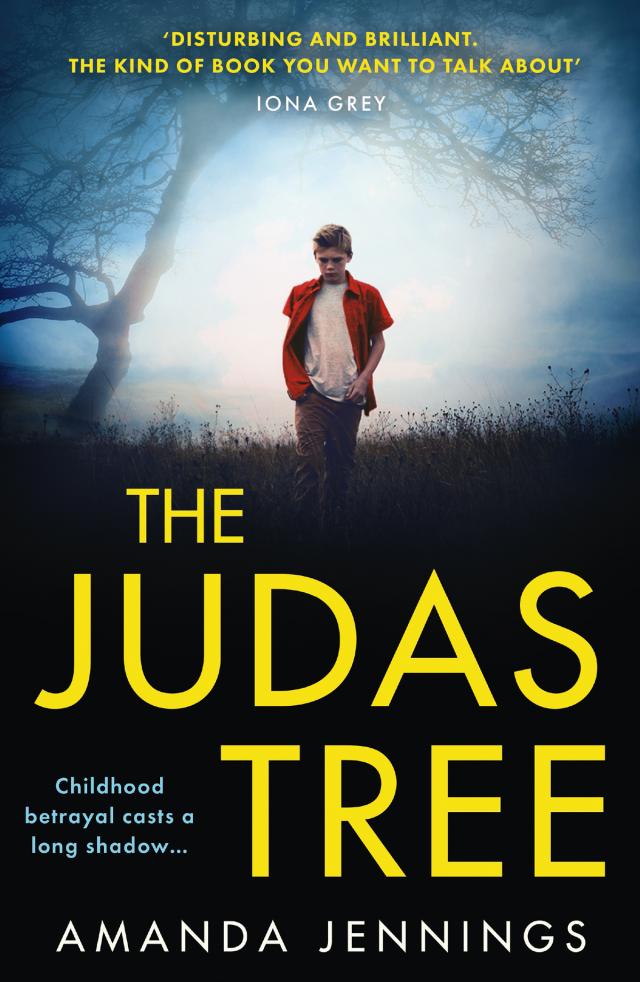


He tied the rope then opened the knife and admired its shining blade one last time. He held open his palm and drew the blade along the line of the scar that crossed it. Blood flowed like cherry juice and he watched it, transfixed for a moment or two, as it fell in drops on the earth below. Then he threw the knife down into the undergrowth and closed his eyes, the bell for morning lessons ringing out across the courtyard, resounding in the branches and leaves of the tree that held him.
Epilogue
The late November rain was falling heavily from the charcoal sky. Cars drove along the New King’s Road with their wipers working overtime. Headlights lit the four-thirty dusk and the pavements were covered in a sheen of wet with water flowing in rapids along the side of the road and into the drains.
Will and Harmony walked carefully, avoiding the deeper puddles, and trying not to snag anyone with the umbrella they shared. They kept their heads low to fend off the bite of the cold. As they reached the covered area outside the Chelsea and Westminster hospital Will stopped to shake the rain off the umbrella and close it before they pushed through the revolving doors into the warmth of the hospital’s foyer.
‘That’s better,’ he said, as they walked through the airy reception area towards the lifts. ‘I’ve never seen so much rain.’
She smiled up at him. ‘You look terrified,’ she said, and reached up to kiss his cheek.
He forced a smile back in an attempt to mask his nerves.
‘Don’t worry,’ she said. ‘It’s going to be fine.’
He pressed the button to go up and glanced at Harmony. Her hand was on her stomach, resting lightly on its roundness. A picture of Luke, dressed in his suit, shaking hands with him in Emma and Ian’s garden, flashed into his head. These unwanted images would always be there, however much he fought to keep them at bay.
It was two older boys, sixth-formers, who’d found his body. The boys had been bunking off prep for a cigarette and stumbled upon him. Will had heard enough detail for him to picture the scene: Luke hanging from the Judas tree, bare-footed, hand cut across the palm.
The image would haunt him forever.
The story had made the national news and triggered a police investigation into abuse at the school when Luke and Will had been pupils. Will had found no satisfaction or release while raking over those days with the police, but there was an element of uneasy relief when Drysdale and a handful of ex-members of staff found themselves facing prosecution. He’d followed the trials closely. He hadn’t wanted to appear in court so sent a statement to be read on his behalf. His was circumstantial evidence, more linked to the atmosphere and culture of the school than specific events. It was hard reliving those dark days. In the end he was left feeling empty as the full extent of the rot was revealed and Will discovered there were numerous men whose lives had been torn apart as children. He knew he’d got off lightly. The policewoman who’d talked to him had shown him a photograph that was found inside Luke’s jacket at the scene of his death. It was the Polaroid of the two of them taken in the summer before it all went wrong. Luke had wanted to send it to his parents to show them who Will was. They’d asked one of the other boys to take it, then hooked arms around each other’s shoulders and grinned. Luke had loved the photo so much he’d decided to keep it. Knowing he’d had it on him when he took his life was heartbreaking.
The receptionist called Harmony’s name and he followed his wife into a small dimly lit room off the main waiting area. She removed her coat and a nurse asked her to climb onto the bed and lift her sweater over her bump and unzip her trousers.
The sonographer smiled and introduced herself then pulled the top of Harmony’s knickers well below the swell of her stomach and tucked green paper towel into them.
‘This will feel cold to start with. Sorry.’
‘That’s fine.’ Harmony smiled at her.
She squeezed a large dollop of gel onto Harmony’s tummy. Then she took hold of the ultrasound scanner and pushed it hard against her, moving it around in the gel, while staring at the screen.
Will noticed Harmony wince. ‘Does it hurt?’ he asked.
‘No,’ she whispered back. ‘A bit uncomfortable. I drank a pint of water before I came out and haven’t peed.’ She looked at the woman, who stared intently at the screen. ‘Apparently, it makes the picture easier to see.’
‘That’s right,’ the woman said with a nod, her eyes still fixed ahead.
Will looked at the screen but found it hard to see anything that resembled a baby. To him it was just a mass of shapes in black and white. Then there was a deep, fast, beating sound and the sonographer centred on that part of Harmony’s stomach, pushing the scanner deeper into her, making her wince for a second time.
‘Are you sure it doesn’t—’ Will began.
‘This is the baby’s heartbeat,’ the woman said.
Will looked at the screen again and saw a tiny black mass pulsing in time with the sound they could hear.
Harmony reached for his hand.
‘And there’s the baby’s head.’ She paused and moved the scanner. ‘The spine.’
‘I can’t see it,’ he said, leaning towards the screen and squinting.
‘Don’t worry, most people can’t.’ She pointed at the screen with her fingers. ‘This is the face. The nose, the lips.’
Just then the baby opened its mouth and seemed to yawn.
‘Oh my God,’ said Harmony, a small laugh escaping her lips. ‘That’s amazing.’
It was a peculiar feeling. One of dread and excitement. This is it, he thought, as he stared at the indistinct face of the child on the screen.
His chance to make amends.
Luke’s child.
He thought back to when she’d told him. She’d been devastated. He sat on the sofa and stayed quiet as she dropped to her knees at his feet, took his hands in hers, and apologised over and over.
‘If you want me to …’ She couldn’t finish the sentence. ‘I will though … I will understand. If you want me to do that … I’m sorry, Will. I’m so sorry.’
He’d sat in the garden, at the wrought-iron table, tracing his fingers over the filigree patterns in the rusting metal. Harmony was pregnant. The pain inside him was intense. He wanted her to be carrying his child. Could he ask her to get rid of it? He heard his mother’s words in his head: ‘You selfish, selfish boy.’ She was right, he knew that. He’d learned a lot about himself in the last seven months. He thought back to Drysdale’s office, of how he’d watched the light seep out of Luke’s eyes when he’d failed to stand beside him.
He was responsible, not alone, but in part, for the jigsaw puzzle of Luke’s tragic life. He knew that if ever there was a chance for atonement this was it. This was his opportunity to make amends for those things he’d done wrong, the selfish decisions he’d made again and again over the years. He could be a father to Luke’s child and give it all the love and support that had been denied Luke himself. He finally had the chance to prove his own father wrong, that life isn’t always ugly, and that sometimes it can be fair.
‘Is the baby healthy?’ Harmony asked. ‘There’s nothing we should be worried about?’
‘Everything looks fine,’ the sonographer replied with a reassuring smile. ‘I’ve got a few measurements to take but otherwise all good.’ She turned to them both. ‘Do you want a picture of your baby?’
Will smiled at Harmony, who gripped his hand as if her life depended on it, then leant forward and kissed her forehead.
Then he turned his head and nodded.
Author’s Note
An idea for a book can come from anywhere. From an overheard snippet of conversation. From a newspaper article. From an exchange you witness between two strangers in a supermarket. Sometimes, of course, an idea will spring from personal experience, from something close to home, something that affects you or your loved ones directly.
A few years ago my husband received a telephone call from the police while he was at work. It was a call which threw him completely off balance for a period of time. As the woman took a moment to explain who she was he experienced a familiar and unwelcome wave of nausea that he had not felt since childhood. Though he had no clues as to the reason for her call, he described to me later how his world seemed to close in as she introduced herself, how his conscious awareness of the situation diminished and he became an almost third-party observer of the call. Waves of buried memories and emotions swept through him. Even before she’d finished giving her his name he experienced a strange conviction that he knew what the call was about. ‘Does this relate to what went on at my school twenty-five years ago?’ When she asked how he knew he replied that he had been expecting this call for years but hadn’t realised it until that moment.
My husband was sent to a tiny boarding choir school when he was eight years old and stayed until he was thirteen when he left to go to his local grammar school. His parents wanted what they believed was the best for him. He was awarded a full bursary and they felt this opportunity would give him a privileged start to his education. Little did they know that the very fabric of their chosen school was infected by child abuse. Thankfully my husband wasn’t one of those sexually abused, but the violent and oppressive atmosphere of the school stayed with him for many years. He didn’t know, nor could he have understood, what was happening to his less fortunate classmates, but he had an uneasy awareness of the hidden malevolence. Nearly three decades later, two members of staff were being investigated following allegations made by men who’d been victims of their abuse, and the police were seeking witnesses and other victims from the time.
What both upset and fascinated me was the Pandora’s box of emotions that was opened by that phone call. My husband began to look up the names of boys he’d been at school with. He became obsessed with discovering what they’d gone on to do, whether they’d married, had children, whether, essentially, they’d survived their ordeals and managed to find happiness. Tragically, most had never recovered and this hit him hard. It was sobering to talk to him about these boys, these innocents, damaged beyond repair. I became preoccupied with the idea of damaged childhood, not necessarily damaged by abuse, but by an array of incidents: the death of a parent, a father withholding affection from his only son, a child witnessing cruelty, bullying – from both the bullied child and bully’s point of view. I didn’t want to write about sexual abuse – principally because I had touched on it with my first novel – but the subject of bullying came back to me repeatedly. I started toying with the idea of two boys, one who actively denies his past, papering over his painful memories, focusing instead on his adult relationship as his salvation. Then a second boy, more ruined, unable to find peace, with a desire for revenge that consumed him. It was then that the characters of Will and Luke began to take shape. I saw them clearly even before I knew what route my story would take, these two boys, their troubled childhoods indelibly marked by a single, brutal event, both affected differently, both using alternative ways to cope. I imagined them growing up, one carrying guilt into his adult life, the other anger. And how, if I pushed them together years later, their pasts might wreak havoc on their presents. As the story began to take shape, I started to think about what each of them had to lose, what was at risk. For Will it was his wife, Harmony, his ‘anchor in the storm’; his salvation. To threaten his marriage was to threaten to destroy his survival of the past. And there emerged the third key character in my story; Harmony and the dangerous love triangle she finds herself caught up in.
At the beginning Harmony was a fairly neutral character, stable, calm, balanced, but as the themes became clearer, I gave Harmony her own demons from childhood to battle. Though loved by her mother and sister, Harmony had experienced grief as a child and also abandonment. On the surface she seems fine, well-adjusted, rational, but the fallout from her past – the fault lines – were there. Childhood is the most precious and fleeting of times, as is the innocence that goes hand in hand with it, so fragile, so breakable. Any emotional damage to a child will leave scars, some deep, some not so. Trauma in childhood can have far-reaching impact on adulthood. It can influence the decisions people make, tamper with their ability to cope in certain situations, affect how they interact with others, how they deal with the things life throws at them. The inescapable truth is we are all a unique and individual tapestry of our past experiences. Everything that happens to us becomes inextricably woven into what makes us who we are.
What struck me as I began to research the book was the number of times people said things like ‘that’s just what went on’ or ‘it was different back then’ or ‘oh, the headmaster knew’. Blind eyes turned again and again. Children betrayed. Very quickly betrayal as a theme pushed to the front of the book. The exploration of betrayal. What broken trust does to different people. How easily one person can forgive a betrayal and how violently another might yearn for revenge. Or redemption. The concept of betrayal worked its way into the veins of The Judas Tree. And betrayal hurts the most where there is love. The stronger the love, the harder the bite of betrayal and the deeper the scar left behind. Love and betrayal link all the stories in the book in different ways: between lovers and spouses, between children and parents, between friends. When betrayal occurs, there are only two options; forgive or don’t forgive. And with an absence of forgiveness comes anger, comes blame, comes guilt, and sometimes, revenge …
Amanda Jennings, March 2014
Acknowledgements
This book was originally published by Cutting Edge Press in 2014. It was called The Judas Scar. My acknowledgements from 2014 were as follows: My heartfelt thanks and appreciation go to my agent, the incomparable Broo Doherty, who from day one has taken care of me, and always makes me laugh, even when I don’t feel like it. To Paul Swallow for his belief in this book, his incredible passion, and his generosity when it comes to cupcakes. To those friends and family who read various versions of this book, but especially Charlie Jolly for his encouragement, Tiina Verran for her early suggestions, Cosima Wagner and Lou Botham for their expert proof-reading skills, and Sian Johnson who read far too many drafts of this book and offered insightful advice throughout. To Sean Costello for editing with a sensitive and skilful touch and being such a pleasure to work with. To those people I love on Twitter – authors, readers, book bloggers and like-minded souls – who offered support, distraction and laughter whenever I needed it. I have been blown away by the generosity of so many of you. I owe you much. Special mention to Tammy Cohen and Elizabeth Forbes for always being on the end of a phone. I am privileged to have amazing friends, both old and newer, you are my life-blood. Thank you. And then to my family, my three inspiring daughters who make me proud every day, my wonderful parents and sister, and of course, my husband, whose strength and integrity know no bounds and without whom I’d be lacking my very best friend. I love you all.
For this newer edition, renamed The Judas Tree, I would like to thank HQ Stories for republishing this book so it can hopefully find a new audience. I am very fond of this book and very grateful for them to give it a second chance. I’d like to thank my editor Kate Mills, Rebecca Jamieson, Sally Partington, and also Graham Bartlett for helping me with the police bit. Any errors here are mine. Since this book was first written I have had the most magical writing journey. I am blessed with amazing and loyal readers, with fabulous friends in the writing community, and, of course, the same thanks goes to the friends and family I am so fortunate to have. Thank you. All of you.
Looking for an emotional family drama, packed with suspense, obsession, and deceit? Try The Cliff House…
The Cliff House is available now!
Ready for a thrilling psychological suspense novel about lost love and buried secrets? Don’t miss The Storm…
The Storm is available now!
Craving a hypnotic, dark thriller about a dream life that becomes a devastating nightmare? Read The Haven…
The Haven is available now!
Turn to the next page for an extract from The Haven…
Present Day
I open the windows wide and the noises from the square below flood the room. Voices greeting each other. A cockerel crowing. Dogs barking in reply. Young girls laughing in harmony on their way to school. The smell of oranges and almonds mixed with fresh-from-the-oven pastries from the bakery next door. The sun pushes through the window and tiny particles of dust glitter in the shaft of light.
I cut up an apple then pour my coffee. Short and black in a small white china cup with a chip on the rim. Then I reach for her letter and slide my finger along the seal of the envelope to open it. The familiar writing warms me and I smile as I anticipate her news. Inside the letter is a page torn from a magazine.
I unfold it and my heart stops. The coffee cup slips from my fingers and smashes on the tiled floor. My breathing quickens. I stare at the photograph which accompanies the article and a cold sweat inches over my skin in spite of the heat. The features staring back at me have haunted me for years. Though marked by time they are as recognisable as my own.
Alive?
I grip the table to steady myself.
Chapter One
Tara,
February 1995
‘Maybe it would be better coming from you?’