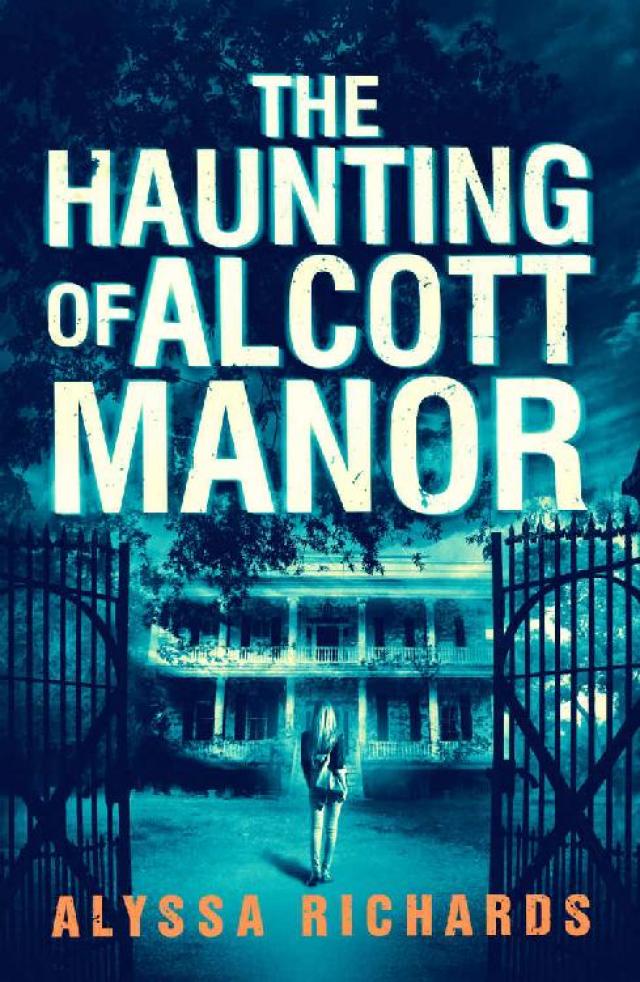
The Haunting of Alcott Manor, page 23
part #1 of Alcott Manor Series


“What we have is real. This could work,” he said. “People have private relationships all the time. They keep them out of public view to protect them. I think if you just give this a chance, you’ll discover it can work quite well. It already has.”
She laughed through the pain. “Think about it. We couldn’t even go to dinner together. We couldn’t go to the movies or have vacations. We couldn’t take a walk on the beach while holding hands. I couldn’t introduce you to my father, my brothers, or my friends. The most important part of my life would always be in hiding—invisible to everyone I care about.” She glanced at the Alcott family tree.
He ran his hands across the sides of his head. “Gemma, we’ll work this out. We have each other.”
“You're a ghost, Henry! There's no working it out! And what about—there would never be children. There would never be a family.” She thought of the slamming screen door and the sandy feet and the sweet giggles that once again eluded her.
He leaned against the wall, defeated. His eyes had lost their sparkle. “No. You’re right about that. We could never have children together.”
“Our lives would never work as a couple. Not to mention that I’d be written off as a nutcase at some point. I’d be the crazy lady who constantly talked to someone who wasn’t there.”
“A love like ours doesn’t come around very often. I’m proof of that,” he said. “Please, let’s just give this some time. We can figure this out.”
“Time is on our side. That’s what you said.” She scoffed. “Because time doesn’t pass for you anymore, does it?”
Tears glistened in his eyes. “I think because of you, for the first time in what for most people would be two lifetimes, I have hope that time will finally move forward for me again. With your help, I think I could finally leave this house and start a new life. One that has nothing to do with my old life. That tragic end will finally find the healing it needs and that house will let go of me forever.”
She shook her head. "So, that's why you did it. You helped me work on the house because it would help you. Benjamin. It would finally free you from your suffering. That's the real reason."
He closed his eyes and sighed. "Do you have any idea how many people I have seen come through the manor over the past century? How many people have claimed to remove Benjamin from the house? I had long given up on anyone being able to help me. When I said I could begin a new life, I meant a new life with you.
“Your work, Gemma, on the land, it did shift things. Maybe not as much as you wanted. But I can feel the beginning of it. And you. Your care, your love. It changed me.” He caressed her face. “I know you were happy, too.”
“I was happy. Truly happy. There was a big part of who you are that I didn’t know about, though. That changes everything, obviously.” She moved his hand from her face. “I know what I want. What I need. I want us—I wanted us with a future and a family. I wanted to live a full life with you.”
“We could have a good life together. It might not be exactly as you planned. Nothing ever is.”
She rubbed the back of her neck. “You are not capable of a future, Henry. You are the past. Besides, what would happen to me in the middle of the night when you turn into Benjamin? What would I do then? Hand you a towel so you don’t drip blood on the carpet? Or would I need to run for my life?”
“Nothing bad happened to you when we were together at the manor.” His tone was soft, apologetic.
A shiver ran across her skin. “I had no idea I was taking my life in my hands by being with you.”
“You were safe with me,” he said.
She turned away. “No one is ever truly safe with a ghost.”
She felt oddly stupid. Fooled. She should have stayed loyal to her work, focused on the job. Henry was as she had originally thought, too perfect for paper, too good to be true.
"Where was the real Henry Alcott my father worked with? The one he wanted me to meet?"
"He lives in London most of the time but was on site when your parents were here. He left before you arrived.”
"So, when I met you and called you Henry, you just didn't correct me, did you?"
"I was stunned that you saw me. When we shook hands, I felt your touch. I felt something between us. That hadn't happened in a long time. So, no, I didn't correct you."
"I can’t do this.” She spun away from him.
“Gemma.”
“No! Just. Leave.”
Chapter 29
Gemma sat in the corner of the Historical Society’s Alcott Manor exhibit area. There was no noise, just the heavy quiet of her disappointment that weighed on her like a lead blanket.
Realizing that someone you loved isn’t who you thought they were was a death. The one you trusted, the one you gave your heart to, was gone. No notice, no reasonable explanation. Their deceit just ripped them from you while you were left to figure out how to stitch yourself back together and move on.
He was a ghost. The walking dead. Even her mother would have advised her against this one, and she tended to have a special compassion for ghosts. “Most of them don’t even know they’re dead, honey,” her mother had often told her. “How can you not have compassion for someone like that?”
She shook her head. Henry knew he was dead. He’d known all along, and he hadn’t told her. The real Henry Alcott who worked in London wasn't even on site anymore. She and Tom and miserable little Paisley were the only ones in charge.
What an idiot she was not to be able to tell the difference. Her mother occasionally mistook a ghost for real now and then. She told Gemma a story of how they entered a house they were working on in Minnesota one summer. The owner had just passed away, and the daughter wanted the home, which was also her childhood home, restored. Gemma’s mother was the first one to arrive. She met a lovely woman who said she was the previous owner’s sister. She showed Gemma’s mother around the home and described exactly what she wanted to be done. She also told her about a secret hiding place where the owner’s private papers were held.
When the daughter showed up, Gemma’s mother told her about the lovely conversation she had with the woman. The daughter said that sounded exactly like her great aunt but that she had been dead for ten years.
A heavy door slammed at the back of the Historical Society. She didn't move. Under normal circumstances, she would have hopped up and introduced herself to whoever was on their way in. As it was, she just sat there. She couldn't bring herself to be sociable. She felt sort of invisible to life, anyway. Maybe they wouldn't notice her.
An older woman with short, white-gray hair tottered in low, fat heels across the room, never the wiser that Gemma was seated in the corner. A large ring of keys jingled like muted bells.
When she reached the front door, she flipped all the locks and turned the open sign to closed. A short while later, Gemma heard the back door slam shut. All was silent again.
She decided that either the lady had been hard of hearing and hadn't heard Gemma come in, or maybe she had left the building for a few minutes. That was the way it often went with smaller town businesses. If they wanted to step out for coffee or a sandwich, they just did. Being gone for fifteen minutes here or there didn't usually make a difference. Though she might have wanted to lock the door before she left.
She inhaled a deep breath. At least they had done well with the manor. The deadline was tomorrow, and Asher would not get his way with the property. Tom would take Judge Wertheimer and his committee through the house and show him all the marvelous progress on the restoration. That would give the judge a strong sense of confidence that a full restoration was not only possible, but imminent, and that would move them on to the next phase of the job.
She realized she would have to find someone to take her place for the final stage of the work. She couldn't work there with Henry, and he couldn't leave.
The anniversary of Anna’s death was tomorrow, as well. Whatever happened as a result of that wouldn’t occur until after the judge’s tour, late into the evening. By then, they’d be home free.
Her dad’s company would get paid, his financial problems would be over, and she would go back to life as it had been before Alcott Manor.
She rose out of her corner and strolled through the exhibit. Henry mentioned that this is where they kept the Alcott's furniture until recently when Paisley had it brought back to the house for the inspection. And didn't he say that they had most everything stored here for a while?
There was a room dedicated to every major era in Charleston's history. She wandered through most of them until she found what she needed: a door marked Employees Only.
Immediately inside was an employee break room, sparsely decorated with a round table and plastic chairs, a microwave, and a fridge. An industrial-looking door opened into a small, disorganized room with brown boxes of files that smelled damp. The wooden door marked PRIVATE led to a narrow but packed library. Six shelves lined every wall, chock-full with books of all shapes and a few antiques, including old box cameras.
"Banzai," she whispered.
She started on the left, just behind the door where materials beginning with the letter A were located. Alcott Manor took up five of the six shelves in that section. Figuring that no one would be back in the museum until morning, she helped herself to every book and scrapbook on the manor and piled them on the rectangular table in the middle of the room.
The seams of the first scrapbook crackled when she opened it. In the dust that rose from the center pages, she heard violins, laughter, and tears, and she saw a billowing of dreams birthed and lost. As was the standard cycle with the manor.
Inside the album were interior photos of the Alcott home that highlighted endless decorating and design details. She’d make sure these were referenced in the final stages of the restoration. Red was a common theme throughout the manor, as was often customary in many Victorian-era homes. Every two pages displayed a new room of black and white photos, but red was an easy color to decipher—red couches in the library, red curtains in the dining room, red everything in Benjamin’s room.
She turned another crisp page. Only Anna’s room held minimal touches of red. In the deep crevice of the two pages devoted to Anna’s boudoir was a frayed and faded ribbon, lavender in color, with a tiny skeleton key tied to the end. The kind that might fit into a diary lock, she wondered? Or some keepsake box of Anna’s? She slipped the key into her pocket. Whatever it fit into might be around the museum somewhere. Maybe it held some valuable piece of information she could use.
She finished that scrapbook and moved on to the next volume of Alcott history. She no longer trusted Henry to be her source of information on the house. Neither should she. He was most likely keeping something else from her. Something that probably made him look bad.
The next book was a collection of yellowed newspaper clippings. Tiny bits of peace and hope fluttered under the tips of her fingers. Now that she had these books, she'd figure out what gave the house its tragic aura and its scent of death that literally moaned from its timber.
Chapter 30
Henry stood in the empty winter garden that had been his hideaway with Gemma. He kicked the blankets, and they folded over on one another. She had every reason to be upset with him. He had gone to great lengths to make sure she wouldn't find out his true identity. For his own sake, he would admit that. His existence here over the last century had been solitary, lonely, and sad. Aside from a few psychics who could confirm his existence, no one saw him. No one interacted with him—certainly not the way that Gemma did.
But he had also kept his secret for her. He knew she needed to finish the work her parents had started.
She had respected him, enjoyed his company, and he knew she had fallen in love with him. At least, she used to feel that way.
His eyes scanned the glass walls that surrounded what used to be Anna's favorite room. When she was alive, he gave up almost everything to help Anna, only to discover that she had betrayed him in every way. The news of Lizzie Mae's parentage stuck in his heart—he had loved that beautiful girl as his own.
Once again, he had helped someone who needed it, a woman who he thought might appreciate his kindness, who he hoped to spend a lifetime with.
Once again, he was wrong.
His future stretched out ahead of him like his past, full of broken dreams and lost hope. The old rage bubbled inside of him, and he let it rise, let it change him into someone he should never have become. Someone he would never escape.
With one hand, he held on to the edge of the white marble fireplace and pulled. It split from the wall with a terrifying rip and burst into shards when it hit the floor. Before he left the room, he turned his hardened stare to the wall to see if a handwritten note had been hidden there.
There was nothing.
He disappeared through the wall and into the main living areas of Alcott Manor to do the only thing he could do, continue his search for that damned suicide note.
Chapter 31
The courthouse was smothering with its inadequate air conditioning and too-large crowds of disgruntled citizens who would rather have been anywhere but there. Gemma pushed her way through the front revolving doors with scores of other people, then waited in the security line.
She’d arrived early at the manor only to find Tom, Paisley, and their attorney, Morris “Mo” Pate jumping into their cars. Tom wanted to meet with Judge Wertheimer before they commenced with the tour, which Gemma agreed to, as long as the tour didn’t extend into the evening. The manor couldn’t be trusted at night. Especially not this night.
Several police cars were also parked in the driveway. Gemma assumed Tom brought them in to protect the house and their work. Smart.
Once on the other side of the security sensors, she found a portable marquis that listed the names of all the cases to be heard that day. Fortunately, it wasn’t a large courthouse, and their courtroom was easy to find.
It was fairly empty, and a few men in business suits were on the opposite side. Others, she didn’t recognize, and she thought were probably Alcott family members. She identified Asher Cardill, who sat on the front row on the opposite side, looking smug and whispering to the men in suits. Someone sat next to him who looked familiar to her, but she couldn't quite place her.
She found an available seat on a bench halfway to the front and squeezed in. When the woman who sat next to Asher turned all the way around to speak with someone behind her, Gemma recognized her. It was Layla Alcott. Her father's nurse. Asher put his arm around her and Gemma frowned. Layla was far too genuine of a person to be hanging around someone like him.
She hated to think it, but she wondered if he married her for her last name and the stock she held because of it. She remembered Layla saying that she wanted the property restored. But if Asher had any idea that he was due Alcott stock, as well, the two of them together would wield a lot of voting power. His company might even be the one to develop the land. The promise of cash might persuade Layla to vote for financial comfort instead of her conscience.
The clerk brought the court to order, and everyone stood noisily when the judge walked in.
“Mr. Pate, your client was given the final chance to make significant progress with the restoration of Alcott Manor. Did they accomplish this, and do you have proof of the results before we take our tour?”
“They did, your honor.” Morris Pate, attorney for the side of the Alcott Family who wanted the restoration, stood and handed a stack of photos to the bailiff, who delivered them to the judge. "We have video, as well, your honor."
The judge flipped through photos. “This will do.” He dropped the photos on his desk and picked up a stack of papers and began to sign. “We’ll meet at the manor at twelve thirty then.”
One of the suited men near Asher stood and raised his hand. His dark hair was slicked straight back, and Gemma thought she caught a whiff of his perfumey cologne. “Your honor, if I may?”
“What do you want?”
“I’m Tim Jessup, an attorney representing the other half of the Alcott family.”
"I know who you are," the judge said. "What do you want?"
"Your honor, I would hazard a guess that those photos you’re looking at there do not reflect the most recent state of Alcott Manor. Otherwise, I don’t think they would show them to you.”
The judge stared over his half glasses at Morris Pate in such a way that demanded an answer.
“Your honor. The fact that he knows this suggests foul play,” Morris said.
“What are you talking about Mr. Pate?”
“Your honor, last night, between the hours of ten p.m. and six o’clock this morning, a crime was committed. Alcott Manor was vandalized. That Mr. Jessup knows about this shows not only that he had immediate knowledge of the incident, but that he or someone from his organization was involved.”
Gemma shook her head. “Oh, no, Henry,” she whispered. Her heart dove headfirst and landed hard. He destroyed the house after she broke it off with him.
The judge banged his gavel. “When were you going to tell me this, and where in the hell was your security?”
“I was about to tell you, but I wanted it established first that my client satisfied their obligation prior to the deadline. We had security. He was killed last night by whoever destroyed several key elements of our restoration.” Morris Pate handed the judge several additional pieces of paper, along with photos attached. "Officer Dobbs with the Charleston Police Department is here if you have any questions." He waved to the officer who sat two rows behind Gemma.
“Another death? Murdered?” The judge’s baritone voice pitched high. The lines on his forehead deepened and lifted and showed no patience. “Jesus, Morris.”
The judge crumpled up the piece of paper in front of him and tossed it to the side. He picked up another pack of stapled papers and started signing. “I’ve given your client plenty of time to get this deathtrap into shape, Mr. Pate. There won’t be any more chances.”