

Ever After, page 1


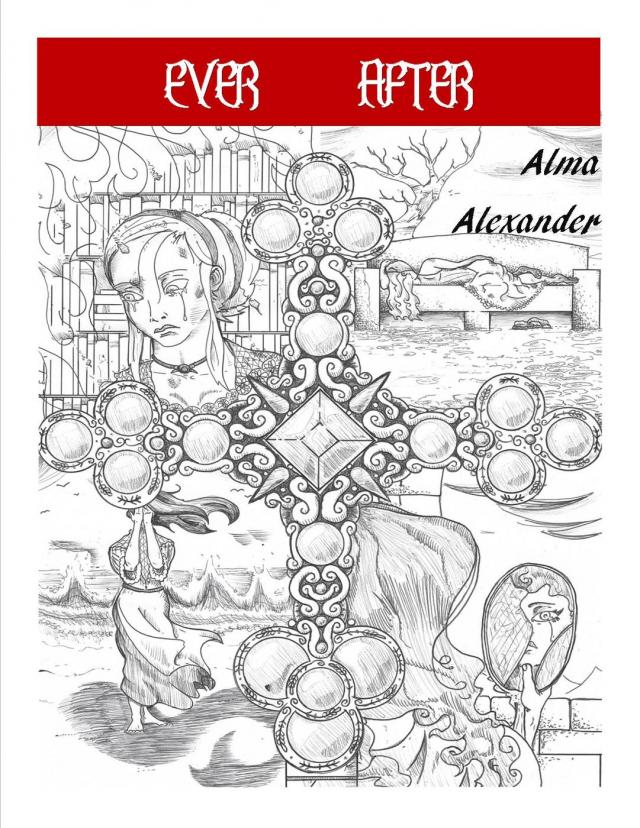
Table of Contents
Title Page
Ever After
1. Princess of Ashes
2. Princess of Pain
3. Princess of Dreams
4. Princess of Lies
Sign up for Alma Alexander's Mailing List
Ever After:
A Story of Four Princesses
Alma Alexander
Kos Books
343 Sudden Valley Drive
Bellingham WA 98229
COPYRIGHT © 2017 ALMA Alexander
ILLUSTRATIONS AND COVER design: matthewtroub82
Book design: Alma Alexander
1. Princess of Ashes
I REMEMBER FIRE.
Fire rose all around me. There was no other color in the world except the grim and purifying red, and orange, and gold. It licked the walls, and brought them down, and then there was dust in the ashes, and the air was roiling smoke, a visible thing, thick and difficult to breathe. There were people who tried to wrap rags around my nose and mouth, to help me suck in what oxygen remained without inhaling the fine choking debris of what had once been home. There were people who helped me stagger out of the inferno, there were people who carried me for a while, after, because I was too weak to stand. I remember the strange stasis my mind was in, stuck in that fire. Part of me drifted without conscious thought in the shadows of that thick smoke – but when I was aware that I was thinking it was the flames that stayed with me.
It was a very long time before I began to think of other things, of the things before the flames, of the things the flames had devoured. And it was only then, really, that the pain began. When the flames were dead, and the air had cleared and got to the wounds the flames left behind.
“What is that one about, Grandfather?”
“That one is poetry. All of those are poetry. I read you some poems from that green book, remember? The one about the flowers?”
“But that one...?”
He chuckled, a sound that was his alone, something that I would always carry with me as an identifying memory – that distinctive small laugh that was the expression of his delight, often aimed at the young me when I said something he found interesting or endearing.
“There is time enough for that one, little one, when you understand a little more of what passes between a man and a woman. Some day. But that is still to come. We can read some more from the green book, for now.”
He might as well have forbidden me to think about elephants (because we all know that once that is done we can think of nothing but elephants ever after). I listened dutifully as he read me more poems from the green book and they were lovely poems, to be sure, but now I knew that there were others that should have been mine, but were Not For Me, not just yet, there were things I was – well – not precisely forbidden, but told I would not understand.
And I rebelled against that. I would understand! There was a part of me that was wise! How dare anyone forbid me any words that existed out there, because they thought those words were beyond me?
The book I had asked about was not removed or sequestered. My grandfather’s word was assumed to be enough – it was his library, after all, and I was his granddaughter, and we all lived under his rules. And, mostly, I obeyed them. Mostly.
I took down the book stealthily, later, and avidly turned the pages.
I was annoyed to discover that Grandfather had been right. I did not really understand what some of the poems meant, although the words themselves were not that hard – I understood the words perfectly, it was the truth behind them that eluded me. I was precocious in many ways but that in itself preserved other kinds of innocence. I was very learned with words and concepts – I understood much at a young age – but I sought my experiences within books and not really with people. Not then. Not yet. And words that spoke of passion for people were strange to me. That, I did not understand completely. The idea that communication could be through touch and scent and sound, as well as through the eyes and the mind. All that was still just a nebulous idea. After all, when I wasn’t in this library, I was still playing with dolls.
Stories, even there. Making up stories about these blank-faced creatures with their staring eyes and painted half-smiles on rosebud mouths which hinted at secrets they would not tell me. So I made up my own stories about them, and made it their truth. Because they were silent, otherwise, and could not tell me different. After I had sneaked my look into the books with those other poems, the ones my grandfather told me were not for my eyes and soul yet, I tried those stories on the dolls, the stories that the poems were telling me. There was something strange and exciting and enticing about creating stories that I didn’t fully understand but knew they were built on pure human passion, for these passionless frozen creatures who would never know any except what I chose to visit upon them. But still, those strange painted smiles. Maybe they knew more than ever they realized.
The smell of Grandmother’s bread that sometimes greeted me when I woke into the warm light of the mornings of my life, rubbing my eyes free of sleep and the dreams that had come in the night. I would come downstairs to the kitchen and Grandmother would be there, and bread would be cooling on the rack on top of the range, and Grandfather might give me a quick smile over the top of his teacup. Mother might be fussing with breakfast. I don’t remember my father in these scenes, much. I don’t know why he seldom shared mornings. My mother used to say that he was grumpy when he woke up and that he was better left alone. I had visions of my father as a great bear waking from slumber, a creature not to be disturbed until he deigned to turn back into a mere man.
The smell. Of bread.
Just baked in a hot oven.
There was always fire, it seems.
There was the knitting. There were several bundled projects on individual sets of needles in various rooms, for the various women in my family to work on. At the same time, my grandmother might be working a pair of socks in the kitchen in the intervals between fussing with food and on a sweater for one of my cousins in the parlor. My mother might be purling up something that would end up on my back come winter, or else working the crochet hook diligently while she created a baby blanket for someone in the family who was expecting (it was a rambling family and someone was always expecting).
I was taught, and there were times there were my projects in the works, too. I knitted things for the dolls, mostly, because the grown-ups had the real people covered. But I did a scarf, once. All by myself. And wore it proudly enough, despite the fact that I had made a mistake about halfway in and it had been too much effort to unravel and fix so I just ignored it and carried on as though it had never happened. It was a scarf that was made from ten different yarn remnants anyway, its textures wildly varying from lacy with long fragile hairy fibers to chunky solid knit that was close to three dimensional. I loved that scarf, actually. Mostly because... it was a story. It was a lot of stories, unfinished stories, knitted into one bigger story.
It was like my family, in a way. Like my days, raveled into a life. Like my country. Like my world. The scarf, itself, defined, described, identified, but with an identity that only existed because so many other smaller identities had been subsumed into it. Whispered memories of yarn remnants – ‘I was made into a sweater’ – ‘I was made into a blanket’ – ‘I was socks, or mittens’ – now all wrapped up into one – ‘I am a scarf’. I am something different, new, whole. No matter how many remnants went into the making of me. No matter how many stories.
I was not a stupid or unobservant child and the things that went on in the wider world around me did not entirely fail to touch me. I knew there was trouble in the world. There was always trouble. I knew that sometimes my grandfather’s worried frown would be smoothed over deliberately for my benefit when I walked into a room unexpectedly. There was at once a sense that he was reading those poetry books of his with a renewed passion, as though seeking salvation in them from something bigger and darker that he could see coming for him, and that he was not reading them at all anymore, because that bigger and darker thing had already eaten that part of him that knew how to care.
But words were his memories. They were what he carried with him.
“It will pass,” he would say, cryptically, to me and not to me, staring out of the window into a street which was curiously empty – or maybe curiously full of hurrying and furtive people who were doing their best not to be seen by other hurrying and furtive people. You didn’t want to know anyone else’s business, in these days. It was dangerous. A little knowledge – even knowledge you didn’t realize you had – could destroy you.
I understood that. The poems, the stories, had taught me that a long time ago.
It will pass.
It will pass.
It was a hope, a prayer. But it was not answered.
Things do not pass. Things end. In fire.
They carried me, and many came beside us – some in cars and trucks, but those were increasingly left behind by the wayside, abandoned, as they ran out of gas and no more was to be found, or the seeking of it would mean more danger than it was worth. After a while we all walked. Even I, when they stopped carrying me and set me down on my own feet. I walked.
It was cold, at night, when we would all stop and wait for day to come again. I shivered. They found a blanket. I wondered what had become of my scarf, whether it was part of the ashes and dust I remembered.
What had become of the books, the poems, the stories, the dolls? The unfinished knitting? The unbaked bread?
All, all fed into the f ire...?
I bore its scars. My hand was burned, because I had been reaching for something that was already out of reach. Perhaps the scarf. Who could remember?
They picked ashes out of my clothes, from my hair. Someone had a hairbrush and my mother drew it through my tangled locks, almost tenderly.
“Look,” she said, that first night, brushing my hair, “you still have cinders in your hair. Poor baby. My poor poor baby. My little Cinderella.”
We walked. And I remembered fire. And I remembered ashes. And I thought about the cinders in my hair.
Someday, I will go back. I want to read those books that my grandfather had thought I had been too young for – someday, when I am old enough to understand. That was something that was taken from me, by fire, by ashes. But I will not let that fire consume my mind or my heart or the memories I carried away from the inferno.
Because one day, I will go back. And I will rebuild.
I will use the memory of fire. Ashes are fragile and without strength or substance... but they carry within them that memory. And if I have to, I will build from cinders.
2. Princess of Pain
THERE WILL BE STORIES TOLD, AFTER. There always are.
They will be wrong. They often are.
Because this is the truth of it. Yes, I fell in love. Yes, I left the sea. But I never wanted to.
You don’t need to know my name, or his. I was not a sea princess (as the tales will tell). He was not a prince. We were ordinary, he and I, of our kinds. And we met by accident – when I was singing on the rocks, as we all do, as we are supposed to do, singing the song of the sea, and he came by, on the shore, at an hour when none should have been abroad, and stopped to listen and was enthralled.
He never saw me. He only heard. I saw him, though. I saw him there on the shore in the moonlight, his fair hair shining in the bone white light, his arms bare and muscled coming out of a sleeveless jerkin which left them and his broad chest exposed, the tight dark trousers which hugged his slim legs, the broad bare feet planted into the sand.
His legs. His bare feet.
I faltered in my song, just a little. He never knew it. But the sea did, and the sea responded. There was a storm off the shore that day, a storm that raised waves higher than they remembered seeing before, a storm which shattered fishing boats against the pier where they had been tied. One of them, his. The man from the beach. The man the sight of whom had caused me to falter and fail and bring the storm upon the ocean, and upon those who walked the land that swept down to it.
They made me go, the powers of the sea. They took me, and they broke me. They took my voice so that I could never speak to him and make him understand; that I could never sing again. And they split apart my tail to give me the legs that I had so admired in the moonlight. They gave me the gift of grace, at that, and I never walked as though I had never walked before or didn’t know how. I suppose I should thank them for that. But the gift was a sharp and bitter one and it came at such a price that it might not have been reckoned to have been a gift at all.
The pain.
The pain of the splitting of my tail to form these two legs, these two bare feet – rendered afresh with every step I took on dry land. I was driven from the water and made to walk on knives, out there on the ground. And I was never to show any of it. I could not. I was made not to. All the agony screamed on the inside. My face did not reflect it. My voice never could again.
There was some talk that if I atoned sufficiently – doing what, I was never quite clear – it might all be given back. But I already knew that I could not return. I was no longer the creature I had been, and would never be that creature again – a refugee from my own past, my own being, my own identity, driven away forever. I had to find a home, make a home, where I could – or drift forever, alone and unmoored, silent, in a world of pain.
He had a woman living in his cottage with him. Not his wife. Not a bad woman, simple, a little coarse, a woman of no sophistication or elegance or beauty. She was ordinary enough. But she clearly filled his need – she put food before him every day, she washed his clothing free of the smell of fish, she warmed his bed at night. There was a child, even – but the way he behaved towards the boy it might have been his son or it might have been someone else’s, part of the bargain with the woman, that he would take them both in and give them a roof and their daily bread.
It was not with pleasure that I set out to destroy that, particularly since I heard them talk and laugh together and I knew that he would never talk or laugh like that with me. How could he? When I could not return any of it in kind? But even though it would matter at all whether or not I got him to swear he loved me – I would never get my tail back, or my song, or my life in the sea, no matter what I did – he was what had got me thrown out, driven away into exile. If I couldn’t have my home and my identity, both taken from me, at least I would take him. Because he was the reason of my exile, he would be my reward, the only thing of value that was worth the price I had paid for all of this.
So I showed myself, a little, every day. I smiled at him. I know how to steal a man’s soul. It’s what we do, the sea creatures, we, and the sea, together, since time began. But it wasn’t his soul I was taking, it was his heart, and his mind, and his body. And those were harder to get, and to keep.
She knew, his woman. She knew me for what I was – or she suspected something, anyway. She tried to warn him. But mine were eyes that were deep, the deep blue of the deepest ocean, and hers... were ordinary, brown, close-set, suspicious. Mine was the pale amber hair which spilled luxuriantly over my shoulders, falling down my back, forward over my breasts demurely tucked into their chemise, and hers... was straight and pale and lank, the color of dirty dishwater, and smelling of fish. Mine were lips the color of coral, and hers were sea-rough, chapped, split, broken. When he first kissed me, I knew that he tasted that difference – and it was already over, by then. Because by the time of the second kiss I was the one living in the cottage by the sea, not her, and not the child (I had been right about that. Not his. He would not have given up his so readily.)
I knew that after a while he regretted the bargain. That he missed her. And the boy.
But by then he was mine, and I was his, and that was the way things were.
That is the love story that they would write fairy tales about.
Only... they would paint it in a different palette. They would paint it with passion, and not with raw need. They would paint it with choice and not a desperate seeking of sanctuary and survival. They would paint it sweetly and prettily, and it was not. The coupling at night was sometimes hard, and harsh, and there was pain, on both sides. We loved one another, I think, yes. But not in the fairy tale way.
When the child came, it all broke open.
Because his daughter – I could never bear male progeny, he would have no sons of me – was born with the tail, and her voice, even then, at birth, when she first cried out, had the song of the sea in it. He might not have heard that song, perhaps, if all else had been equal – but the evidence of otherness was already there and once you saw the tail on the tiny creature you could not help hearing the difference in her voice.
I watched him fall to his knees beside the birthing chair where the midwife had abandoned me and my baby in horror and fled to spread the tale to the rest of the fisherfolk. I watched him kneel, and I watched him weep.
And because this was given to me – that once, just once, I might speak again aloud, here on the shore – I chose to do it now.
“I am sorry,” I said to him, and my voice was harsh, rusty from disuse, bitter from its long silence. “I could not tell you. I was not permitted.”
“Why?” he asked, he begged, turning his head away from the child. “Why? Why me?”
“You heard me sing,” I said. “Once, on the shore. And I saw you there. And the sight of you broke my heart, and my song. And the sea does not forgive.”
The other words were left unspoken but they were there. Will you...? Can you? Can you forgive? Forgive this – the depth of this deception, as deep as the deep blue sea? How can you?


