

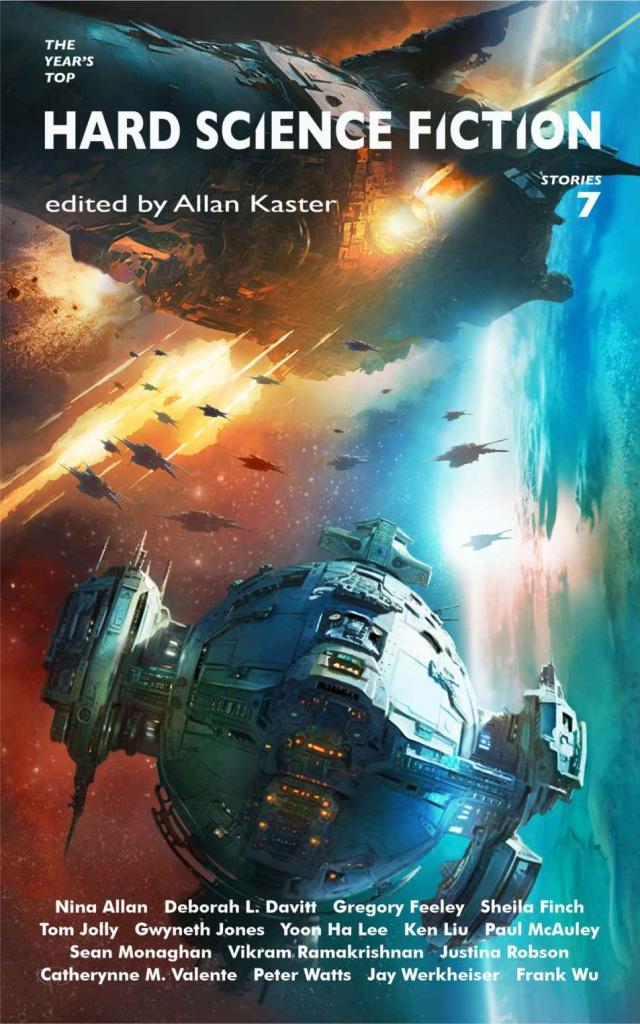
The Year's Top Hard Science Fiction Stories 7, page 1


http://www.audiotexttapes.net
Copyright
© 2023 by Allan Kaster.
All rights reserved.
These short stories are works of fiction. All of the characters, organizations, and events portrayed in these stories are either products of the authors’ imaginations or are used fictitiously.
The scanning, uploading, and distribution of this book via the Internet or any other means without permission of the publisher is illegal, and punishable by law. Please purchase only authorized electronic editions, and do not participate in or encourage the electronic piracy of copyrighted materials. Your support of the authors’ right is appreciated.
Cover art © Maurizio Manzieri
Also Edited by Allan Kaster
The Year’s Top Hard Science Fiction Stories, # 1-6
The Year’s Top Robot and AI Stories, # 1-3
The Year’s Top Tales of Space and Time, # 1-2
The Year’s Top Ten Tales of Science Fiction, # 1-10
The Year’s Top Short SF Novels, # 1-8
The 2020 Look at Space Opera Book
The 2020 Look at Mars Fiction Book
mini-Masterpieces of Science Fiction
Great Science Fiction Stories
Timeless Time Travel Tales
Steampunk Specs
Starship Vectors
We, Robots
Aliens Rule
ACKNOWLEDGMENTS
“The Difference Between Love and Time” by Catherynne M. Valente. Copyright © 2022 by Catherynne M. Valente. First published in Someone in Time: Tales of Time-Crossed Romance (Solaris), edited by Jonathan Strahan. Reprinted by permission of the author.
“Maryon’s Gift” by Paul McAuley. Copyright © 2022 by Paul McAuley. First published in Asimov’s Science Fiction, March/April 2022. Reprinted by permission of the author.
“Goldie” by Sean Monaghan. Copyright © 2022 by Sean Monaghan. First published in Asimov’s Science Fiction, January/February 2022. Reprinted by permission of the author.
“The Wine-Dark Deep” by Sheila Finch. Copyright © 2022 by Sheila Finch. First published in Asimov’s Science Fiction, May/June 2022. Reprinted by permission of the author.
“The Lichens” by Nina Allan. Copyright © 2022 by Nina Allan. First published in Someone in Time: Tales of Time-Crossed Romance (Solaris), edited by Jonathan Strahan. Reprinted by permission of the author.
“Beneath the Surface, a Womb of Ice” by Deborah L. Davitt. Copyright © 2022 by Deborah L. Davitt. First published in Analog Science Fiction and Fact, November/December 2022. Reprinted by permission of the author.
“The Ploughshare and the Storm” by Gwyneth Jones. Copyright © 2022 by Gwyneth Jones. First published in New Worlds Issue #1 (PS Publishing Ltd.), edited by Nick Gevers and Peter Crowther. Reprinted by permission of the author.
“Cloudchaser” by Tom Jolly. Copyright © 2022 by Tom Jolly. First published in Analog Science Fiction and Fact, January/February 2022. Reprinted by permission of the author.
“Critical Mass” by Peter Watts. Copyright © 2022 by Peter Watts. First published electronically on Lightspeed Magazine, July 2022. Reprinted by permission of the author.
“Nonstandard Candles” by Yoon Ha Lee. Copyright © 2022 by Yoon Ha Lee. First published electronically on The Sunday Morning Transport, March 6, 2022. Reprinted by permission of the author.
“The Abacus and the Infinite Vessel” by Vikram Ramakrishnan. Copyright © 2022 by Vikram Ramakrishnan. First published in Asimov’s Science Fiction, May/June 2022. Reprinted by permission of the author.
“Timekeepers’ Symphony” by Ken Liu. Copyright © 2022 by Ken Liu. First published in Clarkesworld, September 2022. Reprinted by permission of the author.
“I Give You the Moon” by Justina Robson. Copyright © 2022 by Justina Robson. First published in Tomorrow’s Parties: Life in the Anthropocene (The MIT Press), edited by Jonathan Strahan. Reprinted by permission of the author.
“A Stone’s Throw” by Gregory Feeley. Copyright © 2022 by Gregory Feeley. First published in Analog Science Fiction and Fact, September/October 2022. Reprinted by permission of the author.
“Communion” by Jay Werkheiser & Frank Wu. Copyright © 2022 by Jay Werkheiser & Frank Wu. First published in Analog Science Fiction and Fact, January/February 2022. Reprinted by permission of the author.
Introduction
Allan Kaster
I like stories that push my reader buttons: characters done wrong; sense of wonder ignited; funny bone tickled; sense of justice thwarted; etc. So much the better when these buttons are being pushed within space adventures, time travels, and the many other subgenres of science fiction. In this regard, the past year was a particularly strong one for hard science fiction.
This year’s volume of The Year’s Top Hard Science Fiction Stories includes stories set on Earth, on Mars, on moons, on planets far away, and in space. There’s a wonderful mix of the sciences in these stories including botany, biology, microbiology, physics, chemistry, as well as biochemistry. Nine of the authors whose stories are featured here are new to this series, which bodes well for the future of this genre.
Story snapshots are below.
“The Lichens” by Nina Allan
—a 22nd century botanist asks a teacher in Scotland, at the time of Culloden, for help with her research.
“Beneath the Surface, a Womb of Ice” by Deborah L. Davitt
—a biochemist involved in the search for underground water on Mars finds refuge in the mechanics of science.
“A Stone’s Throw” by Gregory Feeley
—romance burns hot amidst the cold moons of Neptune.
“The Wine-Dark Deep” by Sheila Finch
—a cephalopod researcher discovers petroglyphs on the walls of a deep underwater cave.
“Cloudchaser” by Tom Jolly
—a collector of rare artifacts hides his valuables on darkworlds.
“The Ploughshare and the Storm” by Gwyneth Jones
—post-humans find a time capsule on Europa.
“Nonstandard Candles” by Yoon Ha Lee
—a cartographer and her apprentice map the outer darkness of space.
“Timekeepers’ Symphony” by Ken Liu
—the colonization of the cosmos transforms humanity’s sense of time.
“Maryon’s Gift” by Paul McAuley
—set in the author’s Jackaroo universe, monks fight to keep a newly discovered pristine world free of humans.
“Goldie” by Sean Monaghan
—scientists learn a lot about themselves while studying the ecosystems of an alien planet.
“The Abacus and the Infinite Vessel” by Vikram Ramakrishnan
—a scientist recalls the struggles of her and her mother after immigrating to Mars.
“I Give You the Moon” by Justina Robson
—a history student yearns for a dose of reality in an AR-immersed future.
“The Difference Between Love and Time” by Catherynne M. Valente
—a woman has a relationship with the space-time continuum that’s a bit different than most of us.
“Critical Mass” by Peter Watts
—an avant-garde artist, past his prime, discovers his works are being vandalized.
“Communion” by Jay Werkheiser and Frank Wu
—a pilot is caught in a life and death struggle between his ship’s AI and an alien microbe after crash landing on an ice moon.
I hope you have as much fun reading these stories as I did. Get set to have some of your reader buttons pushed.
Allan Kaster
Houston, Texas
February, 2023
The Diffence Between Love and Time
Catherynne M. Valente
THE SPACE/TIME CONTINUUM is the sum total of all that ever was or will be or ever possibly could have been or might conceivably exist and/or occur, the constantly tangling braid of physical and theoretical reality, (steadily degrading) temporal processes, and the interactions between the aforementioned.
It is also left-handed.
It is, as you have probably always suspected, non-linear, non-anthropic, non-Euclidean, and wholly non-sensical.
In point of fact, it’s a complete goddamned mess.
It has severe social anxiety.
And a weakness for leather jackets.
◆◆◆
We first met when I was six. Our fathers arranged a playdate. The space/time continuum looked like a boy my own age, with thick glasses in plastic Army camouflage-printed frames, a cute little baby afro, and a faded T-shirt with the old mascot for the poison control hotline on it. Mr. Yuk, grimacing on the chest of time and space, sticking out his admonishing green Yuk-tongue. POISON HELP! 1-800-222-1222.
It smelled like lavender and bread baking in a stone oven.
I said I wanted to play Lego.
It looked helplessly at me with big brown eyes magnified into enormity by prescription lenses like hockey pucks.
It picked up a black block with an arch in it. Part of the drawbridge in my Medieval Castle Siege playset. The space/time continuum handed me the black arch and opened its mouth and the sound of a pulsar spinning, turning, thumping through silver-deafening radio static came out instead of “Where does this piece go?” or “It’s nice to meet you” or “The idea of your shitty Lego drawbridge amusing me for even a nanosecond is hilarious on a geological scale.”
◆◆◆
The space/time continuum is a manifold topology whose coordinates can and frequently do map onto certain physical states, events, bodies. But that map looks like one of those old paper diner menus with a giant squiggle on it labelled Enter Here on one side and You Win! on the other.
And it changes all the time.
And you can’t win.
And the crayon evaporates in your hand and rematerializes in your hospital bassinet under the Welcome Baby! card.
Or on the surface of the moon.
◆◆◆
It doesn’t care for television except for re-runs of Law & Order. It cannot get enough of predictability. It says every episode is a bizarre upside-down bubble universe in which justice exists and things make sense.
◆◆◆
The first real actual word the space/time continuum ever said to me was: “Nothing.”
The first words I said to it were: “You can’t just go around saying ‘nothing’ to people, it’s weird. Do you want my extra Capri Sun?”
The space/time continuum wrapped its skinny baby arms around me and whispered it again in my ear: “Nothing.”
I didn’t like being hugged then. I yelled for my mom. She didn’t come for a long time.
◆◆◆
In high school, the space/time continuum looked like a scene kid with a million flannels and ironic shirts, a long black undercut, and a patch on his backpack from some band called Timeclaw. It got in a lot of trouble for drawing or carving or scratching its initial in desks all over the place, this funky S that kinda also looks like a pointy figure 8. But not lying on its side like the infinity symbol. Infinity standing up.
I’ve seen them everywhere. Still do. The space/time continuum gets around.
You’ve probably seen it, too.
It failed all its classes but shop. It was always punctual at the circular saw. It never failed to make a perfect version of the assignment from oak, birch, ash, even plastic. Every day, it brought me the objects it had been compelled to make by Mr. Wooton. A model PT Cruiser. A wooden orchid. A puzzle shaped like an iguana. My favorite was this bare green circuit board with a little lightbulb on it that flared to life if you put your finger in the right place. It used you to complete the circuit.
The space/time continuum and I sat behind the bike racks for hours after school smoking weed and putting our fingers in the right places.
◆◆◆
Ocean Shores, WA is not the space/time continuum, though it is, of necessity, an inescapable part of it. Ocean Shores, WA is a city that used to be a pretty big deal and is now not even a little deal.
See, back in the sixties, the state of Washington thought maybe it would legalize gambling because fuck it, why not, and people started buying up all the land and building nightclubs and hotels and gold courses and bungalows and boardwalks so that when the legislature hit the buzzer, the good times would be ready to roll. All kinds of movie stars and rich people’s girlfriends and purveyors of semi-legal entertainment poured in from California. But then the state of Washington thought maybe it would not legalize gambling so now there’s just a lot of cold sand dunes and closed attractions and motels with names like Tides Inn or Mermaid’s Rest Motor Court and Weigh Station.
Ocean Shores is hollowed out like a gourd someone meant to make into a drum for a beautiful party. But they wandered off and maybe even forgot what drums are to begin with so now it’s just an empty scraped-out dead vegetable lying on a cold beach nobody would ever hold a party on.
And then a seagull shits in it.
My mom and my dad and me used to always drive down for the last weekend of summer. Dad would always give me a riddle that I had to solve by the end of the trip. Like the one with the wolf and the chicken and the bag of grain or what has a ring but no finger? I’d play the twenty-year old games on the last remaining boardwalk while my parents argued about what to do with me under the white noise of the waves.
Eventually dad left and it was just me and mom. We’d rent a bungalow that was once destined to be Jayne Mansfield’s fuck grotto or whatever and sit in the moldy jacuzzi freezing our asses off, singing showtunes to the seals and shipping freighters out at sea.
The space/time continuum thinks Ocean Shores was at its best when only dinosaurs lived there.
◆◆◆
I asked the space/time continuum who its mother was once. Did she have fluffy curly hair like mine, did she smell nice like mine, was her name Alice like mine, did she sniffle a lot like she was crying even though she usually wasn’t like mine, did she always pack a fruit and a vegetable in his lunchbox (a Lisa Frank purple-blue cosmic orca one that I secretly coveted)?
The space/time continuum glanced nervously at the ashy green blackboard at the front of our classroom. This made me dislike the space/time continuum, as at the time many of the children liked to make fun of me for being dimwitted, even though I do all right. But it gave no other answer, and only a long time later did I consider that it was not looking at the blackboard at all, but the eraser.
◆◆◆
When the space/time continuum stuck that black Lego arch over the scuffed blue moat pieces, it stopped being a Medieval Castle Siege playset and started being a Cartoon Sparkle Rainbow Geoduck playset.
Our dads didn’t notice. They just kept drinking beers, one after the other, lifting the red and white Ranier cans to their lips and setting them down automatically after each rhythmic sip like they were beer-drinking machines stuck in an infinite recursion function.
The space/time continuum in the Mr. Yuk shirt smiled at me shyly. It was giving me a gift. It wanted desperately to please me. I was not pleased. I liked my Medieval Castle Siege playset a lot. It came with four different colored horse minifigs. Geoducks are weird gross dumb giant clams that live in the mud for a thousand years and come with zero horse minifigs. Their shells aren’t rainbow-striped and they don’t have friendly eyes with big long eyelashes and smiling mouths and they definitely don’t sparkle.
I didn’t even think Lego made a Cartoon Sparkle Rainbow Geoduck playset.
But the space/time continuum’s eyelashes were very long, too. So I said thank you.
It made the pulsar sound again.
◆◆◆
You have to understand I was alone a lot of the time. It came and went as it pleased. But not because it was afraid to commit. The space/time continuum asked me to marry it when I was eight and we were pretending to fish with branches and string in the pond behind the primate research labs on the edge of town. I couldn’t figure out why the fish weren’t biting. I was going to bring my mom the biggest salmon you ever saw and she was gonna say how good I was and be so happy instead of staring at the dish soap for an hour while I watched the Muppets, but the stupid fish weren’t on board with my plan.
That time, the space/time continuum looked like a girl my age with a red NO NUKES shirt on under her overalls. It said: We didn’t bring any bait. Or hooks. And there are no fish in this pond because it’s not really a pond, it’s a big puddle that dries up as soon as there’s no rain for a week. Be my wife forever, limited puddle-being.
I said: Shut up, your face is a puddle.
The space/time continuum lay its pigtailed head on my shoulder as the sunset sloshed liquid pink and gold and said: We are a house and a hill.
Okay, weirdo.
But we were already holding hands so tight, without even noticing it.


