

The Year's Top Hard Science Fiction Stories, page 1
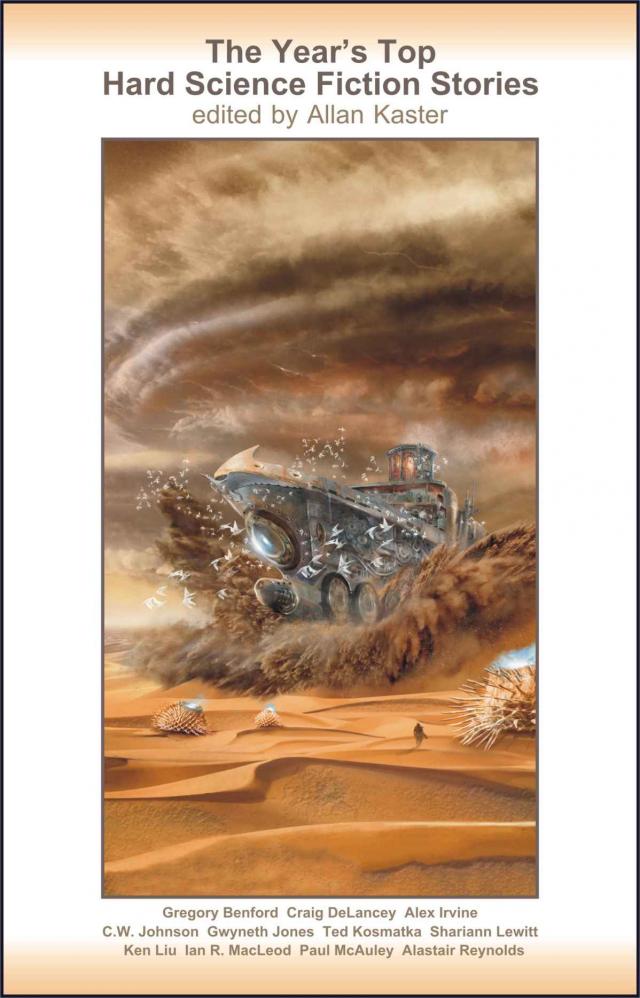


The Year’s Top Hard Science Fiction Stories
edited by Allan Kaster
http://www.audiotexttapes.net
Copyright
© 2017 by AudioText and Allan Kaster
All Rights Reserved
All characters and events in this book are fictitious. All resemblance to persons living or dead is coincidental.
The scanning, uploading, and distribution of this book via the Internet or any other means without permission of the publisher is illegal, and punishable by law. Please purchase only authorized electronic editions, and do not participate in or encourage the electronic piracy of copyrighted materials. Your support of the authors' rights is appreciated.
Also edited by Allan Kaster
The Year's Top Ten Tales of Science Fiction
(audiobook)
The Year's Top Ten Tales of Science Fiction 2
(audiobook & e-book)
The Year's Top Ten Tales of Science Fiction 3
(audiobook & e-book)
The Year's Top Ten Tales of Science Fiction 4
(audiobook & e-book)
The Year's Top Ten Tales of Science Fiction 5
(audiobook & e-book)
The Year's Top Ten Tales of Science Fiction 6
(audiobook & e-book)
The Year's Top Ten Tales of Science Fiction 7
(audiobook & e-book)
The Year's Top Ten Tales of Science Fiction 8
(audiobook, trade paperback & e-book)
The Year's Top Ten Tales of Science Fiction 9
(audiobook, trade paperback & e-book)
The Year's Top Short SF Novels
(audiobook & e-book)
The Year's Top Short SF Novels 2
(audiobook & e-book)
The Year's Top Short SF Novels 3
(audiobook & e-book)
The Year's Top Short SF Novels 4
(audiobook & e-book)
The Year's Top Short SF Novels 5
(audiobook & e-book)
The Year's Top Short SF Novels 6
(audiobook, trade paperback & e-book)
The Year's Top Short SF Novels 7
(forthcoming)
The Year's Top Hard Science Fiction Stories
(audiobook, trade paperback & e-book)
mini-Masterpieces of Science Fiction
(audiobook)
Aliens Rule
(audiobook)
We, Robots
(audiobook)
Starship Vectors
(audiobook)
Timeless Time Travel Tales
(audiobook & e-book)
Steampunk Specs
(audiobook & e-book)
Acknowledgements
“Seven Birthdays” copyright © 2016 by Ken Liu. First published in Bridging Infinity (Solaris), edited by Jonathan Strahan. Reprinted by permission of the author.
“Sixteen Questions for Kamala Chatterjee” copyright © 2016 by Alastair Reynolds. First published in Bridging Infinity (Solaris), edited by Jonathan Strahan. Reprinted by permission of the author.
“Number Nine Moon” copyright © 2016 by Spilogale, Inc. First published in The Magazine of Fantasy & Science Fiction, January/February 2016. Reprinted by permission of the author.
“Chasing Ivory” copyright © 2016 by Dell Magazines. First published in Asimov's Science Fiction, January 2016. Reprinted by permission of the author.
“Something Happened Here, But We're Not Quite Sure What It Was” copyright © 2016 by Paul McAuley. First published on Tor.com, July 2016. Reprinted by permission of the author.
“Of the Beast in the Belly” copyright © 2016 by Dell Magazines. First published in Asimov's Science Fiction, April/May 2016. Reprinted by permission of the author.
“RedKing” copyright © 2016 by Craig DeLancey. First published in Lightspeed, March 2016. Reprinted by permission of the author.
“Vortex” copyright © 2016 by Spilogale, Inc. First published in The Magazine of Fantasy & Science Fiction, January/February 2016. Reprinted by permission of the author.
“The Visitor from Taured” copyright © 2016 by Dell Magazines. First published in Asimov's Science Fiction, September 2016. Reprinted by permission of the author.
“The Seventh Gamer” copyright © 2016 by Gwyneth Jones. First published in To Shape the Dark (Candlewick), edited by Athena Andreadis. Reprinted by permission of the author.
"Fieldwork" copyright © 2016 by Shariann Lewitt. First published in To Shape the Dark (Candlewick), edited by Athena Andreadis. Reprinted by permission of the author.
Seven Birthdays
Ken Liu
7:
THE WIDE LAWN SPREADS out before me almost to the golden surf of the sea, separated by the narrow dark tan band of the beach. The setting sun is bright and warm, the breeze a gentle caress against my arms and face.
“I want to wait a little longer,” I say.
“It’s going to get dark soon,” Dad says.
I chew my bottom lip. “Text her again.”
He shakes his head. “We’ve left her enough messages.”
I look around. Most people have already left the park. The first hint of the evening chill is in the air.
“All right.” I try not to sound disappointed. You shouldn’t be disappointed when something happens over and over again, right? “Let’s fly,” I say.
Dad holds up the kite, a diamond with a painted fairy and two long ribbon tails. I picked it out this morning from the store at the park gate because the fairy’s face reminded me of Mom.
“Ready?” Dad asks.
I nod.
“Go!”
I run toward the sea, toward the burning sky and the melting, orange sun. Dad lets go of the kite, and I feel the fwoomp as it lifts into the air, pulling the string in my hand taut.
“Don’t look back! Keep running and let the string out slowly like I taught you.”
I run. Like Snow White through the forest. Like Cinderella as the clock strikes midnight. Like the Monkey King trying to escape the Buddha’s hand. Like Aeneas pursued by Juno’s stormy rage. I unspool the string as a sudden gust of wind makes me squint, my heart thumping in time with my pumping legs.
“It’s up!”
I slow down, stop, and turn to look. The fairy is in the air, tugging at my hands to let go. I hold on to the handles of the spool, imagining the fairy lifting me into the air so that we can soar together over the Pacific, like Mom and Dad used to dangle me by my arms between them.
“Mia!”
I look over and see Mom striding across the lawn, her long black hair streaming in the breeze like the kite’s tails. She stops before me, kneels on the grass, wraps me in a hug, squeezing my face against hers. She smells like her shampoo, like summer rain and wildflowers, a fragrance that I get to experience only once every few weeks.
“Sorry I’m late,” she says, her voice muffled against my cheek. “Happy birthday!”
I want to give her a kiss, and I don’t want to. The kite line slackens, and I give the line a hard jerk like Dad taught me. It’s very important for me to keep the kite in the air. I don’t know why. Maybe it has to do with the need to kiss her and not kiss her.
Dad jogs up. He doesn’t say anything about the time. He doesn’t mention that we missed our dinner reservation.
Mom gives me a kiss and pulls her face away, but keeps her arms around me. “Something came up,” she says, her voice even, controlled. “Ambassador Chao-Walker’s flight was delayed and she managed to squeeze me in for three hours at the airport. I had to walk her through the details of the solar management plan before the Shanghai Forum next week. It was important.”
“It always is,” Dad says.
Mom’s arms tense against me. This has always been their pattern, even when they used to live together. Unasked for explanations. Accusations that don’t sound like accusations.
Gently, I wriggle out of her embrace. “Look.”
This has always been part of the pattern too: my trying to break their pattern. I can’t help but think there’s a simple solution, something I can do to make it all better.
I point up at the kite, hoping she’ll see how I picked out a fairy whose face looks like hers. But the kite is too high up now for her to notice the resemblance. I’ve let out all the string. The long line droops gently like a ladder connecting the Earth to heaven, the highest segment glowing golden in the dying rays of the sun.
“It’s lovely,” she says. “Someday, when things quiet down a little, I’ll take you to see the kite festival back where I grew up, on the other side of the Pacific. You’ll love it.”
“We’ll have to fly then,” I say.
“Yes,” she says. “Don’t be afraid to fly. I fly all the time.”
I’m not afraid, but I nod anyway to show that I’m assured. I don’t ask when “someday” is going to be.
“I wish the kite could fly higher,” I say, desperate to keep the words flowing, as though unspooling more conversation will keep something precious aloft. “If I cut the line, will it fly across the Pacific?”
After a moment, Mom says, “Not really…. The kite stays up only because of the line. A k ite is just like a plane, and the pulling force from your line acts like thrust. Did you know that the first airplanes the Wright Brothers made were actually kites? They learned how to make wings that way. Someday I’ll show you how the kite generates lift—”
“Sure it will,” Dad interrupts. “It will fly across the Pacific. It’s your birthday. Anything is possible.”
Neither of them says anything after that.
I don’t tell Dad that I enjoy listening to Mom talk about machines and engineering and history and other things that I don’t fully understand. I don’t tell her that I already know that the kite wouldn’t fly across the ocean—I was just trying to get her to talk to me instead of defending herself. I don’t tell him that I’m too old to believe anything is possible on my birthday—I wished for them not to fight, and look how that has turned out. I don’t tell her that I know she doesn’t mean to break her promises to me, but it still hurts when she does. I don’t tell them that I wish I could cut the line that ties me to their wings—the tugging on my heart from their competing winds is too much.
I know they love me even if they no longer love each other; but knowing doesn’t make it any easier.
Slowly, the sun sinks into the ocean; slowly, the stars wink to life in the sky. The kite has disappeared among the stars. I imagine the fairy visiting each star to give it a playful kiss.
Mom pulls out her phone and types furiously.
“I’m guessing you haven’t had dinner,” Dad says.
“No. Not lunch either. Been running around all day,” Mom says, not looking up from the screen.
“There is a pretty good vegan place I just discovered a few blocks from the parking lot,” Dad says. “Maybe we can pick up a cake from the sweet shop on the way and ask them to serve it after dinner.”
“Um-hum.”
“Would you put that away?” Dad says. “Please.”
Mom takes a deep breath and puts the phone away. “I’m trying to change my flight to a later one so I can spend more time with Mia.”
“You can’t even stay with us one night?”
“I have to be in D.C. in the morning to meet with Professor Chakrabarti and Senator Frug.”
Dad’s face hardens. “For someone so concerned about the state of our planet, you certainly fly a lot. If you and your clients didn’t always want to move faster and ship more—”
“You know perfectly well my clients aren’t the reason I’m doing this—”
“I know it’s really easy to deceive yourself. But you’re working for the most colossal corporations and autocratic governments—”
“I’m working on a technical solution instead of empty promises! We have an ethical duty to all of humanity. I’m fighting for the eighty percent of the world’s population living on under ten dollars—”
Unnoticed by the colossi in my life, I let the kite pull me away. Their arguing voices fade in the wind. Step by step, I walk closer to the pounding surf, the line tugging me toward the stars.
49:
THE WHEELCHAIR IS HAVING trouble making Mom comfortable.
First the chair tries to raise the seat so that her eyes are level with the screen of the ancient computer I found for her. But even with her bent back and hunched-over shoulders, she’s having trouble reaching the keyboard on the desk below. As she stretches her trembling fingers toward the keys, the chair descends. She pecks out a few letters and numbers, struggles to look up at the screen, now towering above her. The motors hum as the chair lifts her again. Ad infinitum.
Over three thousand robots work under the supervision of three nurses to take care of the needs of some three hundred residents in Sunset Homes. This is how we die now. Out of sight. Dependent on the wisdom of machines. The pinnacle of Western civilization.
I walk over and prop up the keyboard with a stack of old hardcover books taken from her home before I sold it. The motors stop humming. A simple hack for a complicated problem, the sort of thing she would appreciate.
She looks at me, her clouded eyes devoid of recognition.
“Mom, it’s me,” I say. Then, after a second, I add, “Your daughter, Mia.”
She has some good days, I recall the words of the chief nurse. Doing math seems to calm her down. Thank you for suggesting that.
She examines my face. “No,” she says. She hesitates for a second. “Mia is seven.”
Then she turns back to her computer and continues pecking out numbers on the keyboard. “Need to plot the demographic and conflict curves again,” she mutters. “Gotta show them this is the only way….”
I sit down on the small bed. I suppose it should sting—the fact that she remembers her outdated computations better than she remembers me. But she is already so far away, a kite barely tethered to this world by the thin strand of her obsession with dimming the Earth’s sky, that I cannot summon up the outrage or heartache.
I’m familiar with the patterns of her mind, imprisoned in that Swiss cheesed brain. She doesn’t remember what happened yesterday, or the week before, or much of the past few decades. She doesn’t remember my face or the names of my two husbands. She doesn’t remember Dad’s funeral. I don’t bother showing her pictures from Abby’s graduation or the video of Thomas’s wedding.
The only thing left to talk about is my work. There’s no expectation that she’ll remember the names I bring up or understand the problems I’m trying to solve. I tell her the difficulties of scanning the human mind, the complications of recreating carbon-based computation in silicon, the promise of a hardware upgrade for the fragile human brain that seems so close and yet so far away. It’s mostly a monologue. She’s comfortable with the flow of technical jargon. It’s enough that she’s listening, that she’s not hurrying to fly somewhere else.
She stops her calculations. “What day is today?” she asks.
“It’s my—Mia’s birthday,” I say.
“I should go see her,” she says. “I just need to finish this—”
“Why don’t we take a walk together outside?” I ask. “She likes being out in the sun.”
“The sun…. It’s too bright….” she mutters. Then she pulls her hands away from the keyboard. “All right.”
The wheelchair nimbly rolls next to me through the corridors until we’re outside. Screaming children are running helter-skelter over the wide lawn like energized electrons while white-haired and wrinkled residents sit in distinct clusters like nuclei scattered in vacuum. Spending time with children is supposed to improve the mood of the aged, and so Sunset Homes tries to recreate the tribal bonfire and the village hearth with busloads of kindergarteners.
She squints against the bright glow of the sun. “Mia is here?”
“We’ll look for her.”
We walk through the hubbub together, looking for the ghost of her memory. Gradually, she opens up and begins to talk to me about her life.
“Anthropogenic global warming is real,” she says. “But the mainstream consensus is far too optimistic. The reality is much worse. For our children’s sake, we must solve it in our time.”
Thomas and Abby have long stopped accompanying me on these visits to a grandmother who no longer knows who they are. I don’t blame them. She’s as much a stranger to them as they’re to her. They have no memories of her baking cookies for them on lazy summer afternoons or allowing them to stay up way past their bedtime to browse cartoons on tablets. She has always been at best a distant presence in their lives, most felt when she paid for their college tuition with a single check. A fairy godmother as unreal as those tales of how the Earth had once been doomed.
She cares more about the idea of future generations than her actual children and grandchildren. I know I’m being unfair, but the truth is often unfair.
“Left unchecked, much of East Asia will become uninhabitable in a century,” she says. “When you plot out a record of little ice ages and mini warm periods in our history, you get a record of mass migrations, wars, genocides. Do you understand?”
A giggling girl dashes in front of us; the wheelchair grinds to a halt. A gaggle of boys and girls run past us, chasing the little girl.
“The rich countries, who did the most polluting, want the poor countries to stop development and stop consuming so much energy,” she says. “They think it’s equitable to tell the poor to pay for the sins of the rich, to make those with darker skins stop trying to catch up to those with lighter skins.”


