

Shimmer Number 22, November 2014, page 1


www.shimmerzine.com
Table of Contents
Editor's Note - E. Catherine Tobler
A Whisper In the Weld - Alix E. Harrow
Shimmer Interviews: Alix E. Harrow
Caretaker - Carlie St. George
Shimmer Interviews: Carlie St. George
Cantor’s Dragon - Craig DeLancey
Shimmer Interviews: Craig DeLancey
The One They Took Before - Kelly Sandoval
Shimmer Interviews: Kelly Sandoval
Authors
Artists
Staff
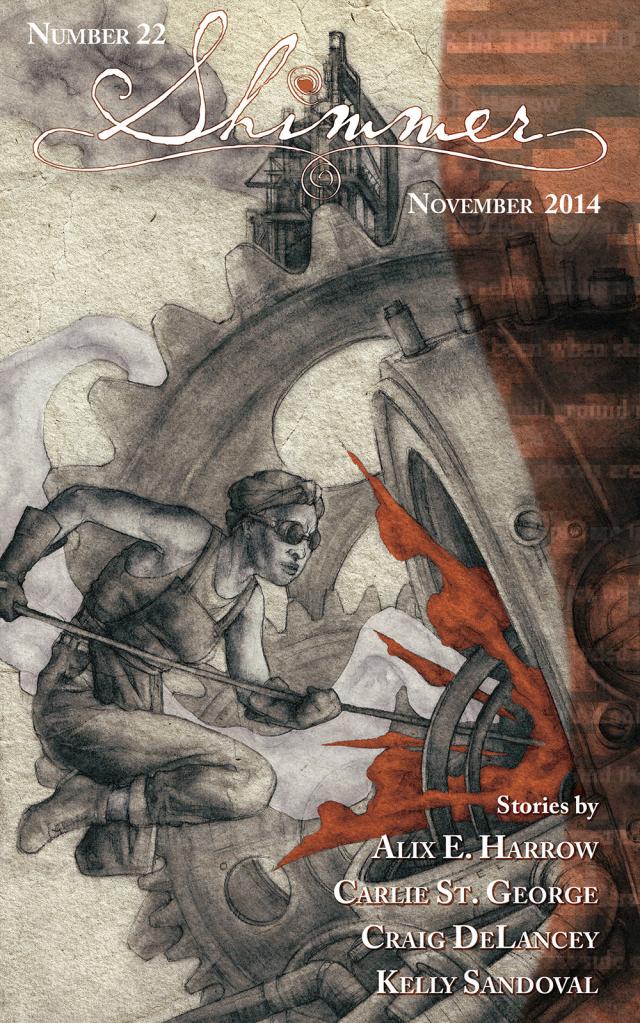
Front Cover: Illustration, Sandro Castelli; Design, Robert Lee
Shimmer is distributed every other month by Beth Wodzinski, HC 64 Box 2406 Castle Valley UT 84532 Issues: single $2.99 or $15 for a six-issue subscription. Submissions to shimmersubs@gmail.com. Copyrights to all stories and illustrations are the property of their creators. The contents of this publication may not be reproduced in whole or in part without the consent of the copyright holder.
Editor's Note
This has been one of the most challenging years I've ever experienced, personally and professionally. 2014 has contained losses—some we expected and some we never saw coming. 2014 has contained reams of bad news dropped upon, oh look, reams of bad news.
I wonder: was the world always like this and we just never knew, but now we can't not know, because we are constantly connected to a world larger than our neighborhoods; we are global now, "living in the future" we say, watching as events half the world away impact our daily lives.
We carry the world in our pockets—the news is always there, sought or not. No stumbling out to a newspaper box to get the headlines, they're already stacked in your phone. The news is no longer a sound bite on television—you can watch in real time as life, terrible and glorious life, unfolds in streets across the world. And that world is huge and often terrible, and overwhelming.
Time and again, because of that, I come back to short fiction.
A short story allows me to narrow my focus and slow my breath—I did this as a kid in school, too, though only in looking back did I realize it for what it was. For a few precious pages, I don't have to think about what is happening anywhere else; for half an hour, I can sink into a wholly new world—or a hidden aspect of our own—and vanish.
If you find yourself needing to pause and take a breath, I hope these four stories allow that. They explore loss and recovery in equal measure—all the thistles and dandelions growing up through Isa bloomed at once, out of season, in a riotous bouquet. These four stories close out an amazing Shimmer year, which means our printed annual is on the horizon. These four stories encompass a hope that we carry on in the face of strange doings; that we keep taking the next step, even if we don't know exactly where it leads.
As 2014 winds down, be excellent to each other, and remember to breathe.
E. Catherine Tobler
Senior Editor
A Whisper In the Weld
by Alix E. Harrow
Isa died in a sudden suffocation of boiling blood and iron cinder in her mouth; she returned to herself wearing a blue cotton dress stained with fresh tobacco. She was younger and leaner, as she’d been when she first met Leslie Bell. Her skin shone dark and warm without the black dust of the mill ground into it.
After death, ghosts are sculpted like cold clay into the shapes they wore when they were most alive. Some people are taken awfully by surprise. Women whose whole lives were about their husbands and homes are, without warning, precisely as they were when they met a stranger’s eyes on a crowded streetcar. Men who had the kinds of careers that involved velvet-lined train cars and cigar smoke are suddenly nine years old, running their spectral fingers through the tall grasses and thinking of nothing at all.
Isa wasn’t surprised by the blue cotton dress. She had always known what she was about.
She came back to herself, with a feeling like hot wire being drawn through the die, in the rusty gravel on the west side of the Sparrows Point steel mill. She was disoriented for a moment, used to seeing the mill like a distant map below her from the top of Betty the blast furnace: the glowing arcs of welders and the arterial railways pumping coal and ore and sand and coke through the mill, and the distant rows of clapboard homes where her daughters waited for The Adventures of Superman to come on the radio at 5:15.
The foreman was coming up the road towards the mill with his white arms resting across the shoulders of two young, dark girls. Isa’s children. Oh, she hated the weight of that arm on her daughters’ perfect shoulders. Vesta—tall, brave Vesta, who fried eggs every morning for her little sister before school—walked like a person who had lost the trick of it. Effie’s oversize lunch pail banged against the side of her leg with every step. Their faces were like stones, or the faces of children who have lost their mother and father, and seen the red-hot maw of the world open up beneath their feet.
Isa already knew, but her daughters’ faces told her she was truly dead and could never hold her children again. The rage and pain and wishing-away of it swallowed her whole and she lost track of herself for a while.
Ghosts don’t linger, much. A few days of strolling through the world, which is much too loud and bright, then the dirt calls them down to trickle amongst the low, burrowing things to lose the boundaries of themselves in the rich smell of rot. Some stay, in the name of love or vengeance, but most people are pragmatists at heart, and lay themselves down to rest.
Isa lingered. Leslie used to call her mule-headed. Some parts of herself frayed and tattered when she died—the taste of grits with molasses on them, the way her daughter’s tight-braided hair felt beneath her palm—but not the mule-headedness.
That first night she stayed so close to her daughters they felt a constant, humid chill down their necks. She walked beside them as they returned to their home, identical to a hundred other homes in Sparrows Point: a single, dirty box with a bare bulb dangling in the center, a leaky parlor stove in the corner. She touched the tears on Effie’s face with moth-wing fingers. She followed Vesta to the back stoop where, unwatched by her younger sister, she beat her fists on the stones and tore her tight braids lose. When her children finally closed their eyes in the center of the rope bed they shared, she lay down and slipped her arms around them. Effie shivered and burrowed further beneath the blankets.
Isa told herself she would only stay through that first terrible night. But dawn found her in the kitchen running frictionless fingers across the parlor stove, wanting badly to fall into the morning rhythm of coal and cooking. She pulled at the stove door, but she was a breeze blowing against a rusted-iron mountain, and it remained closed.
She pulled harder. The faint edges of her fingers frayed and spooled, half-slipping into the door, and she felt every humped weld and fractured seam in the parlor stove before it creaked obediently open.
She ripped away from it, reeling, and her other hand landed in the bowl of eggs on the counter. Beneath her weightless palms, the eggs rotted in their shells.
She did not touch anything else that morning, but huddled on a kitchen chair remembering the sweet slipping-away of her hands into the iron, feeling both fragile and dangerous.
Vesta rose and fixed breakfast, casting suspicious glances at the open stove and the faintly graying eggs. When her sister set a tin plate of grits in front of her, Effie burst into sudden, loud sobs.
“Effie. Effie, listen honey.” Vesta sounded so much like her mother that Isa’s hands shook. “Persephone.” The occult power of her full name stopped her.
Vesta sat and pulled her sister’s gangling legs into her lap, and spoke to her in a tone that no fifteen-year-old should have to use and no nine-year-old should have to hear. “Listen: Momma and Daddy are both dead, and it’s just us two girls left. But we can’t sit around and bawl about it, can we?” Effie’s expression said she didn’t see why not.
“No, we can’t," Vesta continued. "Remember what Momma did when they came to tell us about Daddy? She made biscuits and swept the floor and combed our hair.” And then she’d gone to the common privy and vomited until she had nothing left in her but bile and despair. Some of the neighbor women fluttered as though they might say something, but she bared her teeth at them like a feral creature and they’d all remembered things they had to rush home and tend.
“That’s what we’re going to do. We’re going to pack our lunches and go to school and come home and make beans and a hambone for dinner.” And, because they were each trying so fiercely for the other, that’s what they did.
Isa stayed in the house. She couldn’t wash their dishes or fold their nightgowns, flung across the bed with the abandon of children who haven’t yet realized there’s no one left to pick up after them. But she could murmur to Effie’s cat—a slinking, ugly animal that only a nine-year-old could think was pretty, alternately named Lord Snowflake or Dustbucket depending on the quantity of coal grit in his fur. He wound himself around Isa’s ankles, purring with the conviction of a former stray. He didn’t seem to mind that she was dead. Cats have never seen the allure of the dualistic philosophies that plague humans, and some of our most cherished divisions—between right and wrong, life and death, rodents which are acceptable to kill and songbirds which are apparently not—seem rather arbitrary to them. She stroked him, and pulled her thoughts away from the dark, Southern earth that called her.
< br /> In the early afternoon, Isa went to the edge of the bay and waited for Leslie’s ghost to come home to her across the ocean. She wondered if war had changed him, and if he’d died with one of her letters in his breast pocket.
Yellow-gray steam boiled out of the mill and hung over the Liberty ships bobbing in the bay like deadly toys. She saw the ships the way a surgeon might see a person, looking through their steel skins to the skeletons of beams and welds running through their bodies. Isa wondered if the men who went to war saw the labor of their wives and sisters in the steel around them. She wondered if their labor was winning the war and saving their soldiers, the way the posters said, or if it was all just coal tossed into the ravenous belly of war.
Leslie did not come.
She went to the bay every afternoon for days or maybe weeks; time is a humped and lurching thing for ghosts. Effie’s cat followed her, genially acknowledging the other ghosts they passed. Isa recognized some of them easily, but many of them were unfamiliar to her as their past selves. Few people were at their best in Sparrows Point; most of them had traded away the smell of summer rain on the fields for the heat and stink and incredible noise of the mill town, on the promise of a regular paycheck. Most of them dreamed of going home.
Isa dreamed too, during the long nights when she lay weightless beside her daughters. But ghosts only dream of the past.
She dreamed of her first day in the mill, hired because the foreman liked the way her shoulders pushed against the seams of her dress and the unfashionable shortness of her hair. “Just about like hiring a man, isn’t it Sissy?”
He clapped her on the back and led her to a group of other new women, and spoke to them all about the war and the state of the nation and the sacrifices everyone had to make. He handed out aprons and warned them that long hair, fingernails, and jewelry were safety hazards. Isa touched her locket, a tarnished heart containing three ebony curls of hair, and tucked the chain beneath her collar.
At first, they put her in the black places below the ground, shoveling coal. She became a sweating, muscled beast in the center of a labyrinth, trying to shovel her way out of the dark. Her dreams of that time were scattered and clogged with coal dust.
Moving up to the top gang was rising out of the underworld into spring. “This here is Betty, the biggest blast furnace in the East.” The woman training her was short and gap-toothed, with dark rings around her eyes where her goggles sat. Later, Isa would find out that her name was Mary and she was from Lewisburg and her twin brother was a mess man on the USS West Virginia and they would be friends.
“Listen, this is the truth: Betty Grable might keep our boys happy when they’re over there with nothing but a couple of pin-ups, but our Betty is the one that saves their goddamn lives.” Isa could tell it was a worn joke, but Mary was proud of it.
She worked years on the top gang, climbing up and down Betty’s vast, many-tentacled body twice a day. They kept the vents clean and the charger rolling and they skimmed the flammable dust off every surface. They couldn't speak to each other, with their faces buried in the rubber and metal of gas masks and the roar of the furnace deafening them, but they learned to read the language of each other’s bodies. When the wind blew the smog out over the bay and cleared the sky, when she and her team worked in a perfect dance of sinew and iron on top of the world, Isa was happy.
Often, Isa dreamed of Mary’s accident: Mary leaning over the hatch of the northernmost stove, hauling it open—a sheet of blue-white flame, Mary’s screams just audible over the mill's grinding thunder. Mary came back to work with her left arm a black and pink mass of lumped scar. One-handed, she was only good as a tin-flopper or a record-keeper.
Isa met Mary for lunch on her first day back and neither of them said a word about it. The foreman strolled by and thumped Mary on the back and told her she was a real trooper, and left a Moon Pie on the bench “in case she was homesick.”
Mary unwrapped the pie from its filmy plastic. Then she crushed it, methodically, beneath her boot. She said, calmly, “Goddamn them all to hell, Isa. They want you to think we’re serving God and country—and an old white man who sure as hell isn’t any uncle of ours. But we’re just serving Mr. Eugene Grace and his ten thousand foremen, always patting us on the goddamn back and calling us his girls. And you want to know the part that eats me up at night? Soon as my brother comes home they’ll boot me and my bum arm right out and I’ll never see a fair wage or the top of Betty again.”
Isa didn’t say anything. “Ah, you already know it. I know you do. This place swallows us whole and spits out bones.”
The rest of her dreams were of Leslie, and the girls when they were young.
Leslie did not come.
If Leslie could have come to her, he would have. It wasn’t something Isa believed about her husband, the way wives believe their husbands never look at other women or won’t drink up their paychecks, but something she knew about him and her and the shape of the thing between them. It was like knowing which way was north, or how much buttermilk to add to the biscuit dough.
She worried that death in battle was different, and Leslie’s ghost had been ripped asunder. But steel was war, too, and her death was surely no less violent and fiery and brave than his. Or maybe he’d gotten lost in the unfamiliar shapes of a foreign landscape.
But Leslie never got lost. If he could have come to her, he would have, and no oceans or continents could ever have stopped him. And so, no matter what those typewritten letters had said, shining up from the page like tiny, blackened bones, Isa knew her husband wasn’t dead.
The rush of elation and deepest sorrow almost unmade her—and oh, how sweetly the earth whispered to her, tempted her—but she snatched the fraying edges of herself and ran. She had always been long-legged, but now her steps ate up the ground in the weightless bounds of a doe. She passed children playing unattended on their stoops and laundry hung out to dry, absorbing the hot stink of coal smoke. Then she was outside the school, a sagging clapboard rectangle at the edge of the white neighborhood. Children poured down the steps.
Vesta held Effie’s hand in hers and did not look left or right. Isa fell in beside them, reaching reflexively to straighten their stiff collars and tuck away stray hairs before she stopped herself.
“Vesta and Persephone Bell?” The voice was clipped and northern. A white woman in a brown khaki dress stood in front of the girls. Everything from her square handbag to her narrow eyes said she had the authority of state behind her. Vesta regarded her with a flat, unimpressed stare which, if she hadn’t been fifteen years old, would have sliced right through the woman.
She only readjusted her round glasses. “Your parents were Leslie and Isa Bell, residents of Turner Station on Sparrows Point?” The past tense jarred Isa, but Vesta nodded.
“I’m Mrs. Patterson. I’m here to speak with you about your future now that your parents are at rest. Would you both please step back inside—”
Effie interrupted in a dangerous, chirpy tone that Isa knew very well. “Oh, Momma and Daddy aren’t resting anywhere, Miss Patty. Both their bodies got burned right up.” The woman blinked. “Well, we don’t know about Daddy—they said he was missing after a air raid. But Momma died cleaning the dust out from under the blast furnace. Couple hundred pounds of red-hot dust came down on her—poof. We didn’t get her body neither.”
Isa felt a sudden depth of sympathy for the state worker, whose mouth had fallen slightly open. In a certain mood, Effie could provoke preachers to cuss and sweet-natured dogs to bite. The woman gathered herself, and ushered Vesta and Effie back up the steps into the school. Isa drifted after them, a worried shadow in blue cotton.
The trio arranged themselves around a teacher’s boxy metal desk. The state worker explained to the girls that it had taken a while for their situation to become clear to the office, because their mother’s death wasn’t reported in a timely fashion. But they were legally orphans and couldn’t continue living on their own in company housing. They would come with her into the city to live as wards of the state. As a younger girl, Effie would be sent to St. Mary’s—


