And Time Stood Still, page 10


At the moment I am wondering about what we are doing to some of our funerals here in Ireland. Are we are turning them into reality TV? Funerals have turned into our biggest-attended church functions. Are they providing a connection point in our disconnected communities that have lost so many gathering points? This in itself is not a bad thing, but what about the bereaved? Do we need to have a look at what we are doing to the them? The bigger the tragedy, the bigger the crowds. Endless hours of hand-shaking, sometimes with people they do not even know, can turn into a mind-numbing exercise for traumatised people. Who can say slow down and think? Not the priest, because they are now almost afraid to open their mouths; not the undertaker, because he is providing a service; and certainly not the bereaved, who are too distraught to break the mould. It is preferable to the culture of pretending that death is ‘nothing at all’, but surely there must be a balance. Also the recent practice of taking large numbers of people to pubs and hotels after the funeral for a meal seems to me to be too much. This originated in the custom of taking people who had made a long journey back to the home for sustenance. But do big crowds comfort the bereaved? Also, at the time of a funeral nobody thinks of expense, but months afterwards bills have to be paid.
A few years ago I was at the funeral of a relative whose husband had died and as she was leaving the graveyard to go to a hotel as her children had arranged, she said plaintively, ‘I just want to go back to my own house.’ I said to her, ‘Do exactly as you want to do’, and she did. There is a lot of pressure on us to run with the herd, but there are times when we need to stop and work things out for ourselves.
Sometimes a project is good to focus the mind on something other than the all-consuming grief. While thus occupied, healing may happen and we could return to an easier place. Grieving is a Catch 22 situation! It saps our energy so we are unable to occupy ourselves with projects. Or we may go into a spin of activity as a distraction and exhaust ourselves.
Keeping Busy
Am I afraid to stop
In case all my pieces
Shatter apart?
Could I disintegrate
And never come back
Together again?
As we travel through grief we will work out what is best for us. Each person’s grief journey is unique to them and we all cope in different ways.
After Con died in 2001 I wrote a book that I never had published but it served its purpose in that it took over my mind; I siphoned my grief into it. When Gabriel died in 2005 I redesigned the garden and the hours of digging kept me sane. The work was tough on the body but good for the mind. After Ellen died in 2009 I had the house re-roofed and insulated – while it was in progress I slept in the attic and every morning woke up to the sound of hammering on the roof, so I had to get up!
Looking back now I realise that these were all coping mechanisms. When in the grief groove we can go around endlessly in the same circle of desolation. A project helps to lift us out temporarily and prevents us getting stuck in the groove. When we return from the project the groove has healed a little and we may not sink down as deep.
On the first occasion when I met a sympathiser and did not cry I felt a great sense of relief. Strands of normality are reassuring. Going somewhere for the first time after a bereavement is a huge effort.
The Gap
We had gone
There together.
Now I go alone
And cannot
Fill the space;
Want to go home
Lock myself in
Where I do not
Have to hold back tears
And pretend to be normal.
Secrets
You are gone
So now I walk
The beach alone.
I pick up
A small round stone
Glistening with sea and sand,
Massage it through my fingers.
The smooth hard stone
Withholds the secrets
Of sea and land.
Enclosed and impenetrable,
It is as incomprehensible
As death.
It is difficult if we get dragged to unappealing places but if there is the slightest chance that something might help I tried to go. Coming home to an empty chair gets more bearable the oftener we do it.
In death we need ritual but in grief we all cope in different ways. We each find our own coping skills and we have within us deep reservoirs of unquarried strength. We will dig into these as we struggle on and be amazed at the veins of endurance that are buried in there.
Glen Waterfall
The roaring waterfall
Blew the crust
Off the hard wound of grief.
As pain burst forth
It screamed aloud
With the raging torrents.
But the determined water
Penetrated into the depths
Of locked up grief,
Showed no mercy.
I cried and screamed
With anger and relief
As foaming water
Washed out imprisoned pain.
When the storm abated
Icy water had cleansed
My inner being.
I was more at ease
With my deep sorrow.
Linked by Love
You are gone
And I am here
Wounded by your going,
Grieving for togetherness.
But we are more
Than we have shared.
Let not my staying
Or your going
Divide us now
Because you and I
Are closer than
Our earthly bodies.
Our love a rainbow
Bridging life and death
Links us now.
Welcome
A long wet winter
Drowns our spirit.
With souls sodden
From sheeting rain
We welcome in
The light of spring.
As birds released
From locked cages
To fly again.
Easter
Planted a lilac tree
Gift from a friend.
It rose from the earth
Like the risen Christ.
Friendship and resurrection,
Branches of the same tree.
Kindness
The warmth of your kindness
Kept me in my mind;
Its worth could not be measured,
It had goodness undefined;
You held out a caring hand
When I was full of pain;
You thawed my frozen being
And made me live again.
OTHER BOOKS BY ALICE TAYLOR
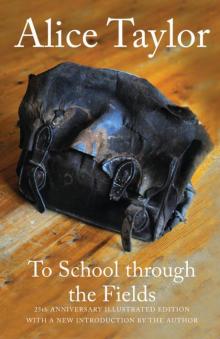
TO SCHOOL THROUGH THE FIELDS
Her classic account of growing up in the Irish countryside, the biggest-selling book ever published in Ireland.
THE PARISH
In a series of vignettes of life in her village, Taylor reasserts the priorities of public space and local community, and explores the potential for a future that achieves harmony between comfort and the pressing need to respect the environment.
THE VILLAGE
The third of Taylor`s unique accounts of life in the Irish countryside, and another massive bestseller with universal appeal.
THE NIGHT BEFORE CHRISTMAS
A nostalgic, loving look back to a family firmly rooted in tradition and humour and, in particular, the Christmas traditions of her childhood.
QUENCH THE LAMP
A witty and lyrical memoir centring on the 1950s when the author and her friends were budding teenagers. Evokes the past vividly and without complaint as the years of hard labour were also filled with fun in a close-knit community.
COUNTRY DAYS
Taylor takes her readers along the byways of Ireland and into the heart of the country. In stories by turn comic and poignant, she explores the character of family and friends, testing the bonds of concern and kindness which hold people together.
FICTION:
THE WOMAN OF THE HOUSE
A story of love for the home place and of the passions and jealousies it can inspire. Following his brutish father’s unlamented death, young Danny Conway strives to rescue the family farm from ruin.
ACROSS THE RIVER
Taylor’s second novel, a story of land, love and family set in rural Ireland. Sequel to The Woman of the House.
FOR A COMPLETE LIST OF BOOKS
BY ALICE TAYLOR,
SEE WWW.OBRIEN.IE
About the Author
Alice Taylor
I was born on a hillside farm in North Cork near the Kerry border overlooking an inspirational view from the McGillycuddy Reeks to the Galtee Mountains; it was akin to looking out at a giant watercolour painting. This farm and amazing landscape were the inspiration for my first six books and maybe, in many ways, for all my books. When I married a wonderful man I came to live in the little village of Innishannon in West Cork, and have been here ever since. Innishannon continued the inspiration begun on the home farm. It was a busy life, running the village shop, post office and a guest house, and rearing children, as well as being involved in all village activity. I love this village and have written about it in The Village and The Parish. For many years I was part of a busy, crowded household. I love gardening, painting and writing, and have two lively black Doberman dogs who keep me company.
ALICE’S BOOKS:
To School through the Fields
Quench the Lamp
The Night before Christmas
A Country Miscellany
Country Days
The Village
The Parish
The Journey
The Woman of the House
Across the River
House of Memories
An Evening with Alice Taylor (tape)
Copyright
This eBook edition first published 2012 by Brandon
an imprint of The O’Brien Press Ltd,
12 Terenure Road East, Rathgar, Dublin 6, Ireland
Tel: +353 1 4923333; Fax: +353 1 4922777
E-mail: books@obrien.ie
Website: www.obrien.ie
First published 2012
eBook ISBN: 978–1–84717–533–5
Text © copyright Alice Taylor 2012
Copyright for typesetting, layout, editing, design
© The O’Brien Press
Photographs, including cover image: Emma Byrne;
with thanks to Laura Feeney for plough p6; Mogue Doyle for collar and hames p45 and harness bridle p120; Mogue and Brigid Byrne for seat p37.
UNAUTHORISED COPYING IS ILLEGAL
All rights reserved. No part of this publication may be reproduced or utilised in any form or my any means, including electronic, digital, mechanical, visual or audio, or mounted on any network servers, without permission in writing from the publisher. Carrying out any unauthorised act in relation to a copyright work may result in both a civil claim for damages and criminal prosecution. For permission to copy any part of this publication contact The O’Brien Press Ltd at books@obrien.ie.
British Library Cataloguing-in-Publication Data
A catalogue record for this title
is available from the British Library
Alice Taylor, And Time Stood Still