

Wolf Road, page 21
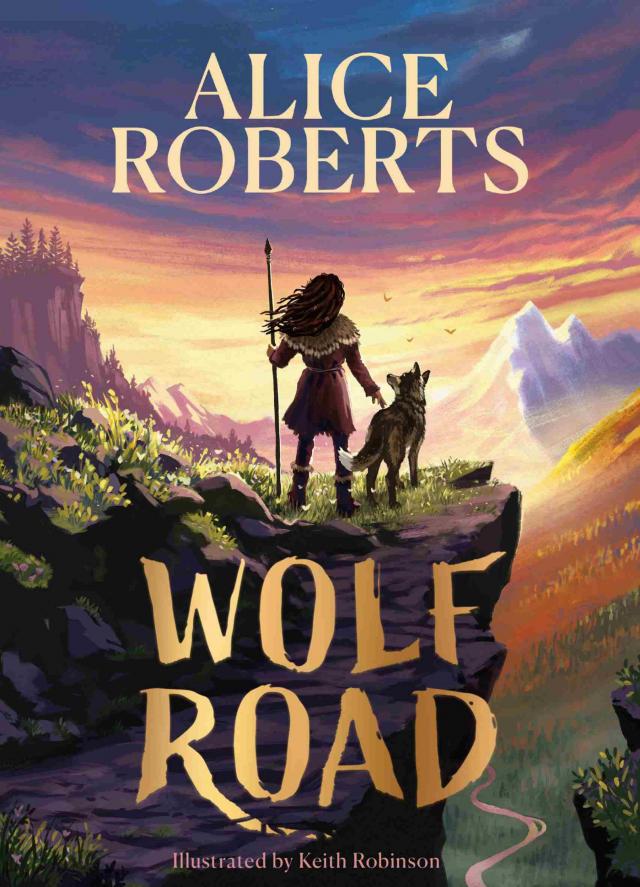


The languages spoken by Ice Age hunters are lost in time, but I have drawn on several sources for inspiration. I made contact with Sami-speakers Henrik Omma and Eva Isaksen; Henrik lives in Oxford, UK and Eva lives in Norway. As modern-day reindeer herder-hunters, the Sami people’s way of life is perhaps closest to that of Tuuli and her tribe. I was interested to learn how Sami people see themselves as very close to nature, and I have chosen bird and animal names for everyone in the tribe. Some of the names are inspired by Sami words, others by Finnish. I am not suggesting any of these modern languages are related to those spoken in Europe in the Palaeolithic; instead, it’s the connection of words with landscape that I wanted to use as inspiration. Eva and Henrik were happy for me to be creative in this way.
The name Tuuli comes from the Finnic word for ‘wind’; tuulihaukka means ‘wind hawk’ or ‘kestrel’ in Finnish; tuuletallaja is ‘kestrel’ in Estonian. (The equivalent in Sami is bieggafálli. Eva also told me about two different words for wind in her Sami language – biegga is simply ‘wind’, whereas borga is snow-wind). Aski comes from an old Sami word for the moon, aske; Nika comes from the name Niekija, in a traditional Sami story about the daughter of the moon.
The name of the mother goddess, also an earth goddess, in Tuuli’s culture – Ama – comes from the Basque for ‘mother’. Basque is a European language with very ancient roots. The god Hern is named after Herne the Hunter of English folklore, the Wild Huntsman, and here I’ve given myself licence to imagine a very deep past for him. There have been many European ‘gods of the hunt’, from the Celtic Cernunnos, whose name means ‘horn’, often depicted with antlers on his head, to the Norse god Odin, who the Romans saw as similar to their god Mercury. Perhaps they go back a long, long way.
Eva told me about Sami spirituality and the role of the shaman in the community. Shamans enter trances and go on ‘wanderings’, when they assume the form of an animal such as an eagle. Then they wake up and tell others what they have experienced. It’s very similar for other communities living in the Arctic, such as the Evenki reindeer herders of Siberia. Aski takes on that role of shaman and spiritual leader in my story.
The society of these Ice Age hunters is built around the tribe or ‘talo’ – which is itself an extended family. The word talo is Finnish and means ‘house’, and can be used in the sense of a wider family, particularly among reindeer herders, existing in unity with the landscape. The Sami word čearda (pronounced ‘seer-da’) means something similar – ‘home’ but also ‘big family’ – a community of close relatives.
Sami children tend to have a lot of freedom and independence. From around twelve years old, children may go off on expeditions with their friends. Children are allowed to make their own choices – and they’re expected to learn from their mistakes. Sami parents may try to avoid confrontation, waiting for a quiet moment to discuss difficult subjects. And as well as learning survival skills, children must learn how to get on with all sorts of people – because that’s key to survival, too. In this story, Tuuli is wary but, in the end, more accepting of the new stranger in their midst than many of the adults.
Andar’s name really does come from an ancient word meaning ‘other’. It comes from a very old germanic word andar or ander, which can be traced back to a very, very ancient word *an-tero – meaning: other, different. So it’s not really a name at all – it’s just a word that Tuuli’s ancestors used to describe another group of people who were ‘different’ from them. Andar has a different language to Tuuli, different clothes, and he makes his stone tools in a different way. His face, skin and hair colour are quite unusual, too.
Andar’s gift to Tuuli is a red-painted, pierced scallop shell. This shell is just like the one I was shown by archaeologist João Zilhão; he found it in a cave called Cueva Antón in Spain – where Neanderthals had been living.
ABOUT THE AUTHOR
Professor Alice Roberts is an academic, author and broad-caster, specializing in human anatomy and evolution, archaeology and history. In 2001, Alice made her television debut on Channel 4’s Time Team, and has presented more than a hundred television programmes including the primetime BBC TV series Digging for Britain. Alice has been a Professor of Public Engagement with Science at the University of Birmingham since 2012, where she teaches human anatomy to medical students.
As well as authoring the Sunday Times bestselling Ancestors and Buried, she has also written several other popular science books including The Incredible Unlikeliness of Being which was shortlisted for the Wellcome Book Prize in 2015. Wolf Road is her first children’s novel.
www.SimonandSchuster.co.uk/Authors/Alice-Roberts
First published in Great Britain in 2023 by Simon & Schuster UK Ltd
Text copyright © 2023 Alice Roberts
Illustrations © 2023 Keith Robinson
This book is copyright under the Berne Convention.
No reproduction without permission.
All rights reserved.
The rights of Alice Roberts and Keith Robinson to be identified as author and illustrator of this work respectively has been asserted by them in accordance with sections 77 and 78 of the
Copyright, Design and Patents Act, 1988.
Simon & Schuster UK Ltd
1st Floor, 222 Gray’s Inn Road
London WC1X 8HB
www.simonandschuster.co.uk
www.simonandschuster.com.au
www.simonandschuster.co.in
Simon & Schuster Australia, Sydney
Simon & Schuster India, New Delhi
A CIP catalogue record for this book is available from the British Library.
HB ISBN 978-1-3985-2133-9
eBook ISBN 978-1-3985-2134-6
eAudio ISBN 978-1-3985-2135-3
This book is a work of fiction. Names, characters, places and incidents are either the product of the author’s imagination or are used fictitiously. Any resemblance to actual people living or dead, events or locales is entirely coincidental.
Jacket illustration © 2023 Keith Robinson
Alice Roberts, Wolf Road


