

Continuum 4, page 1
part #4 of Continuum Series


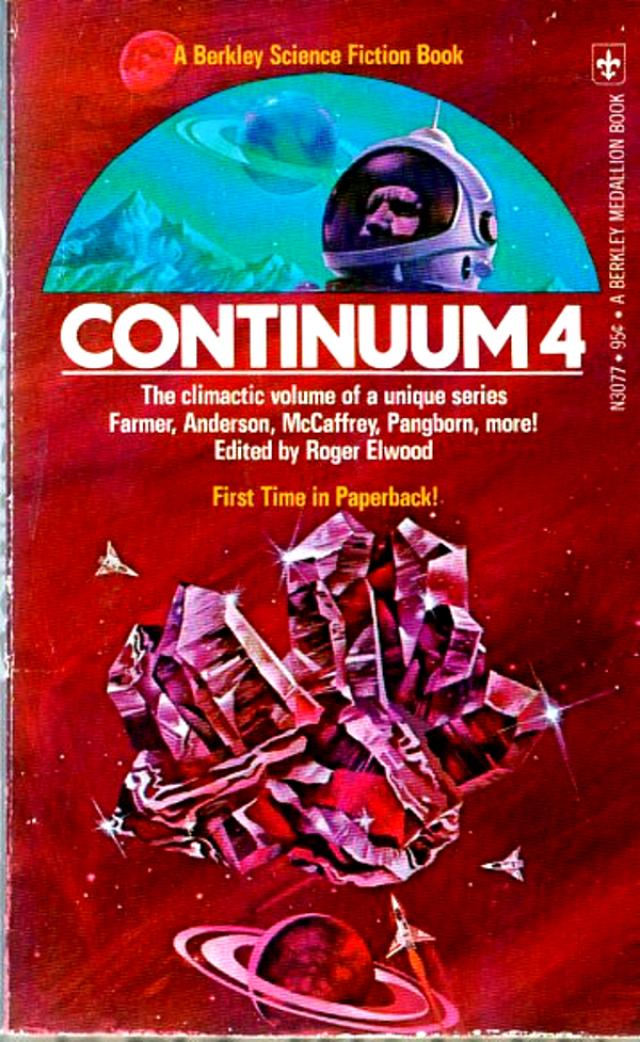
Continuum 4
* * *
Edited by
Roger Elwood
Copyright © 1975 by Roger Elwood
All rights reserved. This book or parts thereof may not be reproduced in any form without permission. Published simultaneously in Canada by Longman Canada Limited, Toronto.
SBN: 399-11469-6
Library of Congress Catalog Card Number: 73-87184
Printed in the United States of America
Continuum 4
Stations of the Nightmare — Part Four
Philip José Farmer
To Promote the General Welfare
Poul Anderson
Caravans Unlimited: Monitor
Chad Oliver
The Armageddon Tapes — Tape IV
Thomas N. Scortia
Killashandra — Coda and Finale
Anne McCaffrey
Thag
Gene Wolfe
Mam Sola’s House
Edgar Pangborn
Making the Connections
Pamela Sargent and George Zebrowski
Philip José Farmer
Stations of the Nightmare
Part 4: Passing On
1.
WINDLIKE, ghostlike, he raced around the earth.
When he was human, Earth was solid and horizon-bound. When he was saucer, it was a complex pattern of shifting triangles and cubes. Land was dully glowing chestnut and silver. Water was brightly glowing scarlet and gold. The three-cornered shapes and hollow cubes of land were smaller than those of water. The Gulf Stream was the same color as the rest of the Atlantic, but the cubes orbited more closely around the triangles.
Clouds of water were toadstools. Smog was a herd of shapes like porcupine fish. The clear air, of which there was very little, was like the snow on the screen of a malfunctioning TV set. Rain and snow alike were polyhedrons, but rain was azure and snow was burnt orange.
That was as “seen” from the stratosphere. When he raced close to the earth, the triangles and cubes merged, became still, became shades of green. The trees were upside-down pyramids, looking more like strangely shaped tumors of the earth than separate entities.
At times he slowed down and eased up to a house. He “looked” into the windows. Dogs resembled astrakhans; cats, gas jets; humans, the symbols on the dollar bill, pyramids with one great crimson eye, always expanding or shrinking.
Around and around, up and down. And nowhere another of his kind. He should have accepted the invitation of his “mother,” and thus he could have journeyed through space to the planet of some far-off star with her as a companion and guide. Now, if he lived a thousand years, and he would, he might never see another of his own. On the other hand (only a figure of speech, since he had no hands in this form), he might run into a dozen the day after tomorrow. The night after tomorrow, rather, since he flew only late at night. In the daytime of the United States of America, he walked on two legs.
He did not need sleep. To metamorphize was to lose the need for sleep. Something happened in his altered body which did away with the toxics accumulated as biped. The poisons streamed out behind as he soared, dark green, flattened spheres mixed with the sapphire quills that traced the change of angle in his flight.
A falling star, he shot toward his apartment, braked with a flare of white-edged blue comets, stopped before the open window, and entered. The transition was so quick that any human eye would have seen only a blur. And he was in the form which billions knew as Paul Eyre.
2.
Being human had its advantages. When he sped like a saucer-shaped Santa Claus from pole to pole, he browsed on photons, gravitons, X-rays, magnetic lines, and chronotrons. But they were tasteless. Not so the buttered toast, the crisp bacon, the fried egg, the cantaloupe, the coffee. Intake was delicious, and so was output. Before the change, he had excreted with haste and shame, though he had been too dull to know that was the situation. Now he experienced a near ecstasy; getting rid of was not the same as taking in, but it was just as pleasurable. He shaved, showered, and dressed, read for four hours and, at seven-thirty, walked out of his apartment. The day manager and the guards said hello and looked at him with a barely concealed dislike, fear, and awe. Ostensibly, they were there to protect him. Actually, they were protecting the others from him. The others were the rest of humanity.
Practically, they were incapable of protecting him or the others.
He walked out of the building. Across the street was another apartment building. It held rooms in which many dozens of people, around the clock, trained cameras or listened to wire taps or swiveled directional microphones. He had “seen” them at night, their pulsing eyes glowing. They were reporting to various agencies in Washington, in Europe, and in Asia. They spied on him and on each other.
He walked swiftly twelve blocks and turned into a driveway leading to a huge old mansion. Once it had belonged to a rich family, then it had been a funeral home, and now it was his headquarters. The crowd along the driveway and on the porch cheered as he walked among them. They reached out their hands, though they never touched him. He made a gesture that they should draw back, and they surged like a wave withdrawing from a beach. They loved him, and they hated him.
Of the thousand or so on the parking lot, the grounds, the sidewalk, and the porch, half were the lame, the halt, the blind, the dying. The others were relatives or friends or the hired, bringing those on crutches, stretchers, and wheelchairs. He could, and would, send most of the sick home with their diseases left behind as abandoned baggage. But what could he do for the others, those defined as healthy? What could he do for greed, hate, prejudice, and self-loathing?
Lepers all.
He stopped on the porch, turned around, and held up his hand. Silence floated. “Go home now!” he said. “Make way for the others!”
There were cries of joy and amazement. Crutches soared. Men and women danced and cried. Children stood up from wheelchairs. Some, still on stretchers, were rushed to waiting ambulances. They were the ones whose convalescence would take some time. A woman whose misshapen bones were beginning to jell cried out in fear. But she would be all right in a few weeks.
A man near the foot of the steps to the porch suddenly reached into his coat pocket and brought out a revolver. His face was pale and contorted.
“Die, you filthy anti-Christ!” he screamed. “Die and go to hell!”
Hate was snatched away by pain. He dropped the revolver and clutched at his chest. Two plainclothesmen moved toward him, but they were too late. He was dead on the sidewalk by the time they had reached him.
Paul Eyre murmured, “They never learn!”
3.
In the beginning, he had sat in a large office while the “patients” walked by or were carried before him. They had entered one door and without pausing or speaking proceeded to the exit. There was no business to transact except that of getting people in and out as swiftly as possible. Each was handed a card which stated that if the recipient cared to, he could send whatever sum he felt like sending to this address. Paul Eyre did not doubt that among his employees were agents of the American Medical Association and the Food and Drug Administration. They watched him as if he were a hawk among chickens and he owner of the chickens. But their reports were monotonous, unspiced by irregularities.
After a few months, Eyre had moved out onto the porch. In warm weather, he looked at the passersby through screens. In cold weather, the porch was glassed in. Automobiles, trucks, and buses crept by on the horse-shaped driveway and the street while he looked at the pale and hopeful faces in them. To heal, he had to see them in the flesh, though a single glance sufficed.
On the other hand, he did not have to see to kill. Snipers hidden in rooms many stories above him fell dead as they put their finger on the trigger. An automatic device set to gas him, operating by a time clock so there would be no direct human initiation, had gone up in smoke. A suicidal fanatic had tried to fly his nitroglycerine-loaded airplane into his headquarters, but it had blown up while over the Illinois River. A time bomb had exploded in the face of a man before he could get it into his car.
There had doubtless been many other fatal incidents about which Paul Eyre knew nothing.
That was, to him, the strange thing about his powers. He had not the slightest idea how they operated. There was no tickling, no tingling, no change in body temperature, no outward or inward manifestation of energy transmitted or withdrawn.
He had established, however, that he did not kill just because he disliked or hated a person. The power was activated only when a person was about to be an immediate physical danger to him.
He was an enigma for more than himself. Everybody, even the Indian in the remote Amazon jungle or the aborigine in the great Australian desert, had heard of him. They came from everywhere, and business in Busiris, Illinois, boomed. Every motel, hotel, and rooming house was jammed. Motels and restaurants were going up like telephone poles. The police department had had to double its traffic division, but there were no outcries from the taxpayers. Eyre was paying for the new personnel. There were protests from Eyre’s neighbors about the crowded streets, but nobody could do anything about this. And “the Eyrecraft industry,” as the local paper termed it, had brought prosperity to Busiris. It was the largest industry in the county, larger even than the giant Trackless Diesel Motor Corporation for which Eyre had once worked.
And so he sat on the porch, even during his lunch period, or paced back and forth while the sick were carried by. At seven in the evening, he wa
He dined alone in his apartment except for the three evenings a week that his current mistresses visited him. These were beautiful young women who had their peculiar reasons for wanting to bed with him. Some were grateful because he had healed them or relatives or husbands. Some felt they adored him because he was a miracle worker. Some, he found out later, were agents for the AMA, the IRS, the FBI, Russia, China, Cuba, England, Israel, the United Arab Republic, Germany (West and East), and India. Some had even asked him to take refuge in their countries. Their countries had tried to kidnap him, with fatal results for the agents, so now they were trying to seduce him. He never turned them over to the FBI (in one case, the young woman was working for both Albania and the FBI). He merely told them to leave and quit bothering him.
Sometimes, he would go to the window and look down at the street. It was white with faces turned up to him as if he were the sun and they the plants. Their murmur came up to him even through the soundproofing. “Heal me,” it cried, “and I will be happy!”
He knew better, but he healed them anyway. He couldn’t help himself.
Somebody had once suggested that he fly over the world while the sick were brought out into the open spaces for him to look down upon. He had rejected this. Even if he could cover every square foot of the planet in a single day, he would have a million new patients the next day. But to travel by plane around and around the globe would be to lose all his privacy. How could he leave his quarters at night and girdle the earth, search the skies, sublunary space, Africa, Polynesia, and the South Pole? No, here at least, he had made arrangements to leave by the back window which faced a court where no one could come. No doubt, it was under electronic and photographic surveillance. But his watchers were government officials, and their reports were top secret. They didn’t believe what they reported. Some things are so impossible that to admit you believe them is to admit that you’re crazy. Between the two was a credibility fuse easily blown in human beings.
Why had Paul Eyre become the great healer? Why had he subjected himself to a boring duty which could never achieve its goal, the extermination of all physical diseases in mankind? For one thing, he didn’t have the heart to turn the sick away. For another, he was getting rich, and he needed much money to pay for the support of his daughter and his ex-wife. And, last but by no means least, he was, being human when in human form, gratified by the attention and the idolization. He was the most important man on the planet. Important in a way which the public did not even suspect. If they had, they would have tried to tear him apart, literally. He shuddered when he thought of it, not because the mob would succeed, because they wouldn’t. It was the vision of hundreds, perhaps thousands, dropping dead at the same time that sickened him. So far, the few known deaths, his would-be murderers, had been explained away as caused by excitement combined with a weak heart. Though none of his attackers had had heart trouble, fake medical histories had been supplied. The pathologists who did the dissections did not have to be bribed to validate these. They always found the heart ruptured, even when it looked healthy.
Eyre read for a while after eating the meal ordered from a delicatessen. (No need to test it; the poisoner would have died before he could touch the food.) He put the book aside and watched TV for half an hour, then turned it off. How trivial even his favorite programs seemed. Bullshit and nonsense, as his friend, Tincrowdor, was fond of saying.
Tincrowdor. Was he a friend? When Eyre had been held in prison, Tincrowdor had helped him. At the same time, Tincrowdor had thought of ways to kill him. But that, Tincrowdor had explained, had been done because he did not really believe that Eyre could be killed. Besides, the intellectual challenge had been too much for him. He had to try.
He went to the phone and called the switchboard downstairs. He waited, while the ringing went on and on. How many were listening in? At least a dozen American government agencies, the AMA, and half a dozen foreign agents. Trolls eavesdropping on the troll killer. Helpless to do anything but listen and then make their reports.
At last, a boozy male voice answered. “Leo Queequeg Tincrowdor, poet laureate of B-T-A-O-C, speaking.”
If the unwary caller asked what the letters meant, Tincrowdor would reply, “Busiris, the asshole of creation.”
“Come on over,” Eyre said. “I’d like to talk to you.”
“You’re not mad at me?”
“I just want to talk. That is, if you’re fairly sober.”
“I’m fairly,” Tincrowdor said. “Tell your gorillas not to shoot.”
“They’re just here to watch me,” Eyre said, “not to protect me. You could come in with a bazooka, and they’d only ask you to produce your ID.” Which was not much of an exaggeration.
4.
Before Tincrowdor arrived, another visitor phoned from the lobby. This was Dr. Lehnhausen, the righthand man of the President of the United States. Eyre was surprised, though not very much. Lehnhausen had made unannounced trips before, flying in secretly from Washington, talking to him for an hour or so, and then departing as swiftly as he had come.
A minute later, Eyre admitted Lehnhausen. Four men stood guard, two by the door, one at the elevator, and one at the end of the hall, near the fire escape.
Lehnhausen was a tall, dark man with a slight German accent. He waved his hand at Eyre and said, “How are you, sir?”
“I’m never sick, and I’m always busy,” Eyre said. “And you?”
“That depends upon what you tell me,” Lehnhausen said. “I’m here to ask you to reconsider your decision. He told me that he hoped you would remember that you are an American.”
How I would have thrilled at those words only a year ago! Eyre thought. The President himself asking me to do my duty, to defend my country.
“I never said no,” Eyre said. “I thought I’d made that clear. What I did say, and you were there and know it, is that it’s not necessary for me to live in Washington or to be advised by a bunch of generals and bureaucrats. I will defend this nation, but it will be done automatically. And it doesn’t matter where I am.”
“Yes, we understand that,” Lehnhausen said. “But what if the President believes that it is necessary to launch an atomic missile attack before another nation does?”
“I don’t know,” Eyre said. He began to pace back and forth and to sweat. “I have tried repeatedly to explain that I have no control over this, this power. Anything that is an immediate threat to me seems to be killed. An atomic war would threaten me, even if the attack were launched from this country at another one. The enemy would retaliate, of course, and that would be a threat. To stop this, I, or whatever is working inside me, might decide that the man who gives the word to attack should drop dead before he can give that word.
“This means that whoever starts to give the word, to press the button, would die. Which means that there is no need for the President to order an attack. The attack he would be trying to forestall would never come. The enemy executive would die before he could give the order. The man succeeding him would die, and so on.
“So, there is no call for the President to give his order. Do you see what I mean? God knows I’ve told you enough times, and I find this visit unnecessary and annoying. I can’t seem to get the truth through to you people in Washington.”
Lehnhausen said, bitterly, “What you have done is to nullify our atomic potential. We can’t use it, and that places us at a disadvantage with nations which have a greater potential in conventional means of warfare. Both the Soviet Union and China can assemble far larger armies than we can. The Soviet Union’s navy is larger than ours. Russia could take over Europe at any time, and there is nothing we could do about it. And China could take over Asia. Then what would happen?”


