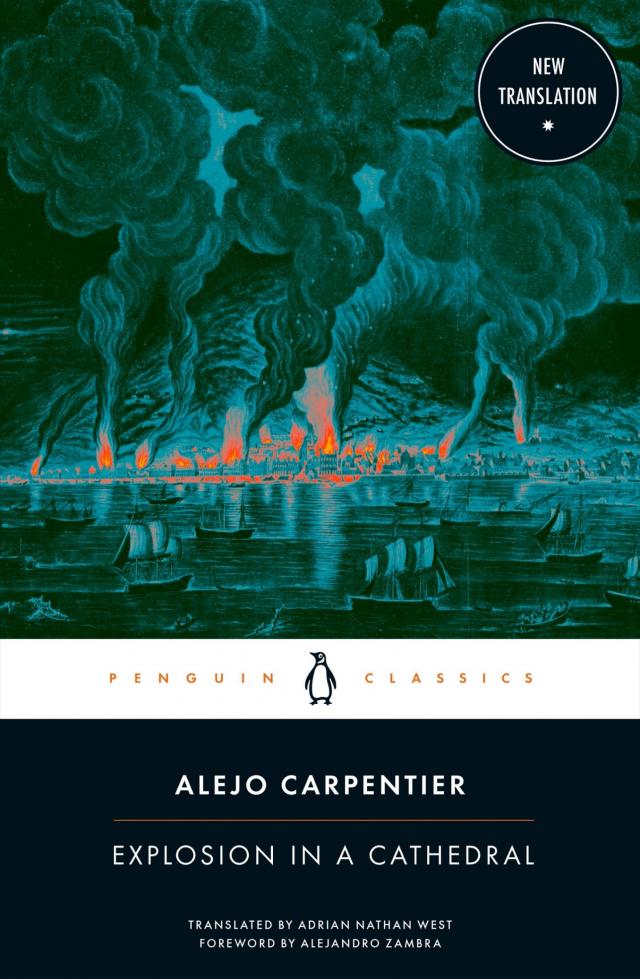
Explosion in a Cathedral, page 26


* * *
• • •
When Esteban found himself on the streets of Paramaribo after anguished waiting in the depressive and sordid atmosphere of Cayenne—a world whose history was nothing but a succession of rapine, epidemics, slaughters, exiles, and collective agony—he had the feeling of arriving to a town painted and garlanded for a grand party, a town with a little of the kermesse about it and a great deal of the tropical paradise. Abundance prevailed, as though a still life had been emptied across the avenues lined with orange, tamarind, and lemon trees, with beaming houses of handsome wood—some of them three, four stories high—with gauze curtains in their open windows. Inside them stood large armoires filled with the fruits of prosperity and tulle mosquito nets over swaying hammocks with elegant frill trim. Again Esteban saw the girandoles and chandeliers, the mirrors with their depths as of water, the windscreens, the windows of his childhood. Barrels rolled over the loading docks; geese squawked in the courtyards; in the garrisons, fifes blew, and from the heights of Fort Zeelandia, a guard marked the passage of the hours on a sundial, striking a bell with the circular gesture of a quintain. In the grocers’, beside the butchers’ stalls where turtle meat lay on display next to garlic-studded pork, stood once more the marvels—Esteban had nearly forgotten them—of bottles of porter, thick Westphalian hams, smoked eel and mullet, pickled anchovies with capers and bay leaf, and manly Durham mustard. Ships with gilded prows and lighted beacons plied the rivers, with negro oarsmen in white loincloths paddling under awnings or canopies of bright silk or Genoese velvet. So refined was this overseas Holland that the mahogany floors were scrubbed each day with bitter oranges, and their juice, absorbed by the wood, gave off a delicious spiced perfume. The Catholic church, the protestant and Lutheran houses of worship, the Portuguese synagogue, the German synagogue, resonant with their handbells, organs, chants, hymns, and psalmodies on the Sabbath and on and feast days, on Christmas and on Yom Kippur, on Passover and on Holy Saturday, with texts and liturgies, gilded candles, fires, sumptuous Hannukah menorahs, rose up before Esteban’s eyes as symbols of a tolerance that man, in certain parts of the world, had struggled to achieve and defend, not buckling before religious or political inquisitions . . . While L’Italie Conquise proceeded to unload and sell its merchandise, the young man frolicked on the banks of the Suriname River, which was like the city’s public baths, watching the frequent arrival of ships from North America, among them a svelte sailboat called the Arrow. Without daring to hope his time in Paramaribo might coincide with the appearance of Captain Dexter’s ship—after six years, it had surely changed crews—Esteban felt he was in the final stage of his adventure. He would remain in Paramaribo, when the French vessel departed, as a commercial agent for the government of Cayenne, assigned with distributing, wherever its effect would be greatest, several hundred printed copies of the Decree of 16 Pluviôse, translated into Dutch and accompanied by calls to sedition. Esteban had already chosen the place he would throw out the papers, tied tight to large stones, so they would disappear forever in the bottom of the river. When that was done, he would wait for a Yankee ship to arrive, one that would, before returning to Baltimore or Boston, make a stop in Santiago de Cuba or Havana. While he waited, he would try to bed down with one of those bountiful and pliant blonde Dutchwomen, almost golden in the lace that hugged their bodies as they emerged from the windows after dinner to inhale the night air. Some sang, accompanying the lauds; others took their weaving from door to door on surprise visits. Their tapestries offered striking views—a street in Delft, a distinguished city hall facade reconstructed from memory, or a colored confusion of coats of arms and tulips. Esteban had heard foreigners were treated with special favor by these ladies, who knew their husbands kept dark-skinned lovers on the country estates where all too often they stayed the night: Nigra sum, sed formosa, filiae Jerusalem. Nolite me considerare quod fusca sum quia decoloravit me sol. This festering conflict, moreover, affected all sides. Many white men, once they’d overcome their initial scruples, developed a taste for warm, dark flesh so strong that they seemed to be spellbound. Legends ran wild about infusions, drugs, mysterious waters secretly administered to pale-skinned lovers to tie them down, hold onto them, alienate them from their will until they’d grown insensible of women of their race. It pleased the Masters to play the Bull or Swan or the Shower of Gold, supplementing their sacred seed with gifts of bangles, kerchiefs, calico skirts, and floral essences brought from Paris. The white man, whose strayings in the lesser territories were looked upon with indulgence, lost none of his prestige when he approached a negress. And were he to end up with a brood of quadroons or octaroons or griffes or sacatrases, their profusion brought him renown as a Fecund Patriarch. The white female, on the other hand, on the very rare occasions that she dared approach a man of the wrong color, was seen as an abomination. There was no worse role, from Natchez County to the shores of Mar del Plata, than that of the colonial Desdemona . . . L’Italie Conquise was gone, and with the arrival of the Amazon, a cargo ship from Baltimore on its way home from the Plate River, Esteban’s stay in Paramaribo came to an end. He had enjoyed, in the interim, the favors of a mature lady, a reader of what she took to be contemporary novels, like Richardson’s Clarissa and Pamela. Her flesh was cool, aromatic, always softened with rice powders prodigiously employed, and she treated him to Portuguese wines while her husband slept on the Egmont estate for motives not difficult to guess at . . . Two hours before taking his bags aboard the Amazon, Esteban met with Greuber, the chief surgeon at the hospital, to assure himself of the harmlessness of a small swelling bothering him under his left arm. The good doctor rubbed a salve into the irritated spot and saw him off from a room where nine negroes, under the custody of armed guards, were apathetically smoking acrid fermented tobacco that stank of vinegar from clay pipes, the bits gnawed away almost to the bowl. To his horror, he was told that the Suriname Court of Justice had convicted these slaves of flight and sedition and ordered the amputation of their left legs. The sentence was to be executed cleanly, in accordance with scientific techniques, avoiding those archaic procedures of more barbarous eras that caused excessive suffering or endangered the lives of the condemned, and so the nine slaves were brought to the finest surgeon in Paramaribo, who would carry out, saw in hand, the Tribunal’s judgment. “They also amputate the arm,” Doctor Greuber said, “of those slaves that lift a hand against their master.” And turning toward those waiting, the surgeon shouted: “Send the first one in!” When he saw a tall negro of defiant mien and powerful muscles stand in silence, Esteban, on the verge of fainting, ran to the nearest tavern and shouted for a brandy, for anything, to dampen his dread. And he looked toward the outer wall of the hospital, unable to tear his eyes from a closed window, haunted by what was taking place behind it. “We are the worst beasts of all creation,” he repeated to himself with fury, enraged with himself, and if he’d had the means, he would have burned the building to the ground . . . Standing onboard the Amazon, which was headed downriver in the middle current of the Suriname, Esteban hurled several bundles into a fishing canoe rowed by several black men. “Read this,” he shouted to them. “And if you don’t know how, find someone to read it to you.” They contained the Dutch versions of the Decree of 16 Pluviôse. He was glad now he hadn’t thrown them in the water, as he was about to do days before.
XXXIV.
. . . They found themselves facing the Dragon’s Mouths, on an immensely starry night, in the same place the Great Admiral of Ferdinand and Isabella saw sweet water struggling with salt as it had since the Creation of the World. “The sweet water pushed against the other so it could not enter, and the salt against the sweet so that it could not leave.” Today as yesterday, great logs from the inland, torn away by the August swells, pounded by the river rocks, floated toward the sea, fleeing the sweet water and dispersing through the immense salt sea. Esteban watched them floating toward Trinidad, Tobago, or the Grenadines, sketched out in black over quivering phosphorescences, like the long, long ships that had penetrated these same domains not so many centuries ago in search of the Promised Land. In that Stone Age—still so present to many—the Empire to the North had fascinated all who gathered at night around the bonfires. And yet they knew almost nothing of it. Fishermen heard tales from the mouths of other fishermen, who themselves had heard from other fishermen further to the north, and these had heard what they knew from others further away still. Objects had traveled, though, through barter and the innumerable landings of ships. They existed, enigmatic and solemn, of inscrutable manufacture. They were tiny stones—what did the size of them matter?—that spoke through their forms; stones that stared, defied, laughed, or stiffened into strange grimaces, from a land of immense esplanades, bathing virgins, unimaginable buildings. With time, all that talk of the Empire to the North made the men feel entitled to it. Words had created things, and these were handed down through the generations, making of those things a kind of collective patrimony. The distant world was then a Land-in-Waiting, and the Chosen People must go there when the stars gave the signal to depart. In expectation, the human mass grew by the day, joining the anthill of peoples at the mouth of the Endless River, the Mother-River, hundreds of days south of the Dragon’s Mouths. Tribes had come from their mountain ranges, abandoning the villages they’d inhabited since time immemorial. Others deserted the right bank, and those from the heart of the jungle emerged from the undergrowth in thin groups under the new moon, with the awed eyes of people who had walked long months through green shadows, following tributaries, avoiding the boglands . . . And still, the wait stretched on. So vast was the undertaking, so long the road to be traveled, that the chiefs could not take a decision. Children and grandchildren grew old, and still they were there, teeming, lethargic, their talk always the same, contemplating Objects which grew in prestige with the delay. And one night, never forgotten, a flaming shape crossed the sky with a loud whistle, over the path the men had determined long ago would lead them to the Empire to the North. And the horde began to march in hundreds of groups of warriors, penetrating foreign lands. The men of the other peoples were exterminated without remorse, their women preserved for the multiplying of the conquerors. In this way were created languages: the language of women, of cooking and birth, and the language of men, of war, the knowledge of which was held to be a sovereign privilege . . . The march lasted more than a century, through jungles, plains, passes, until the invaders found themselves standing before the sea. They had heard the inhabitants of the villages, learning of the Southerners’ pitiless advance, had gone to the islands that lay far, but not so far, over the horizon. New Objects like those they’d encountered before hinted that the Island Path might be best for reaching the Empire to the North. And as it wasn’t time that mattered, but only the fixed idea of one day arriving to the Land-in-Waiting, the men stopped and learned there the arts of navigation. The broken canoes abandoned on the beaches served as models for the boats the invaders fashioned from hollowed tree trunks. Then, having to ford long distances, they made them larger and more slender, grander in scale, with high pointed prows and room for sixty men. And one day, the great-great grandchildren of those who had begun the overland migration began the maritime migration in turn, setting forth in fleets of ships to discover the islands. They crossed the straits easily, bested the currents, leaped from land to land and slew the inhabitants—tame farmers and fishermen, oblivious to the arts of war. The mariners advanced across the island, ever bolder and more adept, used now to guiding themselves by the position of the stars. As they traced out their route, the towers, the esplanades, the buildings of the Empire to the North rose before their eyes. They felt its nearness in the islands that grew and were increasingly mountainous and prosperous. In three islands, in two, even in one—they counted by islands—they would at last reach the Land-in-Waiting. The vanguard had already touched shore in the largest country of all—perhaps it was the final stage. The marvels to come were no longer to be the preserve of the invaders’ grandchildren. No, these eyes of mine shall see them. The rhythm of the sea songs and the oars quickened at the very thought, and they plunged through the sea in succession, driven onward by impatient hands.
* * *
• • •
But there, on the horizon, strange shapes appeared, unfamiliar, with perforated flanks and tall trees holding cloths that trembled or swelled and flaunted unknown signs. The invaders met other invaders, unforeseen, unforeseeable, arrived from who knew where, come to annihilate a dream of centuries. The Great Migration had been futile: the Empire to the North would pass into the hands of the Unenvisioned. In spite, in visceral ire, the Caribs threw themselves on the enormous ships, their audacity shocking the men who defended them. They climbed onboard, attacking in raw desperation, which the new arrivals couldn’t understand. In this struggle without compromise, two irreconcilable historical moments collided, pitting the Man of Totems against the Man of Theology. Because, suddenly, the disputed Archipelago had become a Theological Archipelago. The islands shed their identities, drawn into a Sacramental Act of the Great Theater of the World. The first island seen by the invader from a continent unimaginable to those from here was given the name San Salvador, the Christ, and a first cross of wood branches was planted on its shore. The second had been consecrated to the Sacred Mother, and called Santa María de la Concepción. The Antilles transformed into a stained-glass window, immense and pierced with lights, the Donors were present in the shorelines of Ferdinand and Isabella; Thomas the Apostle, John the Baptist, Saint Lucy, Saint Martin, Our Lady of Guadalupe and the supreme beings of the Trinity were each given their territory; the towns of Navidad, Santiago, and Santo Domingo were born against the blue curtain of a sky spangled white by the labyrinth of the Eleven Thousand Virgins, numberless like the stars of the Campus Stellae. Spanning millennia, this Mediterranean was made heir to its double, receiving, with wheat and Latin, Wine and the Vulgate, the Imposition of Christian Signs. The Caribs, a race thwarted and wounded to the death in the triumphal moment of their centuries-long quest, would never reach the Mayan Empire. Of their failed Great Migration, which may have begun on the left bank of the Amazon River when the others’ chronicles were recording a thirteenth century that was no such thing for any but themselves, nothing remained on the shores and beaches but the Carib petroglyphs—artifacts of an epic never to be written—their creatures drawn, engraved in stone, beneath a haughty solar emblem . . . Esteban was in the Dragon’s Mouths, on a still starry dawn, where the Great Admiral watched the sweet water struggle with the salt, as it had since the days of the Creation of the World. “The sweet water pushed against the other so it could not enter, and the salt against the sweet so that it could not leave.” But that sweet water, so swift-flowing, could come only from the Infinite Land or else—and this was far more credible for men who still believed in the monsters cataloged by Isidore of Seville—from Paradise on Earth. Many a time the cartographers had moved that Paradise on Earth, nurtured by springs fed by the great rivers, now to Africa, now to Asia. And when the Admiral drank of the water his ship was rowing through, he found it “ever fresher and tastier,” and supposed that the river that carried it to the sea must flow from the foot of the Tree of Life. Stunned by such a thought, he began to doubt the classical texts: “I do not find, nor have I ever found, a scripture in Latin or Greek that states the location in this world of Paradise on Earth, and I have not seen it on any map.” And as Venerable Bede and Saint Ambrose and Duns Scotus situated Paradise in the Orient, and the men from Europe believed they had reached that Orient navigating with and not against the Sun, they were dazzled to learn the truth: that the Spanish Isle called Santo Domingo was Tarsis, was Cathay, was Ophir, and was Ophar, and was Cipango—islands and territories mentioned by the ancients, a part now of the closed universe encompassed by Spain, just as the Peninsula had been absorbed in the Reconquista. Then came the late years Seneca had announced, “in which the ocean shall relax the bonds of things, and a great land shall be discovered; and a new seaman, like him who guided Jason, shall discover a new world; Tiphys shall unveil new worlds, and Thule shall no longer be the utmost extremity of the earth.” The Discovery took on a theological dimension. The journey to the Gulf of Pearls of the Land of Grace was written in glowing letters in the Book of Prophecies of Isaiah. Joachim of Fiore’s prediction was affirmed that Spain would give rise to one who would rebuild the House of Mount Zion. The world had the shape of a woman’s breast, and the Tree of Life grew from its nipple. And its inexhaustible spring, which could slake the thirst of every living thing, was seen now to feed not only the Ganges, the Tigris, and the Euphrates, but also the Orinoco, which carried Great Trunks and emptied them into the sea; and at its headlands, found at last after an interminable wait—able to be reached, tamed, known in all its splendor—lay Paradise on Earth. In these Dragon’s Mouths, of water pierced by the birthing Sun, the Admiral shouted exultantly, seeing the centenary combat between salt water and sweet: “And now ought the King, Queen, Princes, and all their dominions, as well as the whole of Christendom, give thanks to our Savior Jesus Christ who has granted us such a victory and great success. Let processions be ordered, let solemn festivals be celebrated, let the temples be filled with boughs and flowers. Let Christ rejoice upon earth as he does in Heaven, to witness the coming salvation of so many people, heretofore given over to perdition.” These lands’ abundant gold would end the abject servitude man had suffered in the scarcity of Europe. The Prophets’ visions, the predictions of the ancients, the theologians’ inspirations were affirmed. The perennial Combat of the Waters before them revealed that they were finally arrived, after an agonizing wait of centuries, to the Promised Land . . . Esteban was in the same Dragon’s Mouths that had devoured so many expeditions sailing from salt water into sweet in search of a Promised Land shifting and evanescent—so shifting and evanescent that in the end, it retreated forever behind the cold mirror of the lakes of Patagonia. He thought, leaning against the gunwales of the Amazon, facing a broken, wooded coast unchanged since it was looked upon by the Great Admiral of Ferdinand and Isabella, of the tenacity of the myth of the Promised Land. The myth’s character changed with the color of the centuries, reacting to ever new appetites, but its essence was always the same: there was, there had to be, there must be in the present—in whatever present was at hand—a Better World. The Caribs had imagined this Better World in their way, as the Great Admiral of Ferdinand and Isabella had likewise imagined it in these roiling Dragon’s Mouths, stirred, exhilarated by the taste of water flowing in from afar. The Portuguese had dreamed of the admirable kingdom of Prester John, just as the children of the Castilian plain would someday dream of the Jauja Valley after their dinner of a crust of bread with oil and garlic. The Encyclopedists had found a Better World in the society of the Ancient Incas; the United States had seemed a Better World when its ambassadors arrived in Europe without wigs, wearing buckled shoes, their way of speaking plain and clear, imparting blessings in the name of Freedom. And Esteban had journeyed to a Better World not so long ago, dazzled by the great Pillar of Fire he saw towering over the Orient. And he had abandoned it and was returning now with overwhelming weariness, seeking vain solace in the memory of pleasant adventures. As the days passed onboard, his life came to seem a long nightmare—a nightmare with fires, persecutions, and chastisements, prefigured by Cazotte with his camels vomiting spaniels; by the endless augurs of the End Times brought together in this century, which totalized, in its extension, the action of several centuries. Colors, sounds, and words persecuted him, producing in him a profound disturbance like those that occur in certain regions of the heart, when anguish is made palpable in skipped beats and asymmetries in vital rhythms in the aftermath of an infirmity that might well have been fatal. All he’d left behind him evoked blackness and tumult, drums and death rattles, shouts and slashing, brought together in his mind under the idea of the earthquake, collective convulsions, ritual furor . . . “I am back from life among barbarians,” Esteban told Sofía when she opened for him, with a solemn creak of the hinges, the heavy door of his family home, still standing on the corner with its singular adornment of soaring grillwork painted white.