12 Sea Trials (The Fighting Sail Series, #12), page 1


Sea Trials
The Fighting Sail Series, Volume 12
Alaric Bond
Published by Old Salt Press LLC, 2019.
Table of Contents
Title Page
Dedication
Sea Trials (The Fighting Sail Series, #12)
Sea Trials | Chapter One
Chapter Two
Chapter Three
Chapter Four
Chapter Five
Chapter Six
Chapter Seven
Chapter Eight
Chapter Nine
Chapter Ten
Chapter Eleven
Chapter Twelve
Chapter Thirteen
Chapter Fourteen
Chapter Fifteen
Chapter Sixteen
Chapter Seventeen
Chapter Eighteen
Chapter Nineteen
Chapter Twenty
Chapter Twenty-One
Chapter Twenty-Two
Chapter Twenty-Three
Selected Character List
Author’s Notes
About the Author
Selected Glossary
Also by Alaric Bond
About Old Salt Press
for Joan and Ron
(WR)
All rights reserved. No part of this book may be reproduced or transmitted in any form or by any means, electronic or mechanical, including photocopying, recording or by any information storage and retrieval system, without written permission from the author, except for the inclusion of brief quotations in a review.
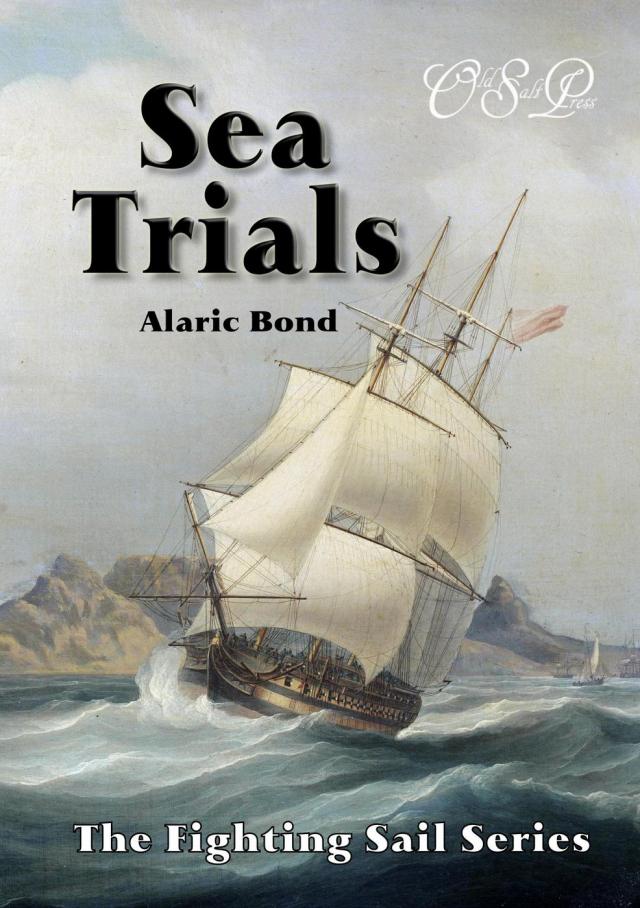
The cover illustration shows HMS Illustrious heading out of Table Bay in choppy conditions and a stiff breeze, by Thomas Whitcombe (1760-1824).
Publisher’s Note: This is a work of historical fiction. Certain characters and their actions may have been inspired by historical individuals and events. The characters in the novel, however, represent the work of the author’s imagination. Any resemblance to actual persons, living or dead, is entirely coincidental. Published by Old Salt Press. Old Salt Press, LLC is based in Jersey City, New Jersey with an affiliate in New Zealand. For more information about our titles go to www.oldsaltpress.com
Sea Trials
Chapter One
“Really, Tom, I don’t know what you have to complain about.”
King blinked and sat back in the only chair that fitted into their tiny cabin; he supposed she was right. After all he was at sea, the element where he felt most at home, and aboard a new and sprightly warship. Furthermore, the elegant young French woman currently combing out her hair before him was now in almost every sense his wife and seemed determined to remain so, despite the many disadvantages in having an English sea officer as a companion.
“It’s being a passenger,” he explained vaguely. “I cannot become used to having no duties to perform.”
“A passenger?” Aimée repeated with a scowl as she withdrew her comb and turned to him. “But we have been aboard this ship for so long!”
“Indeed we have,” King agreed. “Though with a fellow like Johnston in command...”
“Ah, that is the problem.” She grinned in triumph before returning to the tiny mirror. “Our famous captain – what is your English expression: he rubs you the wrong way?”
“Something in that manner.”
“Well I think it is the same for him,” Aimée continued while, stooping slightly to avoid the low deckhead, she began to plait her thick mane of hair. “I think you rub Monsieur Johnston the wrong way also. And it is his ship, and you are merely a passenger.”
“I would mind less were he a true seaman,” King insisted. “As it is he relies too much on his officers; it is fortunate they at least know what’s about.”
“You, too, have good officers,” Aimée reminded him. “Many’s the time you have spoken well of them.”
“I do,” he agreed, “though fancy I can do their jobs as well as my own, whereas Johnston would struggle to replace one of his midshipmen.”
“Then why was he given this ship to command?” she asked.
“The Dear knows,” King shrugged. “Besides, the St. George isn’t strictly his ship, he is only taking her as far as Bombay.”
“But you are still jealous perhaps?”
“Not of the ship.” King was emphatic. “This is naught but a sloop, whereas a fine frigate awaits me in Cape Town.”
“And that is larger?”
“Oh, much,” he assured her, “and far more powerful. Johnston’s St. George mounts nine-pounders and barely enough to call a true broadside whereas my frigate carries eighteen-pounder carriage pieces in addition to her carronades so is a different proposition.”
“Ah, and a man will find such a thing important,” Aimée agreed lightly as she dabbed at her hair with the edge of her comb.
“It is normally considered so,” King replied with just a hint of doubt. “But there is more,” he added quickly. “Mistral is a King’s ship.”
“But of course!” She turned to him and beamed.
“No, I mean she sails on behalf of King George,” he flustered. “She belongs to the British Navy – as do I – whereas Johnston is merely a John Company officer.”
“And that must also be important,” she supposed gravely.
“The Honourable East India Company is a commercial enterprise,” King explained. “So the St. George is a private warship.”
“Well, I don’t know about your royal ships and private navies; when both fight the same war it surely makes no difference?” The hair, though not perfect, was sufficient for a day at sea and she turned her attention to one of the small pots of cream that currently lined their washstand.
“Some would say there is no difference,” King continued with a little more care. They were as close as any married couple, yet Aimée remained French, so technically his enemy. “But truly the Honourable Company is less interested in fighting and more concerned with trade.”
“Then why do they need warships such as this?”
King pursed his lips. “To protect their shipping. The Royal Navy does their bit but cannot be everywhere. The Company occasionally needs additional escorts for their Indiamen, which is why we were able to take this passage to The Cape.”
“Ah yes, the Indiamen...” The woman now adopted a slightly wistful look. “They are fine ships are they not?”
“They are, for their purpose,” King agreed hesitantly.
“From what I hear, the Indiamen serve excellent meals and have much space for their passengers. And they carry so many! Plenty of interesting people to talk to.” She had finished applying the cream and stepped back as far as she could to gauge the result. “It must be why most who travel on long journeys choose to go aboard such wonderful vessels...”
King eyed her warily but made no comment.
“And this private warship that we are aboard, where we are the only passengers, she is escorting three such Indiamen, is that not so?”
“It is,” King agreed dutifully. Their conversation was fast acquiring the hallmarks of one already repeated many times during the long journey from England and would probably end in much the same way.
“Ah, those Indiamen must be so much more comfortable than this, what did you call it, a sloop?” Aimée finally abandoned the mirror and, turning only slightly in the narrow space, ran her finger down his cheek with affection.
“They are more comfortable,” King agreed, taking her hand and kissing it gently. “And I know, I should have booked our passage aboard one,” he conceded. “It just seemed better not to at the time.”
“You do not like comfort, perhaps?”
“I do not care much either way,” he shrugged. “Though have encountered enough John Company passengers to make me wary. To my mind the type who journey so far through choice make poor travelling companions. Most are men, though their wives can be as hearty, and much time is spent drinking and gambling.”
“Much time?”
“Some,” King allowed. “But because of them I felt us better taking passage in the escort.”
“Yes, in the tiny warship,” Aimée agreed as she glanced around their cramped accommodation. “Where perhaps you are more comfortable?”
King made no response, preferring instead to study the washstand which had unaccountably caught his attention.
“And with that nice Captain Johnston in command whom you admire so much,” she persisted. “So tell me, Tom, was that truly a good idea?”
* * *
The St. George was indeed not intended to carry passengers so the presence of Captain King and his French companion had forced Scott and Salmond, the sloop’s second and third mates, to share the adjoining cabin. Not that either minded particularly, they were good friends and often on duty at different times. And there was certainly no resentment against their guests; both men had a measure of respect for the Royal Navy while the presence of a pretty young woman at mealtimes was an unspoken bonus. Especially for Salmond who, though barely in his twenties, was already making inroads into what some would consider the life of a rake.
It had begun at the age of twelve with a girl in his village. The pair had truly been little more than friends but her association convinced him of the pleasures of female company. And it was something the intervening years, along with later spells of celibacy while at sea, had been unable to dispel. For even the longest stretch of desert cannot continue indefinitely and when whatever ship he happened to be aboard finally touched land Salmond’s interest revived like a cactus in the rain.
In this the sloop’s third mate differed little from most lower deck seamen, even if he shunned some of the places they frequented. For it was not the intimacy of physical contact Salmond craved, he simply enjoyed female company. With a dashing smile, a smart blue uniform and an ever-growing fund of stories, the young officer made attractive company and usually found enough daughters of local factors or shore-based officers’ sisters to make his visits a recurring, yet totally innocent, pleasure.
Women were not his only diversion, however; Salmond was enthusiastic about other matters. There was the sea and all aspects of seamanship, as well as foreign travel; in his view the three combined to provide the best that life could offer. He was also an insatiable bookworm, having already consumed and assimilated all he could on Company law and the principles of trading; an activity that had directly led to his present position at what was quite a young age. And his current responsibility for the ship’s guns had awoken yet another distraction. Little in the way of intelligence was required to command a battery of nine-pounders, but Salmond’s innate curiosity found the science behind the weapons’ performance fascinating and he was steadily amassing a considerable library on the subject.
But none of his professional duties were occupying him at that moment. Salmond was off watch and the convoy had run across a packet ship the day before. The craft, a sprightly little thing that immediately caught the young man’s eye, had overhauled their untidy clutter of a convoy at speed, yet paused long enough to transfer post due to be delivered in Cape Town. And so with several hours of free time and a pile of mail to digest, Salmond’s original interest had reclaimed him and when Scott barged into their cabin he was deeply immersed.
“Upon my word,” the second mate exclaimed taking in the pile of papers perched on his friend’s chest. “Would they all be for you?”
“From my sister,” Salmond replied levelly from his bunk. “She is the very devil for correspondence.”
“And has a fair hand,” Scott remarked, collecting one of the closely written sheets. “Though it does tend to vary from letter to letter. As does her choice in ink...”
“She keeps me entertained,” Salmond sniffed, snatching the paper back. “But what calls you here? Does not our respected master require your assistance?”
“Our respected master remains snug in his quarters on account of the hour and a slight chill to the air,” Scott explained, adding, “while mortals such as us must rely on an extra waistcoat when we can find the time.” So saying he hauled his sea chest out from beneath his own bunk and began to rummage through it.
“Busy on deck is it?” Salmond enquired with a notable lack of interest.
“Weather is clear and bright though methinks there to be a storm brewing,” Scott replied while sorting through his clothing.
“Just what I need to keep my trick entertaining,” his friend sighed before listlessly collecting another letter.
“Oh, you’ll be enthralled,” Scott confirmed. “Captain King has just come up; once the old man appears they’ll be needling each other as always. Having the two on board is like sailing with Punch and Judy.”
“Captain King is well thought of in the Royal Navy,” Salmond mused.
“Maybe so.” Scott stood once more. “But not this one, or at least, not by our own dear captain.”
Salmond made no comment. At the back of his mind were thoughts of leaving the HEIC. Like all the sloop’s senior officers, he was only employed to see the warship safely to Bombay. Once there he might well seek a position in the Royal Navy, a Service that took the science of gunnery far more seriously, and the recommendation of an officer like King could be useful.
“So where are these from?” Scott asked glancing back at the letters.
Salmond shrugged. “Here and there,” he said. “Folk I’ve met along the way and seem keen to keep in touch.”
“Folk?” Scott questioned as he made to leave. “Would that be of either gender?”
“Mainly the fairer,” Salmond allowed. “In fact I should say exclusively.”
Scott laughed, “I’ve several years on you and a measure of seniority, yet the only woman who writes is my mother and that is to advise on laundry.”
Salmond adopted a look of apparent concern. “But that is terrible, Sam, and a situation we must surely address. Why every young man should hear from a pretty girl occasionally. What say I lend you one of mine?”
But Scott had already left.
* * *
King was taking in deep draughts of clean sea air. There was something about the scent of the South Atlantic that distinguished it from northern waters. The weather, though more intense, was also easier to predict while a comparative lack of land suited his temperament perfectly. His previous commission had been at The Cape and he was pleased to be returning; according to the first officer’s most recent report, his ship, HMS Mistral, should be free of the dockyard soon and be ready to commence her sea trials on his arrival. Once back in harness, his immediate superior would be Commodore Sir Richard Banks, an officer he had served under for much of his professional life and one he respected more than many, while the station itself promised sufficient action and prize money for the most restless of souls.
Not that King needed much in the way of additional income. His wages and allowances as a post captain easily covered all living expenses for him and Aimée while also allowing the extravagance of retaining their small leased house in Alton while away. And that was ignoring his other funds; the considerable pile amassed during several fortunate engagements. It was a figure most serving officers could only dream of and all but guaranteed them both a comfortable living for the rest of their lives – assuming, of course, that money alone could provide such a thing. He was fortunate to have earned so much although King privately considered it no more than his due. For he had also seen more combat than most and been held prisoner on more than one occasion, while the loss of his left arm surely confirmed him as equally prepared to give as to take.
But, despite so much being to his advantage, and even with the slight feeling of guilt that remained after his last conversation with Aimée, King still felt vaguely discontented and probably would remain so until Table Mountain came into sight. Only then might he quit this passenger caper and start proper work. More than that, only then might he choose with whom to mix. The other officers aboard the St. George were decent enough but he simply could not abide Captain Johnston. And it was at that moment the cause of his discontent made himself known.
“A pleasant day, Mr King.”
Johnston’s appearance actually gave him a start; the man must have emerged from his quarters in studied silence and his sudden approach forced King to step aside to allow him access to the binnacle. To disguise both the movement and his reaction, King took a couple of paces fore and aft as if merely pacing. As so often, there was nothing inherently wrong in Johnston’s action – it was his ship after all and every captain had a right to come and go as he pleased, yet the irritation remained and each time dug a little deeper. He was sure Johnston went out of his way to be objectionable and was the only one aboard the St. George to determinedly ignore King’s proper rank and refer to him as plain Mister.
“Indeed, Mr Johnston,” King replied with equal disregard as he came to a halt. “Though it will rain afore dark if I’m any judge.”
“Think you so?” Johnston sniffed while collecting the traverse board.
King briefly considered the man. He was slender and excitable with pale pockmarked skin that reddened at the first hint of strain. Though in his early forties, an age when most Honourable East India Company masters had a regular command, Johnston remained a jobbing captain, taking short and irregular commissions such as his current placement. But then he so clearly lacked the attributes of a regular HEIC commander; most were experienced, mature seamen who were equally expert in handling important passengers and negotiating for cargoes. King had no idea how Johnston might fare with commercial trade but could vouch for his lack of personal charm and was equally contemptuous of his abilities as a seaman. Yet Johnston had been given charge of a warship; something King was still coming to terms with even this deep into the voyage. It was a temporary appointment for sure but even stiffer requirements were expected of those filling such a role. A man-of-war’s captain must be alert and active with an agile mind: a fighter and a leader of men. Qualities that Johnston so obviously lacked.