13 Lone Escort Fighting Sail #13), page 1


Lone Escort
The Fighting Sail Series, Volume 13
Alaric Bond
Published by Old Salt Press LLC, 2020.
Table of Contents
Title Page
Dedication
Lone Escort (The Fighting Sail Series, #13)
Chapter One
Chapter Two
Chapter Three
Chapter Four
Chapter Five
Chapter Six
Chapter Seven
Chapter Eight
Chapter Nine
Chapter Ten
Chapter Eleven
Chapter Twelve
Chapter Thirteen
Chapter Fourteen
Chapter Fifteen
Chapter Sixteen
Chapter Seventeen
Chapter Eighteen
Chapter Nineteen
Chapter Twenty
Chapter Twenty-One
Chapter Twenty-Two
Chapter Twenty-Three
Chapter Twenty-Four
Epilogue
Selected Character List
Selected Glossary
About the Author
Other novels by Alaric Bond
About Old Salt Press
The Latest Great Reading from Old Salt Press
For Janet and John
Lone Escort
Copyright © 2020 by Alaric Bond
Published by Old Salt Press LLC
Paperback: ISBN: 978-1-943404-29-2
E-book: ISBN: 978-1-943404-30-8
All rights reserved. No part of this book may be reproduced or transmitted in any form or by any means, electronic or mechanical, including photocopying, recording or by any information storage and retrieval system, without written permission from the author, except for the inclusion of brief quotations in a review.
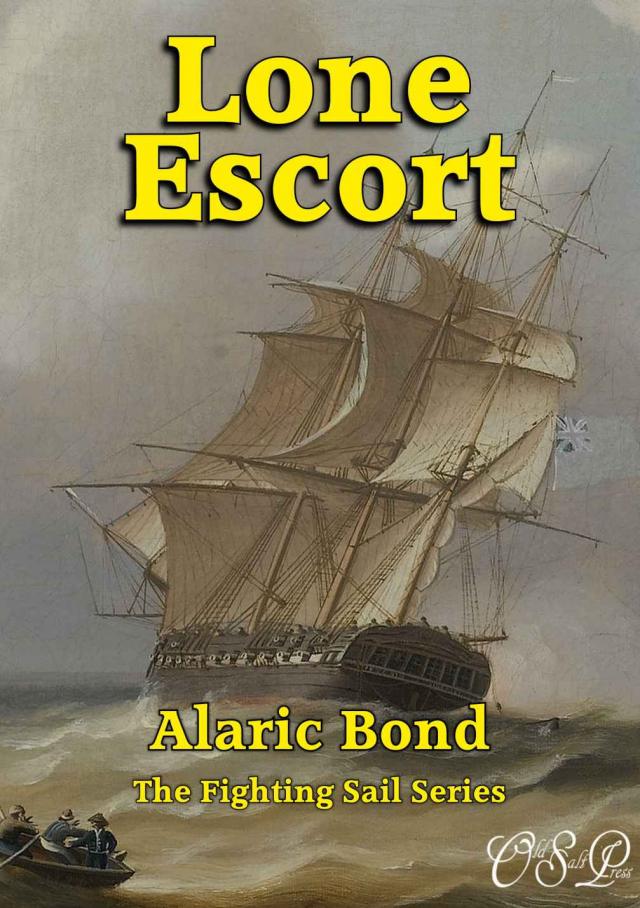
Cover artwork shows details from “A British frigate hove-to with her jollyboat preparing to pluck a man from the sea” by Thomas Buttersworth 1768-1842. This work is in the public domain in its country of origin and other countries and areas where the copyright term is the author's life plus 100 years or fewer. It has been identified as being free of known restrictions under copyright law, including all related and neighbouring rights.
Thanks (as always) to Tessa James for editing.
Publisher’s Note: This is a work of historical fiction. Certain characters and their actions may have been inspired by historical individuals and events. The characters in the novel, however, represent the work of the author’s imagination. Any resemblance to actual persons, living or dead, is entirely coincidental.
Published by Old Salt Press. Old Salt Press, LLC is based in Jersey City, New Jersey with an affiliate in New Zealand. For more information about Old Salt Press titles go to www.oldsaltpress.com
Chapter One
The brig was running towards the rising sun with a fair wind on her tail as Lovemore, in his favoured place on the forecastle, peered into the growing light. He was on watch, but little had been required from any hand for some while and, rather than join the group yarning aft, had wandered forward to station himself where he now stood.
Or perhaps lounged would be a better description; the seaman had one foot resting on the low bulwark and was slouched over it in a manner decidedly relaxed and verging on the slovenly. His face had not seen a razor in days and the wind, which was indeed fair, flowed through an unruly mop of dark curly hair. Neither his posture nor appearance would have passed muster aboard a man-of-war where Lovemore had learned his craft, but the Merriweather was a merchant and her more relaxed regime suited him fine. Besides, though apparently at ease, Lovemore’s mind was unusually alert and, as the creeping rays steadily revealed more of his surroundings, he noticed everything of importance.
For a start, there was no sign of land, which was just as it should be. An hour or so before, the mate had been certain they were in the Channel and now reckoned Falmouth to be off their larboard beam. And that may well be the case although it remained beyond the horizon, which was a pity as it would have been pleasant to glimpse England after so long away. But the mate could have been wrong, no great error in navigation would have shifted them closer to Start Point, or any of the other hazards that littered the area. They might even have missed the Channel completely and now be running straight onto a lee shore several miles to the north, or have already grounded on the Scillies, as some fool of an admiral did over a hundred years before. So Lovemore was actually quite pleased to find them surrounded by a healthy measure of water.
The increasing light picked out several other vessels and Hacker, at the main, was currently relating these to the quarterdeck when Cranston joined him.
“Aye, this is the Channel, sure enough,” his mate confirmed as he rested alongside. The subject of their exact position had been in debate for so long it was a relief to have it settled. Both were experienced seamen and could feel the slight chop that would doubtless grow as the day progressed, and both were equally aware their journey home, the one that had begun almost a year before and on the other side of the world, was almost at an end.
Almost, but not quite; they were bound for the Pool of London: there were a good three hundred miles to cover before finally dropping anchor and in a voyage that had already seen several thousand, this last leg could turn out the most dangerous. French privateers regularly put out from Brest or the Cotentin Peninsular in the hopes of snaring a merchant such as themselves, and there was always the chance of running into a blockade runner; a lone enemy warship escaping the watch still placed over all enemy ports. The Merriweather was both fast and reasonably armed for her type; attributes that allowed her to sail independent of convoy or escort. But though she might defend herself against one of the lighter French raiders, she would fare less well against a combined attack, while meeting almost any size of enemy warship was bound to end with her capture. To be taken so when almost in sight of home was a fate as bad as any grounding yet there was another, equally terrible, that threatened homebound merchants or, more specifically, their crews. Because of this, the small cluster of shipping before them was now the seamen’s sole source of interest, especially as the light grew stronger and more detail was revealed.
“One of ’em might be Navy,” Cranston supposed as he peered under the leech of the brig’s jib. Lovemore followed his gaze; there were five vessels in sight, three were most likely fishers and the fourth possibly a trading smack, but the last was undoubtedly a warship and, though probably British, no less dangerous on that account. Currently she was a good way off but beating in their general direction under topsails and staysails alone and the lack of effort, combined with a distinctive rig and sail pattern, was enough to confirm both her class and nationality.
The Royal Navy had a constant need for trained hands so British warships rarely missed the opportunity to raid a homecoming merchant and press some, occasionally all, her experienced hands. And this one looked to be a frigate; a type that relied on speed as much as firepower. To achieve both meant maintaining a highly skilled crew, so trained manpower was constantly in demand and something the Merriweather could be expected to provide. Even if the warship already had a full complement, it seemed likely they would receive a visit.
Lovemore and Cranston had sailed together for many years, so the exchange of a worried glance was enough to convey their fears, and both resumed their inspection without a word. The frigate was still a good distance off their larboard bow but her course, along with the present wind, suggested a tack was imminent, after which she would be passing close indeed.
“Think the skipper’s aware?” Lovemore asked, finally breaking the silence, and they both glanced back to the brig’s small quarterdeck. The master was indeed present, as was the mate, although both appeared unaware of the danger and were chatting amiably. Then a further shout from Hacker at the masthead cut into their conversation.
“Belike the frigate’s about to alter course,” he bellowed, and both officers looked up, then forward at the vessel concerned. Cranston and Lovemore wriggled impatiently as their betters exchanged comments and then, finally, there was action.
With a chorus of orders, the brig came alive; the rest of the watch on deck appeared, more sail was added, the braces manned and she began to turn several degrees to starboard. Her speed increased with the additional canvas and more so as the wind crept onto her quarter, so when Cranston and Lovemore returned from their work and considered the warship once more, she seemed less of a threat. For by then she was in the midst of her tack and, if all went well, should pass safely a respectable distance off the Merriweather’s stern.
“Reckon we’re clear of her now,” Lovemore stated guardedly.
“Aye, I’d chance,” Cranston agreed. “’Sides, they may be heading for Falmouth.
“Falmouth?” Lovemore questioned.
“Aye, to pay off,” the second seaman confirmed. “In which case they won’t be needin’ no extra bodies and we’re in the clear.”
It was a long shot perhaps but, when combined with their recent change of course, enough to make both relax. Then they noticed something to renew their concerns.
Rather than completing her manoeuvre and settling on a fresh westerly course, the frigate had continued to turn until set to intercept. And as she did, more sail was shaken out until the warship began to lean with the wind as she gathered speed.
“Blighter’s steering to cross our hawse,” Lovemore remarked in horror . It was a classic ploy and the opening gambit of countless single ship engagements even though the frigate was an ally and should present no threat. Both men immediately looked back to the quarterdeck where their officers appeared aware of the problem and were deep in discussion.
“We might run,” Cranston remarked, turning back to his friend.
“Aye,” Lovemore snorted. “Steer deeper into the Channel, though that would bring us closer to the French coast; given the choice between the Navy and a Frog privateer I know which I’d choose.”
“Turn back into the wind, then?” Cranston suggested.
“To what end? Yon frigate’s fair placed off our bow and I’d wager can cut into a breeze faster, and closer, than us.”
Both turned their attention to the brig’s rig. Freshly set up with new line and canvas the Merriweather would have the heels on most small warships on any point of sail. But the years at sea had taken their toll; her canvas was patched and out of shape, cordage had stretched and much of her tackle was worn through.
“Steer for the shore then,” Cranston blustered in desperation. “We might make a port further east; Charlestown or Plymouth even.”
“Wouldn’t do no good, they’ll just follow us in. You an’ I’d be better off finding ourselves a decent hidey-hole to wait them out.”
But now it was Cranston’s turn to scoff. “Ain’t much chance of that,” he snorted. “We’s well laden; you’ll never find an inch of space below, and the Navy can rummage as well as any revenue man.”
“Well we got to do something,” Lovemore muttered. The frigate was now under all plain sail and made a stirring sight with the sun shining through her stiff, fresh canvas. Were they taken, serving aboard her would have benefits over many warships; a better chance of prize money for one, and more space below along with the more interesting missions. However Lovemore had become accustomed to the merchant service and was in no rush to return to a man-of-war. Besides, he had first left England over two years before, there were folk on land he wanted to see, a fair sum in wages to be claimed and he had been looking forward to a simple rest. But even as they watched, the warship was creeping closer, white spray now steaming from her bows as she relentlessly closed on their path. And then came the briefest puffs of smoke; a warning shot, no more, and probably just a blank charge. It would be enough though, and all aboard the brig knew the signal foolish and possibly fatal to ignore.
With a brief order from the quarterdeck, the brig turned slightly and began to spill her wind. The frigate luffed up and took station across her bows and a small boat could be seen being lowered from davits at her stern. Cranston and Lovemore watched in silence as their own craft creaked to a halt. The frigate’s crew soon had one boat in the water but were making a dog’s dinner of launching a second which was being swayed out amidships and seemed to have fouled its tackle. The larger craft swung precariously aloft while those beneath struggled to free the tangle. Neither seaman could say if it were a launch or a barge, nor did they care. For it was roomy; far too roomy for the handful of crew that finally clambered aboard. And when it did begin powering towards them their spirits dropped further, for the rowers were indeed few, and there was more than enough space left to take them all.
* * *
Aboard the frigate, Brotherton, the duty midshipman, watched from a safe distance while his betters discussed the situation.
“A stroke of luck, what?” Captain Wheatstone was standing next to the binnacle and positively beaming; an expression guaranteed to instil grave doubts in the lad, who was relieved to see it directed at the first lieutenant. “A few stout hands will do very nicely and our arrival at Falmouth should not be delayed any.”
“Indeed, sir,” Lieutenant Leyton beamed obsequiously. “Truly fortunate, truly fortunate.”
They were an odd pair, Brotherton decided as he carefully avoided catching either’s eye. Wheatstone was almost impossible to age; he might be no more than thirty, although the thick jowls and perpetual red nose made him look considerably older. But, however ancient, his leaner and somewhat prim second in command must top him by a good ten years and it was equally obvious the older, more experienced, yet junior man, was acting as a form of superior nursemaid to the captain.
That being the case, Leyton’s ingratiating manner was made more nauseating still for, to everyone apart from the captain, the first lieutenant was stiff and exacting; a fellow not to be trifled with or crossed in any way. It was an attitude that intensified with the declining importance of those addressed until, when reaching the level of one such as Brotherton, it became positively hostile. So to see Leyton fawn in such a way was even more sickening and intensified the midshipman’s dislike.
HMS Tenacious remained hove to and broadside on to the brig; her guns might not have been manned but none aboard the merchant could ignore the threat such a position conveyed. Tenacious’ jolly-boat containing Hedges, the senior midshipman, and a detachment of marines was already approaching while her launch, with their master-at-arms and ten stout hands aboard, followed behind. And Brotherton supposed sighting the merchant might be considered fortunate. It was rare for any warship to be fully manned and the few that were must allow for future injuries and illnesses to deplete their stock. However, the midshipman was young and had yet to accept the policy of seizing men expecting a homecoming, then forcing them to fight for their King. Even if the obvious unfairness were overlooked, they would be exchanging better wages and more lenient punishment for a world where danger was positively sought, pay would not be due for at least six months and discipline was harsh and enforced with rope’s end, lash or noose. But despite his age, Brotherton was hardly naïve; he came from a naval family, Tenacious was not his first ship and much had been learned since leaving home eighteen months before. Given time he might put the needs of the service above concerns for his fellow man although that was by no means certain. He glanced at his captain, currently watching as the merchant was boarded and actually licking his lips in anticipation. One day he might even evolve into a character similar to Wheatstone although deep inside the lad hoped not.
* * *
“I have need of men for the King’s service,” Midshipman Hedges announced after hauling himself, unaided, aboard the Merriweather.
Styles, the merchant’s master, had stepped forward to meet him but did not offer his hand. “We’re homeward bound,” he said, “and have been abroad these two years and more.” His tone was soft and without expectation but some objection must be raised before the injustice continued.
“And you will find little has changed in the time,” the midshipman replied with a callous smile. The master regarded him with mild interest; such a rank was usually the preserve of young men, yet the officer before him must be well into his thirties. “You will assemble your hands and I shall make my selection,” Hedges continued.
“We’re bound for the Pool, I have to see my ship there safely,” Styles countered, again with little hope.
“You have wind enough for any number of British ports before and might find fresh hands,” the midshipman sniffed. “Now do not delay me longer, and if I consider you to be selling short I shall see your craft stripped of her cargo and soundly searched.”
* * *
Within minutes the frigate’s launch had been secured alongside and her crew were joining the trim rank of marines already standing in line along the merchant’s bulwarks. Their crisp uniforms of red and white were picked out by the early morning sun, making the iron faces appear even more imposing, while before them, and far less impressive, huddled a cluster of downcast seamen.
“Skipper didn’t put up much of a fight,” Cranston grumbled to Lovemore from the middle of the group.
“What did you expect?” his mate sniffed. “Nothing he could say and nothing he could do against that.” He nodded to where the frigate still lay, dormant but threatening, across their bows.
“I’ve chosen the best seven,” Hedges announced to Guppy, a master-at-arms. “Take the marines and see them back to the ship. I shall follow shortly though first must speak with the captain. You have the men’s records I assume?” he added, turning to Styles.