Nightmare Man, page 2


“Okay, stop right there. What was your name again?”
“Carlton.”
“Carlton, you messed up this time. Last time, you people talked to my wife. She’s easily intimidated. But I know the law, and I just recorded you insulting me and threatening me, and now you’re not going to see a dime of that money, because if you call me again, I’m going to sue you. Carlton. Now, let me talk to your supervisor.”
I don’t get upset as I mute my headset and press the button that turns my light on. There’s no point. I just lean back in my chair and wait.
When Scott, the floor supervisor, comes around, I say, “He recorded me.”
“Shit. Okay, let me talk to him.”
Scott pulls up a second chair and jacks into my phone. I have to stay jacked in, but I don’t really listen. I’ve been at this way too long to learn anything from a floor supervisor. Hell, I’ve worked collections for twice as long as Scott. I’ve been offered the floor supervisor position a number of times. I don’t take it because it pays less and there’s no quarterly performance-based bonus. Almost every job in the company pays less, even if they’re technically higher up the ladder, because doing the actual collecting is so unpleasant they have to pay really well to keep anyone on the phones, the most necessary component of collecting.
“Well, we can write him off. Only a few hundred bucks, no biggie, but Jessie, you should have known you couldn’t push him around.”
“Oh yeah? Why’s that?”
“He sounded smart. Like, educated. You want to take a break?”
We’re allowed a ten-minute break after a bad call, at the floor supervisor’s discretion.
“Yeah, I could use one. Thanks.”
Cubicles sprawl for a hundred yards in every direction. Not everyone works for Kirkland Collections—quite a few companies lease space in the call center—but everyone is working on the phone. That’s a lot of people hating their lives crammed into one lightless place. It could be Hell.
I make quite a few twists and turns before I see daylight. I have to put my shoulder into the side door to get it open, and then slip out before the wind manages to slam it shut on me. My dash to the smoking shelter is made easier by air pressing me along like a strong hand. In fact, if I hadn’t cut so sharply to the side, it would have been happy to carry me off. For a moment I stare in the direction it would have taken me. I look up into the gray sky and imagine tumbling away, so far and fast I can’t find my way back, and for a moment I can interpret the racing of my heart as excitement.
My nervous system refuses to acknowledge that I don’t care about any of the assholes from whom I collect. I don’t care what happens to them when I manage to wring the money from their bank accounts. I don’t care that it was probably a fifty-dollar charge they didn’t even remember, on some old credit card that didn’t get the word that they’d moved, so the bills stopped coming. One that collected interest until it was hundreds, and then was sold to my company just before expiring and being doubled in the transfer. My nerves still send my heart rate through the roof and my lungs gasping as if I’m a normal person who prefers that people not hate me, who doesn’t want to respond to a pleasant “Hello” with an attack, the telephonic equivalent of a dog hitting the fence when you’re strolling along a sidewalk enjoying the sun on your face. My nerves do not believe me when I say I’m made for this and offer my collection rate—one of the highest in the company—as proof. My heart still pounds in my neck so hard it hurts, and I still sip at the air shallowly as if a fat man sits on my chest holding a straw to my lips.
Instead of practicing my breathing techniques, I light a cigarette and stick it where the straw should be, naturally slowing my breathing into long, deep inhalations.
Then something smacks the Plexiglas behind me so hard I almost inhale the cigarette entirely. Spinning fast enough to stumble over my own feet, I see a young woman pressed to the glass by the gusting wind. Her face is turned sideways and smashed into flat planes, her lips smooshed away to the side. Her eye rolls and finds mine and her smooshed lips pull into a smile.
Leslie steps around the corner, and her hair and clothing suddenly fall limp like their puppeteer is taking a smoke break, too.
“Windy out there,” she says as she fishes in her bag for a cigarette. She slips it between her lips and I light it for her.
“Same thing happened to me. I thought about letting it take me.”
“Then who would I smoke and bitch with? Don’t let the wind blow you away until my design business takes off. Then you can go to Oz.”
“Deal. So, you have a bad call, too?” Leslie cold-calls people about changing their mobile phone service.
“Yeah. Oh, you didn’t mean bad like every single call is bad, but outstandingly bad? No, then. I just saw you out here and decided to take my break.”
“How the hell did you manage to get a cube by a window?”
“One of the perks of being an executive.” She isn’t an executive. “Put in your time, and you’ll get your patch of glass. Then you can stare outside and meditate every single minute on the fact that you’d rather be anywhere other than where you are.”
“Instead I’m dying of vitamin D deficiency. If I’d tried that stunt”—I gesture to the Plexiglas, where a phantom face still lingers in grease and makeup—“I’d have broken every bone in my body. Rickets.”
“Osteoporosis isn’t just a woman’s problem, once you get up there in years.” She smiles, and I return it, but that’s the one joke that stings. I can go on all day about how bad life sucks, but the fact that I’m running out of time to change it kills me. I hold a fake smile for as long as I can, like pulling at the corners of my mouth with string, but then I let it drop.
Leslie is only twenty-four. She’s been on the phones for less than two years as she’s tried to build up a clientele for her online graphic design business. That computer stuff was still optional when I was in school. A decade later and a visual artist can’t make it without computer skills. I only just decided to get email a few years ago.
“Did you see Art 21 last night?” Leslie asks. Art 21 is a PBS show about art in the twenty-first century.
“No, but I recorded it. The kids, you know. Philistines.”
“It’s a good one. You’ll have to tell me what you think. The theme was light and shadow. There was some cool-but-predictable fiber-optic art, but then this woman, Margot something-or-other, she works with shadows. Like, she had sculptures that looked like one thing, but then cast a shadow as something else. Like this one angel that threw the shadow of a devil. Real cool shit. I can’t even get my head around it. All her work is real technical. They showed her coding at a computer. And then she had this other art she called deep shadows. You know, it’s like, yeah, the light and shadow thing is a cool dynamic, the way they play off each other. The way they’re intertwined, but it’s been pretty thoroughly explored. This shadow-in-shadow thing she does, though, is intense. And these shadow holograms. I’d love to see her work in person. Apparently you can’t get the full effect on video, but it still looked pretty damn cool, these images coalescing in the blackness.”
I listen to her talk, really more to the lilt of her voice and infectious enthusiasm, and I watch her face, not totally beautiful in a traditional way, with her Roman nose, but it works for her.
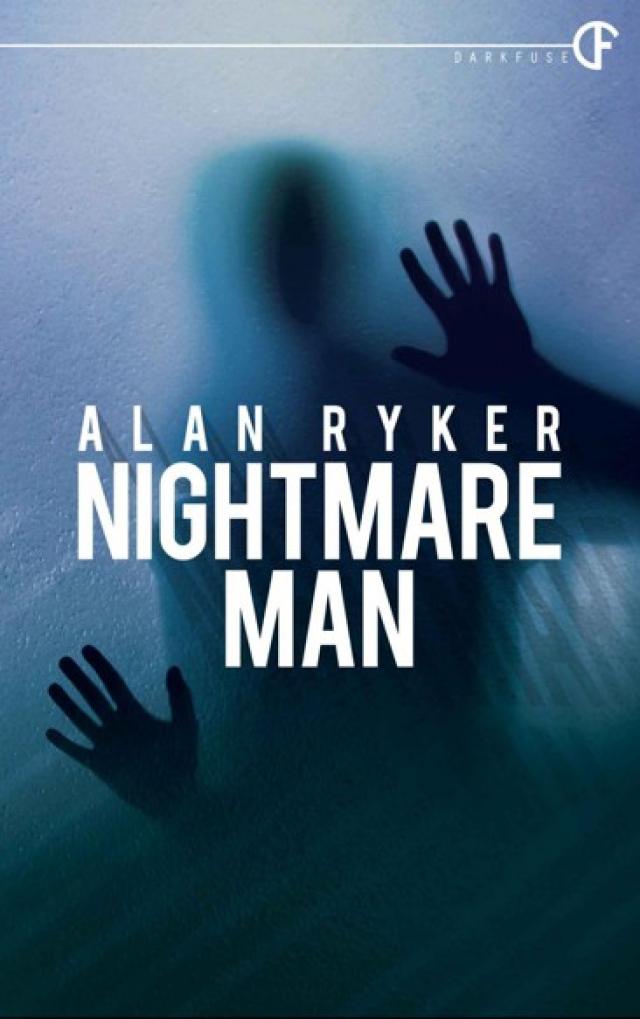
But the shadow art brings her words out of the fog and into sharp, stereophonic fidelity. Because shadow-on-shadow brings back the nightmare man, from last night, from back as far as I can remember. The nightmare man has always been with me.
“How did she do it?”
“Well, she has different mediums. Literal shadow on shadow. Water. Smoke. Glass. Some sort of liquids. One has something to do with magnetic fields. She’s pretty secretive about her methods, though I don’t think I could have understood half of it if she’d explained it. I mean, holograms out of shadow? Still, I’m always surprised about how open the artists on the show usually are about the techniques they innovate to achieve their effects. I don’t know if they figure that knowing the craft isn’t the same as creating the art, or if they figure the worth of the art is in its novelty, so no one will bother stealing their techniques, and if they do, it won’t do them any good anyway, but…”
Leslie keeps going, the way she does when she gets started on art, but I’m thinking of the nightmare man, how he appears out of shadow, how he melts back into it.
Can you use magnets to rip a hole to another dimension? Or is that gravity? Or is that all from science fiction? I need to actually make the time to watch this episode, either tell the kids to go entertain themselves away from their big, square, hypnotic nanny or manage to stay up later than they do. Neither option sounds very likely, but I have to see what this Margot woman is doing, because yes, I wonder if the nightmare man is real.
* * *
After my wife called to make an appointment for me with my doctor, he called back to cancel it and refer me to a shrink and a sleep specialist. He validated what I said: he knew of no better treatment for night terrors than clonazepam, and he was in over his head. So my one appointment became two, which I managed to arrange for the same day. Since I have the entire day off for my two appointments but still can’t manage to sleep past seven, I take the kids to school. They think it’s pretty big fun. Especially Logan. He’s in third grade. Madison is in first.
She asks, “Why aren’t you in school today?”
“I don’t go to school.”
“I mean work.”
“I have to go to the doctor.”
“To help with your nightmares,” Logan says. He has a Teen Titans comic book open on his lap, but he’s staring out the window, and I know what he’s feeling. He’s wishing the car ride would go on forever, that he would never arrive at his school, but stay with his family where he feels safe and comfortable. He does very well in school, but we have a problem with him faking sick. Also with actually getting sick to his stomach when he’s nervous, which has caused problems with some of the other kids. They make fun of him.
“How do you know that?” I ask.
He turns his worried eyes on me. “I heard you and Mom talking in the kitchen the other morning.”
“Yes, I’m going to the doctor to try to get my nightmares fixed.”
Madison says, “Then, when we get scared, we can come and get in bed with you.”
“Hopefully so, honey kitty.” While I’ve managed to pass on my love of comic books and comic book cartoons to Logan (and he managed to get me into Power Rangers—I had no idea how awesome that show is), Madison hasn’t taken to them. She likes Hello Kitty. Everything she owns costs twice as much as it should because it has that cat’s round head stuck on it. We used to call her honey bunny, which is both cute and a reference to Pulp Fiction. She now insists on being called honey kitty. I’ve tried to explain to her that it makes no sense and doesn’t rhyme. She does not care.
“But what if the things you see are real?” Logan asks.
“They’re not, buddy. It’s no different than when you have a nightmare, except I can move during mine. Most people have something in their brains that keeps them still when they sleep. Mine just doesn’t work.”
“How do you know for sure? Maybe it’s like your superpower. Maybe you can see things other people can’t see, like a monster from another dimension. Maybe the medicine will just make it so you can’t see the monsters, but they’ll still be there. Then they’ll get us.”
Glancing from the road to Logan, I’m struck again by his intelligence and sensitivity. He’s far too smart, imaginative and empathetic for this world. He’s like me, but even more so, and look at how the world has broken me. I’m torn between directing him toward the creative endeavors that will make him happy and fulfilled but which he might not succeed at making a living at, and pushing him toward practical interests he might not love, but will give him the skills to make a good living without doing something completely horrible.
“That’s a really creative idea. It’s not what’s happening to me. I’m really just having nightmares, buddy. But maybe you should turn it into a comic book.”
For all my worry that creative dreams will do to him what they’ve done to me, I can’t help it.
His eyes unfocus. I can see his little brain working out how to get his story on paper.
“But not during school, unless you have free time.”
He smiles at me. He must have been thinking about drawing during class. “Okay. Maybe Mrs. Shandy will let me work on it during art class.”
“That’d be good.”
He doesn’t look so sad and nervous as he did a few minutes ago. How can I not encourage him to pursue art when this is the effect it has on him? I know why. Because if he isn’t successful, disappointment and a pragmatic society will deflate him like an industrial-age tycoon villain out on a stroll, popping children’s balloons with a pin as he passes by.
* * *
The psychologist comes into the waiting room to greet me. I didn’t have any specific expectations on what Dr. Gunnar would look like, but I have general preconceptions about shrinks: thin, pale, balding, etc…As I follow Dr. Gunnar back to his office, I look at the way his broad shoulders completely fill what was probably intended to be a loose-fitting sweater, the way his traps bunch and release as he swings his arms. It’s disconcerting.
I take a seat on the leather couch, he in an office chair across from me. I don’t know what to do with my hands.
“So tell me about your night terrors.”
I tell him about the nightmare man. I have known the nightmare man longer than anyone besides possibly my parents. I say “possibly” because my very first memory is of the nightmare man slipping from the open mouth of a toy box I forgot to shut. The mounds of toys inside propped the lid open so that it looked like the mouth of one of those whales that’s all chin, and from out of the shadowy grin the nightmare man flowed like ink and then rose to tower over my bed. We didn’t battle then. I just cowered.
So it depends on your interpretation of “know” as to who I’ve known the longest. Especially because nowhere in that first memory is the impression that I had never seen the nightmare man before. As far as I know, he visited me in the darkness of the womb.
I don’t tell Dr. Gunnar this, but it’s difficult to doubt the most persistent presence in your life.
I imagine sharing the safest, most comforting place on Earth with my mortal enemy. No wonder I have anxiety problems.
“Is there something that triggers these night terrors?”
“Well, I have them all the time now, more nights than not. It has to do with my anxiety.”
“Are you on any anxiety medication?”
“No. Well, I take clonazepam before bed, but that’s for the night terrors, not anxiety.”
“Have you ever thought about going on an SSRI?”
“Sure, I’ve thought about it. But I doubt it would help. I’m a bit anxious by nature, but most of it is situational. My life is very stressful, and my understanding is there’s not a pill I can take that will fix my life.”
He jots some things down. I probably took the wrong tone.
“What’s causing the stress in your life?”
“Mostly my job, but then that spreads out into everything else.”
“What do you do for a living?”
“I work for a collection agency.” When I tell people that, I’m accustomed to getting some sort of reaction. Maybe just a raise of the eyebrows. Maybe a lame joke (”So the enemy has a face. I expected horns”). Sometimes outright hostility, questions about how I can do what I do. Dr. Gunnar is good. He gives me nothing.
“That does sound very stressful. Your paperwork says you have a degree. I assume it’s not in collections. How did you get into that line of work?”
I start telling him my story. Then I start again, going back further. Then I start again. I wasn’t eager to talk to this man, but once I get started on this subject, it’s like everything tries to come out at once.
“I probably need to go way back for this to make any sense,” I say.
He gestures with his hand as if to say the floor is mine. So I go back, way back.
* * *
When I was a kid, it was all about comic books. This was before video games got so immersive, before there was a single twenty-four-hour-a-day cartoon channel, let alone a whole cable package of them, before parents made their children’s entertainment their top priority. It sounds like I’m complaining, but I’m not, because I had comic books.
The first comic books I ever bought were from a massive flea market. There were a couple of stalls with box after box of twenty-five-cent comics. I think I made it to the first B box of the first stall before I’d blown all my cash, walking away with some real crap, but also some fantastic stuff like Arak, Son of Thunder and Batman. I read those comics hundreds of times, but they’re still in good shape. I was a meticulous kid. I’d sit with a pillow in my lap, the comic spread open on the pillow, because I could feel the sweat and grease from my fingertips saturating the pulpy pages.
After that first trip, I begged my parents to take me to the flea market every Saturday, where even my measly two-dollar allowance could buy a solid week’s worth of comics, as long as the reader didn’t mind reading the same issue seven times over the course of as many days. I didn’t mind at all. The books were so jam-packed with art and words that there was something new to discover and appreciate with every pass. As my allowance increased, I was able to afford new comics. For the next decade, I knew exactly where all of my money was going. I wouldn’t spend a cent from Saturday until Wednesday afternoon, when I would blow it all at the comic shop. I’d take sandwiches when my friends ate out, because a meal at McDonald’s sure as hell wasn’t worth three comics. My parents gave me an old beater of a car for my sixteenth birthday (along with a page of original Captain America art), but I still usually road my bike because leg-power was free, and gas cost money. Not much in those days, but I had a list of comics I wanted to get every month, and for every fifteen miles I drove, I had to check one of those off, and that would put a gap in my collection.