The Big Corral, page 1
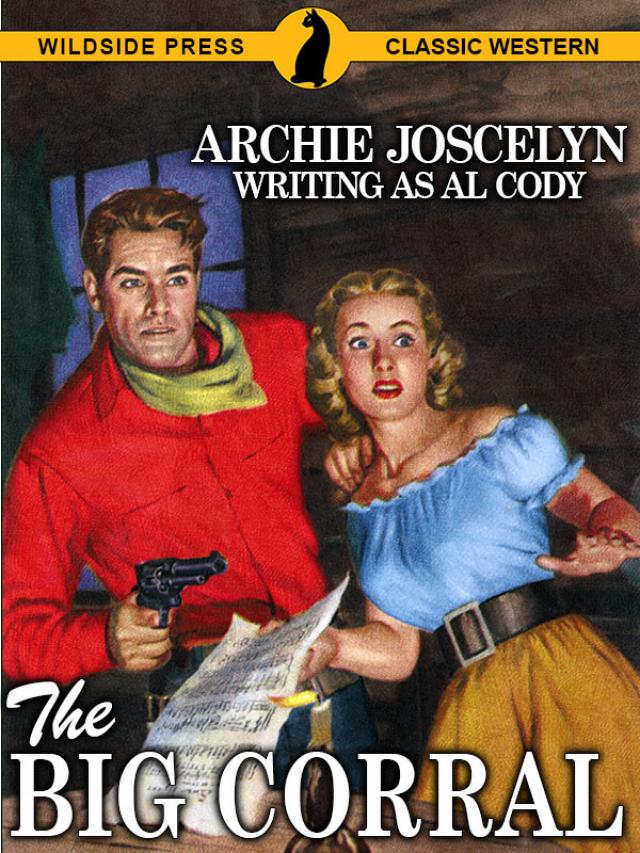


The Big Corral
Al Cody
Copyright © 1948, 1949 by Dodd, Mead & Company, Inc.
Published by Wildside Press LLC.
wildsidepress.com | bcmystery.com
Contents
COPYRIGHT PAGE
Chapter 1
Chapter 2
Chapter 3
Chapter 4
Chapter 5
Chapter 6
Chapter 7
Chapter 8
Chapter 9
Chapter 10
Chapter 11
Chapter 12
Chapter 13
Chapter 14
Chapter 15
Chapter 16
Chapter 17
Chapter 18
Chapter 19
Chapter 20
Chapter 21
Chapter 22
Chapter 23
Chapter 24
Chapter 25
- 1 -
THE GIRL in pink tights, whose hair was like smoke-filled flame, peeped through a slit in the folds of the curtain, and her voice turned falsetto with excitement.
“He’s out there, Marian—the big one who looks like a bear. He’s staring all around the room in that way he has— as though the people were the ground he walks on. But it’s you he’s looking for, of course!”
Marian Breen shrugged one shoulder disdainfully. It was a slender shoulder, the gleam of it rippling like ivory above the deep turkey-red of her dress. She frowned at herself in the mirror, giving an impatient touch to lips already vivid, dark stormy eyes rebellious under hair deep and rich as a miser’s gold.
“What did you say his name was, Marian?” the girl in tights persisted. “And where’s he from?”
“I didn’t say, but he says it’s Rawe North, and claims to be from beyond that new cow town of Wichita,” Marian answered indifferently. “To hear him tell it, he owns all outdoors—or intends to.”
“And he’s crazy about you—as who wouldn’t be? I’ll bet he asks you to marry him tonight! He’s got that look on his face!”
“You’re too romantic, Altie. That’s a look of conquest, not love. What he wants is one big corral with everything he can think of in it—including a woman, if he thinks she’ll add anything to his prestige or the value of his ranch. All that he’s really interested in is that it shall be his corral, the biggest in the country, with the best of everything in it—cows, cayuses, even a woman, All his!”
“Maybe,” Altie agreed doubtfully. “But what’s so bad about that, if you’re the woman? If he asks you, you’ll say yes, won’t you?”
“Will I?” Marian eyed her reflection with a gleam of contempt. “It might depend on how much of it is talk and how much is on the hoof, with his brand on its hide! Such charms as I’m possessed of, which appeal to men, I don’t intend to sell cheaply!”
Altie sighed.
“I sure don’t blame you, Marian,” she agreed. “If I had a face and figure like you’ve got—and that devil-take-all air to go with it—I’d play hard to get, too. All I’ve got is a pair of legs and this hair and a line, and the big ones don’t go for that. I—oh, there’s the other one, Marian! The man who was here months ago. The one who looks like the world was his oyster, and he’d just swallowed it! Now there’ll be something doing!”
“What do you mean?” Marian’s tone sharpened for just an instant as she swung about. Then she had control of herself again; her voice was without a shading of emotion. “Your descriptions, Altie, are colorful, but the way you do run on—”
“You know who I mean, well enough,” Altie said imper-turbably. “Who else could almost lift you out of your chair to take a look, like us ordinary females? I mean the one who’s always smiling and cool, instead of arrogant and cold. The little one—though he’s big enough, for he must be close to six feet, even if your Big Corral does top him by three inches. He’s got red hair like mine, only more carroty, and he has a smile for every woman—but something extra in it when he looks at you, like you were the pearl in his oyster.”
“It sounds as though it might be Tripp Devero,” Marian returned. “He’s from that same Kansas country. And the first time he ever met me, he told me he was going to marry me—when he got around to it!”
Altie squealed.
“And you talk about men like that as though they came in bunches, like wild cherries!” she protested. “But he looks dangerous, somehow!”
“They’re both dangerous,” Marian shrugged. “One’s from Texas, the other from Tennessee. If they want to kill each other off, that will solve one problem!”
Altie eyed her reproachfully.
“You sound as if you didn’t have a heart at all, Marian,” she sighed. “And I suppose, if they fought and only one came out alive, you’d take the winner!”
“I might,” Marian agreed. “Or I might not. If he was big enough to take over his rival’s corral with what’s in it— maybe!”
Out in front, Rawe North crowded his long legs under an inadequate table and glanced around impatiently. It was soon time for the Golden-Throated Thrush to make her appearance and sing, and the big saloon was filling to capacity, as always, for her act. The Paddle Wheel was the biggest, gaudiest saloon in St. Louis, and in these days the most prosperous, due to its main attraction. A fact of which Pete Hartse, the bull-necked proprietor, was jealously aware.
North could see him now, hovering in the background, keeping a watchful eye on the business. Hartse wore a starched white shirt, smudged and gaping at the neck, and his huge bulk was as incongruous in it as a draft horse would have been seeking to prance and cavort in a ring with Shetland ponies. A four-carat diamond blazed from the middle of the shirt front, another of equal size was on one sausage-like finger.
Hartse looked quickly away as North’s eyes ranged to him, and the cattleman smiled grimly. Hartse hated him—they had clashed more than once—and feared him too, of course. Hated and feared him because he was here to take the Thrush away, and Marian Breen was a gold mine. Also, as North suspected, the thick lipped Hartse wanted her for himself. Few women had ever resisted him long. Strange as it seemed, he was counted as a ladies’ man, and North had it reliably that the saloon keeper had gone so far as to offer to marry her. To be turned down then, with his wealth, had infuriated him. Though it had not affected his business sense.
Now, of course, he was doubly jealous. North shrugged. Let him start trouble, if he felt that way! He’d killed such men before.
A newcomer was standing near the doorway, looking over the saloon with a quick, bright glance in which amusement seemed to ripple like the sheen of sunshine on the dust haze inside a room. He had spoken no word, made no gesture, but there was a momentary hush as men—and the women of the place no less—turned to look at him. North felt a red flush creeping into his own face. It was always that way when Tripp Devero entered a room, or any gathering. There was a magnetism about the man of which North was grudgingly jealous.
He studied Devero for a moment, unobserved. Noting the slender gracefulness of him, so that he seemed slighter than he actually was. The reddish hair which added only a touch of clowning to the bitter-bright mockery which seemed always to dwell in his face. Eyes that surveyed the world with that same mirthless humor, quick and sure, like the gun at his hip. If there was a more dangerous man in this room than himself, North knew that it would be Tripp Devero. And the room might be broadened to include the wild turbulence of St. Louis, the sweep of prairieland from Kansas to Texas, and still the same would apply.
There was no doubt in North’s mind as to what Devero was here for, so far from their ranches on that branch of the Arkansas where it ran still as a young stream. Both were big men. there in that raw land of west Kansas, and neighbors. Neighbors, in that only land—a hundred miles or so of it— lay between them. Neighbors, but scarcely friends. Only so impelling a reason as Marian Breen could draw Tripp Devero so far from home, as it had done with North himself.
No, they were not friends, nor ever could be. He hated Devero triply—first for encroaching on land which might otherwise have been his for the taking. Second because Devero was here for the same reason as himself, and always because Devero was what he would never be—slender, graceful, assured, always at ease wherever he went. Rawe North was like his name. Big, blunt, rough-edged. He had always been that way and always would be, and he took a fierce pride in being as he was. But deep down the jealousy rankled.
Devero had seen him now. He stared for a moment, faint surprise showing on his face, and then he came across the room, picking his way like a cat among a disorderly rubble. A drunken man clutched at his shoulder, but Devero slid out from under it with smooth assurance. A girl smiled open invitation at him, and he returned the smile with easy good nature and without a pause. Then he stood, looking down at North.
“You’re too big a man for these tables, Rawe,” he grinned. “And, as usual, I find you underfoot. Though I should have known that you’d be here.”
“I’ve been here a week,” North said shortly. “But I’m leaving tomorrow.”
“Then we should have a neighborly drink before you go,” Devero suggested, and motioned to a bartender. “I’m surprised you’ve been so long, Rawe.”
“I had business,” North shrugged. “As for what you’ve come for—you’re too late.”
“Maybe.” Devero seemed unperturbed. “Time is a funny thing. Like a river. It keeps flowing along, no matter what you do. Sometimes you think you’ve got it dammed up, but it overflows and goes on. Or you dig a new ch
“But you can’t fool with me!” North warned. Such talk bothered him, for he could never quite understand it, but he sensed the meaning and resented it. “I tell you you’re too late. I’m going home tomorrow, and I’m taking her with me!”
“Does she know it yet?” There was faint skepticism in Devero’s query. North tossed off his drink.
“She’ll find it out,” he said,
“Just like that, eh? Well, I’ll dance at your wedding, Rawe —maybe.”
The retort on North’s lips was cut off as the curtains parted on the stage. The boisterous room grew suddenly silent, a greater tribute than applause would have been. Altie was there, along with half a dozen girls similarly clad, and they performed a dance which was watched with tolerance as the curtain-raiser. Then, as they trooped off, the Golden-Throated Thrush floated onto the stage.
Float was an apt word. Her dress swept the floor, so that only a toe twinkled briefly beneath it, as the flash of ivory showed at her shoulders. She moved effortlessly, like a leaf in the wind. The deep, tarnished gold of her hair caught and reflected back the lamplight, and she was at once vividly alive, yet as coldly aloof as a sword. It was that sureness in her which most attracted Rawe North. Like himself, she knew what she wanted, and nothing would turn her aside from her purpose.
For a moment she looked out at the rough, now silent crowd, then began to sing. Easy then to tell why she was known the length of the two rivers as the Golden-Throated Thrush, why Hartse had the best business of any saloon in St. Louis.
She sang none of the popular songs which rawed a man’s throat like new whiskey, or set his blood aflame in similar fashion. Everyone knew that the Thrush sang only the old songs, those which whispered of home, of half forgotten dreams. Songs that stirred memories which might be painful. Music to tauten the face of a man, to twist his heart. Had any other woman sung them to such a crowd, there would have been harsh and angry protest. But with the Thrush, men paid good gold to listen.
She sang six songs, steeped in the fragrance of memories. Only when she had finished was there a storm of applause. Everyone knew that six was her limit, that there would be no encores, no dances, no drinks with the customers. She was Marian Breen, the Thrush, and men took no liberties with her. But Altie and those who had danced were down on the floor now, to dance or to drink with any who might ask.
Tonight, however, instead of retiring directly behind the curtain, Marian startled her audience by stepping down from the stage, walking directly to the table where two outlanders sat. Here in St. Louis they were outlanders, men from the frontier which was constantly being crowded back, which had lapped like the river at St. Louis not long before, but in a night had been so far removed that those who now habited the town could be recognized as a breed apart. Men stared in surprise, and Hartse scowled and cursed under his breath.
Both men sprang to their feet as she approached and North flicked his newly lit cigar toward a cuspidor. She was smiling at both of them, holding out a hand to each.
“How are you, Rawe?” she said. “And you, Tripp? This is nice, to see you again!”
“That goes double,” Devero grinned. “I rode all the way from west Kansas, Marian, to hear you sing again—and to see if you were ready to marry me yet.”
“You haven’t changed much, have you?” she asked, sinking into a chair while they resumed their own. “The first time you ever saw me, you told me you were going to marry me some day.”
“I haven’t changed my mind about that.” Devero retorted. “Your time’s my time, but the sooner the better.”
“As I’ve told you, Tripp, you’re too late,” North reminded him. “I’m startin’ back for Kansas tomorrow, and the Rail Road Track. And she’s going with me!”
“Am I?” Marian surveyed him with a detached interest. “Why didn’t you tell me before?”
“I thought you understood that I intended to marry you,” North said impatiently. “And I’ve been pretty busy with other things.”
“We cattlemen have a lot to tend to, Marian,” Devero explained with a grin. “Special man like Rawe. He’s working to corral himself the biggest ranch in Kansas.”
“That’s right,” North agreed. “I’m going to have the biggest ranch in Kansas—the biggest herds of cattle, the biggest house, the—”
“The biggest wife?” she suggested demurely. “I’m afraid you’d have to feed me a lot of beef steaks to make me that, Rawe.”
North colored, uncomfortably suspicious that these two were making sly fun of him.
“Not the biggest wife,” he corrected. “The most beautiful—”
He was about to say more, but Hartse was approaching the table, his heavy face black with anger. He gestured with a big thumb toward the dressing rooms.
“Ain’t you forgettin’ your own rule, Marian?” he demanded. “Not to talk with none of the customers, here on the floor? Get on back!”
“I’m breaking the rule,” Marian said coolly, “since this is my last night on your floor, Pete Hartse. I’m through with working for you.”
- 2 -
HARTSE STARED, little eyes seeming to recede further into the encompassing folds of flesh. His tone took on an angry rumble.
“Through?” he echoed. “You ain’t no such thing through. You can’t quit that way. Now get back to your room, and be quick about it—”
He was reaching pudgy fingers for her white shoulder when North hit him. He came out of his chair like a grizzly charging from its den, and the simile was good even to the way he struck. It was a full-fisted swing with all his pent-up rage behind it, and it smashed Pete Hartse full in the face—flattening his great nose in a red smear, driving him back for half a dozen steps before he could stop.
But it bespoke the caliber of the man to check then as he did, rocking on the balls of his feet. Other men had been hit by Rawe North, but never had he hit a man as he hit Hartse then. But no other man had ever stood up to such a blow.
For a moment Hartse stood, the gore smearing across his face, starting to spatter down onto the soiled white shirt. Then he started forward, and for all the uncouth bulk of him, he moved with the darting quickness of that shaggy beast of the wilderness which he so much resembled, the wolverine. A bellow emitted from his lips, partly of rage and pain, but partly in signal to his own roustabouts—the crew he kept to back his sway here at the Paddle Wheel, to see that no man disputed him and lived.
Alertly Tripp Devero was on his feet, drawing Marian back with him, as the crowd quickly formed a ring around the contestants. Devero’s voice was cool, even amused, but it carried with a clear distinctness in the moment of hush following Hartse’s roar.
“Well keep it fair,” he warned. “Anybody who interferes I’ll kill.”
Marian Breen, knowing who the crew were, was quick to observe how swiftly that brought them to a stand. Already they had been starting to crowd forward, to come to the aid of their employer. But it was evident that the reputation of Tripp Devero with a gun was known here as it was from the Rio Grande to the sluggish-flowing Platte. They checked, and Hartse mouthed a contemptuous defiance.
“Sure,” he snarled. “I can handle any man that interferes in my business, alone!”
He was reaching with big paws, fingers working hungrily. No man had ever come within the clutch of those fingers and long continued to fight. But Rawe North was not afraid of him. His own blood was at a savage pitch, and here was a chance to show this woman and all others who might be interested, including Tripp Devero, that no man could stand in the way of Rawe North.
North planted himself, one hand against a table. Steadied so, he lifted his foot and kicked. But swift and treacherous as that move was, he had underestimated the speed of his clumsy-looking antagonist. Hartse seemed to pull his protuberant front back, and his hands darted and closed on North’s foot. Then he did an incredible thing. He grunted, face purpling with the effort, but he was turning around, lifting North off his other foot and straightening him with the swing. Only when he had made a complete turn, the tempo quickening. North like the outjutting spoke of a wheel, well up off the floor, did he suddenly release his hold.