Thinking About Memoir, page 5


Going through hell The thing about going through hell is that you also have to fry eggs and pay bills and change into pajamas, so hell is usually set against the ordinary living room of your life. Here is ready-made perspective. Write it all down. The hospital rooms, the cries of children, the shopping lists, the phone number for the electrician or the plumber or the tax guy, the visiting hours for family, the visiting hours for friends. Jumble it all together.
Write two pages of jumble.
Motive for memoir Here is as good a place as any to discuss good reasons—and bad ones—for writing memoir. I have mentioned sisters several times already. Those of us with siblings could probably trace our emotional history by chronicling our relationships with our sisters and brothers. There were long periods when my sisters and I did not get along. There were misunderstandings, misappropriations, mistakes. There were the built-in difficulties of birth order. I was the eldest. (Curious that I put that in the past tense. Perhaps I am finally growing up.) If I were to write about my transgressions, or what I once perceived as theirs, and if I came out either as victim or wise old woman, I would be suspicious. I would have to scrap the whole thing.
Memoir is not a place to get revenge, or to appear angelic, or to cast oneself as victim. If that’s on your mind, write fiction. Memoir should not be self-serving, even accidentally. If you come out as anything but profoundly human, you’ve probably got the wrong motives for doing this, or you haven’t stood far enough back, or come close enough. If you end up where you started—that is, if you wind up with the same feelings about yourself and your life that you had going into this—well, sometimes memoir is about this is how it was. We walked barefoot and upside down to school. We made our own soap, and this is how. That stuff is interesting. Anything you know that I don’t (this includes anything that takes place on a farm) is interesting. If I don’t know it, I want to.
But poor little me is not a good motive for memoir. Neither is good little me. If that’s the point you’re setting off to prove, or (even worse) illustrate, you aren’t going to get very far.
It’s about clarity. Clarity usually involves a good deal more humility than you started out with. And humility is accompanied by generosity. And clarity is dependent on a generosity of vision. I’m not saying we let villains off the hook. There is evil out there. I’m just saying a shift in the way we look at ourselves and our lives is one of the benefits of writing memoir. So keep an open mind, leave room for surprise.
Write two pages of when you failed to rise to the occasion.
Killing time, or grout for memoir I am killing time waiting for the coffee to brew and the kitchen in this tiny restaurant to open so I can lose half an hour eating lunch while the computer at the hardware store across Tinker Street gets itself together. The nice young man there is letting me store six forty-eight-inch dowels, a gigantic flower pot, and The New York Times behind the counter. “It could be a while,” he said, when I asked him when the computer might be working again.
“Can’t I just give you the exact change?” I asked, but he shook his head. I told him I would come back in half an hour. I said it nicely, but I don’t think I was smiling. I wasn’t mad, I just wasn’t smiling. Didn’t feel like it. I believe my expression was neutral.
Earlier, the man laying tile in my bathroom (a job left unfinished because of scheduling difficulties) asked me if I had any grout. “Did you check the basement?” I suggested, and he said there wasn’t any down there. “Then I don’t have any grout,” I answered, leaving the ball in his court. I didn’t leap to my feet and offer to go buy him some, which I might have done in my younger years, making up to him for the fact that he didn’t have any grout either, and he was the one laying the tile. Nor did I ask, “Do I look like I have any grout?” which was another possible response.
So now twelve minutes have gone by and these are the scribbled notes I have been making in my diary. I apologize for how boring they are, but I notice that when my mind wanders aimlessly around, it often returns to manners in one form or another. This can vary from saying “Please” and “Thank you” and chewing with my mouth closed, to feeling apologetic for difficulties beyond my control and not of my making. Guilt is doubtless part of this. Guilt and manners—a provocative place to begin mulling over a life.
Could I somehow divide my life into sections of overly polite, even obsequious, responses to the universe? If I were writing memoir, I might consider such a thing, especially since the older I get the less inclined I am to feel responsible for the success or failure of somebody else’s dinner party. I could think about the history of my life as manifested in manners and/or guilt, the evolving (or devolving) thereof. Think of manners as grout. The point is, again, that even when you’re just doodling around, you’re writing. You’re filling your larder. You’re building the shelves. Trust the work to find its own way. Thank you very much for reading this.
Write two pages of what you no longer feel guilty about.
Write two pages about what you feel even guiltier about.
On the other hand, why be so serious? Why not simply record the life you’ve lived? Growing up sixty-five years ago was vastly different from nowadays. For instance, nobody had invented television when I was little. We didn’t have iPods or BlackBerrys or cell phones.
We got to climb trees. We got to read. We got to play in the mud.
Write two pages that end with “Ha ha.”
I couldn’t finish my lunch. It was healthy in an uninteresting way. “No thank you,” I said to the waitress, “don’t wrap it up.” It wasn’t her fault. I left a big tip.
Further thoughts about manners My aunt Rhoda, who never married, was fond of saying that more marriages were ruined by bad table manners than by infidelity. I was married three times, and I must say that infidelity was right up there at the top of the list, right next to sucking soup through one’s teeth.
Write two pages of what you learned to overlook.
Write two pages of what you could not overlook.
All right, table manners I eat with a large spoon. I eat everything with a large spoon. If I were sitting across the table from me, I’d have to look away. I have only the vaguest notion of how horrible this must appear to the casual observer. After all, the purpose of a large spoon is to get as much on it and then into my mouth as possible. My mother was a stickler for good manners. “Napkin in the lap,” she would say, snapping her fingers. When passing the salt, put it down on the table; never let it be taken from your hand directly. Why not? Bad luck!
Which brings me to superstition. My family was rife with superstition. To this day I do not stir anything with a knife, or rock an empty rocking chair, or say anything or anybody is perfect, at least not without touching wood. I have learned to pass the salt directly from my hand to another’s, although I do always throw some over my left shoulder if it spills. The day I found out that if you do not put the salt down you will have to fight a duel, I lost interest. When the consequences were spelled out like that, they didn’t really bother me anymore.
Write two pages of family superstitions.
Write two pages of pretending to like the food.
Bad manners We weren’t supposed to cut all our meat at once. We were supposed to cut one piece, eat that, then cut another. Why? Never mind. I am already weary of the subject.
Write two pages about good manners that make no sense.
Write two pages in which your enthusiasm rapidly waned.
Ideal day My notion of what constitutes an ideal day has changed over time. Here is one from now. I can’t remember ten years ago. Not yet, anyway.
It is March 2, 2007. Outside the sleet is coming down. Inside I have a fire in the fireplace, and chicken soup on the stove, almost ready for the dumplings to go in. My dog Rosie got hurt on a wire fence on Monday and she has a dozen stitches, and a regimen of no activity until the day after tomorrow. She isn’t even supposed to climb stairs. I had to take Carolina and Harry to a doggie sleep-away for a few days, the three of them together are too rambunctious. So here I am—bad weather, no duties, and an armful of warm dog. Nobody expects anything of me. Nobody even knows I’m here, because I’m supposed to be somewhere else. For me, this is heaven, pure and simple.
It is quiet. I hadn’t realized how noisy Carolina is—she is a hound and it is in her nature to pursue every lead. When she gets up howling—every fifteen minutes or so—Rosie and Harry follow suit, so as not to appear slackers. The peace and quiet is soothing, but I couldn’t live this way for long.
Write two pages of a sudden silence.
I am supposed to be in Atlanta at a writers’ conference and although I had looked forward to it, there was no doubt in my mind that my first responsibility was to my dog. Still, it took me a while to cancel. It wasn’t that I was going to go, I wasn’t. It wasn’t that I preferred Atlanta to Rosie, I didn’t. But some part of me just couldn’t undo my flight, or my hotel room, or my part in the conference (very small). I drove myself crazy. What was wrong with me? Why didn’t I get it over with? Finally I did, and I felt better, and after the dust settled I realized what had stopped me. Alone in a new city, hobnobbing with my fellow goblins, it was an adventure. I wasn’t ready to stop wondering what it would be like.
Write two pages about your ideal day—one for each decade.
Write two pages of putting off relief.
One last thing. When I first found Rosie stuck and bleeding, I wanted some other person to come and be the responsible party, to take her off the wire, to examine the extent of her injuries, to get her to the hospital. But there was nobody but me out there, and Rosie is my dog. My friend Claudette drove us to the vet. She said she hated to look at injuries too, which made me feel marginally better about myself.
Write two pages of a responsibility you’d rather have ducked.
Monday night, after I got Rosie home, I ate two pints of ice cream, one after the other. The first was because she was home and going to be all right. The second was because she’d been injured in the first place.
Controlling the details Suppose you are writing about a woman sitting down at her table to eat supper. Suppose her husband has died, and this is the first time she’s had to face his empty chair. Suppose she went grocery shopping earlier in the afternoon. Maybe she did several errands; she picked up some dry cleaning, bought a book. Maybe you include these details, maybe you don’t. Let’s look at the choices.
If you list everything she bought at the market, the bread, butter, sugar, the tomatoes and pasta, the dog food, and then you describe her putting everything away carefully, you might be doing it for one of two reasons. You might want to show that she is reluctant to go home, so you linger with her over every choice, you show the reader that she is taking longer about this than she might otherwise have done. You don’t have to say right out that she is putting off returning to an empty house as long as she can. The empty house is there in the background. Make sure the rhythm of language is working. Say the sentences out loud. Maybe you want the rhythm to represent a tumbling downhill. If you are in control of the language, you can do anything. But if you are listing her purchases because you feel like it, or because you are in the habit of stuffing details into everything, you will probably have to say out loud that she is lonely. This means the writing is failing. This means, possibly, that the details are in there only because you are obsessive about detail. That’s not a good enough reason. You will bury the moment under the heap of groceries. You want the moment of her sitting down alone to be the point. You want the reader to ache as she aches. All you need is to have her look at his empty chair.
Or maybe she is celebrating. Maybe she is glad her husband had died, maybe he was a terrible selfish boring old coot, maybe he abused her in various ways. Maybe he was mean to her, mean to his children. Then this meal is a different kind of occasion, she cooks herself something special. She raises a glass of wine to his empty chair.
Or maybe the way you portray loneliness is to be spare in your language—the lonely unadorned sentence. She took the long way home. It was dark when she pulled into the driveway. She fed the dogs and scrambled herself a couple of eggs. Maybe she notices the clinking sound her fork makes on the plate. The point is you shouldn’t have to say anything about her emotions. This is that old chestnut: Show, don’t tell. Of course, it is also possible to tell and make that work too, but I don’t know how to do that.
What, you may ask, does dramatization have to do with memoir? Surely this is more the stuff of fiction. Writing is writing, and the reader will be more engaged if allowed to feel without being told what to feel. Trusting the reader provides a tension that keeps the writer engaged too.
Write two pages (or less) of a single woman’s shopping list.
Write two pages in which you are reluctant to go home.
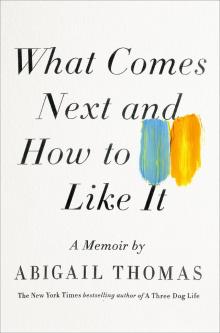
Light Different memoirs require different voices. If you are writing about your autistic child, you are writing as a mother. If you are recalling an untimely death, you write from loss. When I wrote A Three Dog Life, which is a book about my husband’s traumatic brain injury, I was writing as his wife. I wasn’t writing as the mother of four, or the grandmother of twelve; I wasn’t writing about my relationship to my own parents, or to my sisters, or my friends, I was writing as Rich’s wife. That is the lens through which I looked at what was happening; both of us were changed and changing. There were aspects of myself I’d prefer never to have uncovered, but memoir will do that.
Catastrophe brings out the best and the worst. That’s the deal, and everything goes into the mix, good and bad. On the whole, I’d say it’s easier to know oneself than to fool oneself, and it requires less energy.
If it can’t be forgiven, at least it can be brought up to the light.
five
Writing from Loss
Make something out of it Writing is a way to fathom what we have lost, to make sense out of what makes no sense. This section is about losses of all kinds. I don’t believe that everything happens for a reason, but I have faith in our ability to retrieve from loss something valuable to keep, or to give away. In writing A Three Dog Life, I had to examine a subject I thought myself too sophisticated to be troubled with—survivor guilt. In tossing around for some way to feel okay about the fact that I was alive and well, I looked up the word acceptance, and found that in part of its DNA is an ancient cousin that means “a thread used in weaving.” Sometimes the language itself holds an answer. You must weave in the thread and keep on weaving.
Lost objects, lost childhood, lost dreams, lost innocence. Lost loved ones. Here is a group of exercises that deal with both the trivial and the profound.
What we cannot lose Maybe there are those of us who need our props: our books in our bookcases, our pillows, our chairs and doodads, our kitchen sinks. Maybe if we are too long away, we lose sense of who we are, we are ungrounded. There is a passage in So Long, See You Tomorrow, a novel by William Maxwell, in which he talks of a boy sent away from home, and he lists the things that are no longer in this boy’s life: “Take all this away and what have you done to him? In the face of a deprivation so great, what is the use of asking him to go on being the boy he was. He might as well start life over again as some other boy instead.”
Write two pages of what would have to be taken away to make you no longer who you are.
Write two pages of what you don’t need.
Loss of time When I was young, and for a long time afterward, Sunday afternoons were melancholy. I used to blame it on memories of my father retiring alone to his study to listen to classical music. I didn’t like classical music. It made me uneasy. I liked Carl Perkins and Elvis Presley and Ray Charles. I liked Bobby Darin and Buddy Holly. I didn’t understand music you couldn’t sing or dance to, and there was something about him holed up in there all by himself that depressed me. I didn’t like the closed door.
But I think something else was going on. The span of a week is a reminder of the finite, even to the young. And powerful Sunday, which starts out fat and lazy, stretching endlessly ahead, dwindles to a wisp, and just like that, it’s over.
Write two pages about your relationship to Sundays, in ten-year intervals.
Write two pages of your relationship to Saturdays, ditto.
Loss of sleep I have a friend who went to another city to sleep. He had insomnia and he had tried everything else. I have no trouble sleeping, my problem is staying awake, but I went along for the ride. We flew to New Orleans, where I hadn’t been since I was eight years old. We ate beignets and fried oysters. We stayed in a large hotel. As it turned out, the city was full of football fans. LSU was playing Oklahoma (was it Oklahoma?) in one of the college-bowl playoffs. Purple pom-poms everywhere. Nothing looked familiar to me and he still couldn’t get to sleep.
Write two pages of taking extreme measures.
Write two pages of insomniac thoughts.
My friend lives with something that kills you. He jokes about it, and most of the time I forget how serious it is. He’s the person I call when something hilarious happens, or something scares me to death. He is the person I rely on to keep me sane and honest. He is wise and terribly funny. My fears for him are selfish. It’s not his death I fear so much as my life without him.
Write two pages of a selfish fear.