The Body Farm, page 25


The next few months were difficult. I knew Emerson was gone, but I could not tell Beatrice, who continued to wake up screaming from nightmares and startle every time her phone rang. With the two of you, at least, I could be myself again. Fun Mama. Science-y Mama. When the weather warmed, I took you to the zoo. I hung a tire swing from our oak tree. We worked in the backyard, transferring the herbs Armando and Joe had helped you grow in indoor pots to a vegetable garden by the fence.
“It’s been a while since I’ve heard from you-know-who,” Beatrice said on a rainy day in spring. “I’m getting antsy waiting for the other shoe to drop.”
“Maybe it won’t,” I said. “Maybe he’s finally moved on.”
She smiled at me. Her hopefulness is amazing. I will never stop admiring it.
Flowers bloomed. You splashed in puddles. One morning you found caterpillars, seven of them, crawling around on the parsley we’d planted in the garden. They were black swallowtails—I could tell from the coloration and their choice of host plant. We carried them inside, safe from predators, and raised them by hand. I have never seen such smiles. You named them, loved them. When they melted and solidified into chrysalises, you mourned. When they hatched into miraculous, dewy creatures with midnight-black wings, you laughed. When we released them into our garden, you danced, watching them flit and circle and finally rise, vanishing into the blue.
On the one hand, homicide is objectively wrong. On the other hand, is it? I don’t think I’m deranged. I hope you don’t think so either, my darlings. I believe you see me as I truly am: a doting mother, a loving wife, and an affectionate friend to my friends. A good provider. A well-balanced person. A conscientious member of society.
The Emersons of this world are a dying breed. That’s my hope, anyway. I want it to stop with your generation. It comes down to you, my beautiful boys. You are growing up every moment, and one day, all too soon, you will no longer be interested in fairy tales. You will shed the wild sweetness of these early years. It’s hard to imagine you as preteens, high schoolers, adults, but I know it’s coming.
You will be good men. That isn’t hopefulness on my part—it’s decision, intention. Despite our years together, none of Beatrice’s optimism has rubbed off on me. I know you’ll be good men because I will see to it. Lucas, with your tender heart, so like your mother’s. Theo, with your righteous spirit, so much like mine.
“Can Emerson be gone?” Beatrice asked when summer came. “He isn’t gone, is he? I’m afraid to let my guard down.”
“I think he gave up,” I said, pouring her a glass of wine. “Maybe he finally saw how happy you are. How happy we are.”
She laughed the way she used to, a cascading waterfall. I hadn’t heard that unfettered laugh since the first blue envelope arrived.
○
When I began writing this letter to you, I thought I understood my purpose. I believed I was setting down my confession in case the truth ever came to light. I wanted you to know why I did what I did. At the Body Farm, we only care about how, but you, my children, would want to know why. And so I have tried to explain. I intended to hide the letter somewhere secret, to be opened in the event of my conviction. Not arrest, you understand—conviction. That was my plan at the start, anyway.
But now that I have written it all down, I can see that I will never be caught. It was indeed a perfect murder. I even incinerated Emerson’s burner phone, and mine, along with his body—the only extant things in the universe that could possibly connect him to me.
It has been a year since I killed him. Winter has settled in once more, and Beatrice seems at ease in her own skin again. I’ve seen her shoveling snow without glancing up every time someone walks by. She forgets to turn on the security alarm some nights. The doorbell rang the other day and she ran, excited for the package she’d ordered, throwing open the door without looking through the peephole first. I took her out for a night on the town and she did herself up, highlighter on her cheeks, a slinky red dress I’d never seen before. She wouldn’t have been so bold and colorful if Emerson was on her mind. Our lovemaking—well, I’m sure you don’t want to hear about it, so I will only say that Emerson had a stifling influence on both of us that has since vanished entirely.
Even now, the police don’t realize he’s missing. They probably never will. Beatrice mentioned once that Emerson didn’t have any family. I’m sure there are no friends to report his loss either. A loner. An oddball. The only person who will notice his absence is Beatrice, and for her it has been a balm, a delicious silence, the cessation of persistent pain.
What, then, have I written here? Not a confession—there would be no point. I will take the truth to my grave. I will let time prove to Beatrice that Emerson is gone, and I will say nothing, not to her, not to you, not to anyone.
And yet, even if no one will ever read this letter, it may still serve a purpose. It could be a blueprint of sorts—a battle plan. Not that I anticipate ever needing to take such drastic action again, you understand. I killed Emerson because I had to. There was no other solution to the particular problem of his aliveness.
But if I were to take the lessons I learned from his death and turn my attention to someone else, another “bad guy,” a stranger to me . . . I will admit that during one of my recent graveyard shifts, in the ghoulish lull of the witching hour, the thought did cross my mind. The only tricky part of Emerson’s murder was the connection between us, however tangential. There was the slimmest chance that a search of motives could lead back to me.
A stranger, however—someone with no link to me at all—well, what could be easier? Yes, the thought has crossed my mind. There’s that neighbor who screams such vile things at his wife after a few drinks. There’s the principal of the local elementary school, who has kept his job for a decade despite persistent rumors that he sexually harasses his teachers. There’s the woman Hyo told me about, a dear friend of hers from college, trapped in an abusive relationship, too afraid to leave him even after he beat her badly enough to put her in the hospital. Hyo mentioned the man’s name to me as she wiped away her tears. I did just happen to jot it down.
And a couple of weeks ago, there was a news story about a serial rapist right here in Lyle, convicted of assaulting eight different women and sentenced to a paltry two years in prison. I did just happen to make a note of his release date as well. God, it would be so easy. No affiliation between any of these men and me. No apparent motive. My rotation on the night watch comes back around like clockwork, and the skeletons are always piling up again, ready to be incinerated.
So maybe what I have written here is a cautionary tale. Maybe it was never intended for you or me. Maybe, all along, I meant it for men like that rapist or the principal or the neighbor—men like Emerson. The fact that none of those despicable souls will read it is irrelevant. A story like mine has power in the mere fact of its existence. A warning. A tremor in the fabric. A new kind of ending.
I don’t have to decide yet what I will do. I have all the time in the world to see what kind of person I am becoming. We are all in a process of constant evolution, larvae metamorphosing into blowflies. That’s what I love most about insects: their capacity for transformation. A tiny translucent egg sac becomes a half-blind, slow-moving grub, which mutates into a cocoon filled with mush that lies motionless in the soil for days as though dead, then erupts into its final form, a fierce winged creature with a panoramic field of vision and an accelerated perception of time, with feet that can taste the ground. It’s the closest thing to magic to be found in this life.
And insects transfigure more than themselves. Without bees, there would be no flowers or fruits. Without bone beetles and coffin flies, the dead would not decay, and the cycle of life would be broken. The work of insects, like mine, is both grotesque and vital. They transmute flesh and bone into mulch and nutrients. They change the dead into the raw materials for new life. There are no plants as green as the ones on the Body Farm, feeding from the richest, most blood-soaked soil on earth.
What happened to Emerson was not legal, but it was right. It was fairy-tale justice. And I suppose, in the end, that’s what this story is: a fairy tale. Once upon a time, there was a golden-hearted woman, pursued over hill and dale by an evil ogre. She met a gallant knight—me, of course—and bore two fine sons. They lived peacefully for a time, hoping the ogre was gone, but he came back, as wicked things so often do. Bravely, cleverly, the knight slew the ogre and burned him up. The golden-hearted woman rejoiced. Together they raised their sons to be better men than the men who came before them. And they all lived happily ever after.
Acknowledgments
This book would never have come into being without the support of so many people. Thanks to my family, writer friends, mom friends, readers, students, colleagues, and in particular:
Scott—unique, brilliant, charming, hilarious, RRM’s, Bean senses, playground, Hercules, razor perceptions, to be, handsomeness, best friend. I can’t do justice on the page to the marvel that you are and the gift you have been in my life. Love isn’t a big enough word.
Milo—the most interesting person I’ve ever known, a shining light, the only one who’s ever made me do a spit take with laughter, my favorite human. I am grateful every day to be your mother. Every day with you is a new adventure.
Laura Langlie—beloved agent, champion, friend. None of this would be possible without you.
Dan Smetanka—the most insightful and generous editor I could ever have hoped for. You ask for magic, and because of you, I am able to find it.
Sarah Bendix—my always friend, my heart, purveyor of excellent memes, lifeline via text. You taught me what friendship is, how to do it, and why it’s worth it.
Dad—painter, teacher, meditator, sci-fi writer, world traveler, woodworker, gardener, musician, the ultimate renaissance man. You showed me how to notice the beauty of the clouds, how to identify songbirds and fix a faucet, how to love the world, how to never stop learning.
Joe—no one else could possibly understand all the times that Bloom County and Calvin and Hobbes quotes are needed. Thank god you are always there if I come across an important fact about dinosaurs. Any day that goes by without a text from you is a lesser day.
Patsy—legally my aunt, but factually my fairy godmother. You change my life for the better with a wave of your magic wand.
Lan Samantha Chang—mentor, genius, and all-around stellar human. Thank you for bringing me back to the Iowa Writers’ Workshop. Thank you for bringing me home.
StoryStudio Chicago—a nonpareil sanctuary for writers. I am ferociously proud of my remarkable students. I am forever grateful to be a part of this wonderful community.
Counterpoint Press—everyone on the team is amazing, but I must especially thank Megan Fishmann, Barrett Briske, Laura Berry, tracy danes, Rachel Fershleiser, and Kira Weiner.
Laurie—you saved my life, and you continue to save my life.
My dogs—you can’t read, but you are essential to my writing nonetheless.
These acknowledgments would not be complete without mentioning my mother. She died in 2022, and she will never see this book come into being, though I’m glad she had the chance to read a few of the stories before she got sick. I am a writer because of her. I am who I am because of her. She edited everything I ever wrote. She loved me fiercely and unconditionally. She never believed in an afterlife, but I’m going to say it anyway: Thank you, Mom.
The author gratefully acknowledges the following publications, in which some of the stories in this collection previously appeared:
“The Rapture of the Deep” in Missouri Review
“The First Rule of Natalie” (as “Selkie”) in Joyland
“Porcupines in Trees” in Ninth Letter
“Childish” in Triquarterly
“Starlike” (as “Star-like”) in Arkansas Review
“The Body Farm” in Epoch
© Maia Rosenfeld
ABBY GENI is the author of The Lightkeepers, winner of the Barnes & Noble Discover Great New Writers Award for Fiction and the inaugural Chicago Review of Books Award for Best Fiction; The Wildlands, a finalist for the Los Angeles Times Book Prize; and The Last Animal, an Indies Introduce Debut Authors selection and a finalist for the Orion Book Award. Geni is a graduate of the Iowa Writers’ Workshop and a recipient of the Iowa Fellowship. Find out more at www.abbygeni.com.
THE BODY FARM
This is a work of fiction. All of the characters, organizations, and events portrayed in this novel are either products of the author’s imagination or are used fictitiously.
Copyright © 2024 by Abby Geni
All rights reserved under domestic and international copyright. Outside of fair use (such as quoting within a book review), no part of this publication may be reproduced, stored in a retrieval system, or transmitted in any form or by any means, electronic, mechanical, photocopying, recording, or otherwise, without the written permission of the publisher. For permissions, please contact the publisher.
First Counterpoint edition: 2024
Library of Congress Cataloging-in-Publication Data
Names: Geni, Abby, author.
Title: The body farm : stories / Abby Geni.
Description: First Counterpoint edition. | Berkeley : Counterpoint, 2024.
Identifiers: LCCN 2023052625 | ISBN 9781640096264 (hardcover) | ISBN 9781640096271 (ebook)
Subjects: LCGFT: Short stories.
Classification: LCC PS3607.E545 B63 2024 | DDC 813/.6--dc23/eng/20231109
LC record available at https://lccn.loc.gov/2023052625
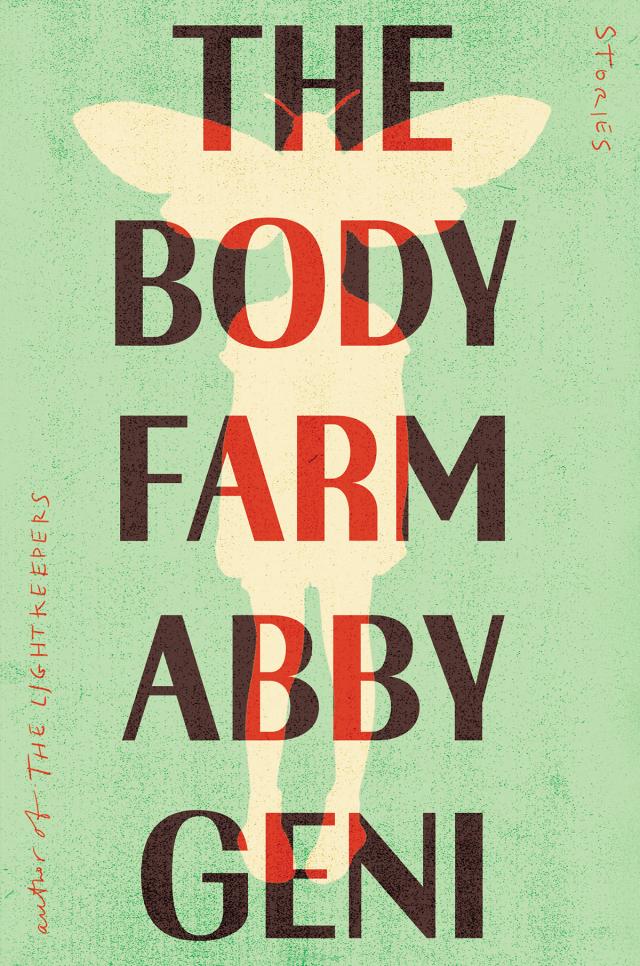
Jacket design by Jaya Miceli
Jacket illustration of silhouette © Shutterstock / Nowik Sylwia
Book design by tracy danes
COUNTERPOINT
Los Angeles and San Francisco, CA
www.counterpointpress.com
d_r0
Abby Geni, The Body Farm