Other People's Houses, page 29


Richard pulled out his phone. “Well then, you should probably call them.”
* * *
• • •
It was Michael who answered his phone, and Michael who went to get the boys. Frances and Ava sat on the sofa, side by side, watching the play of police car lights and reporters’ cameras on the inside of the curtains. Eventually Ava cleared her throat.
“Well, it was an effective image, even if it wasn’t very pretty.”
Frances sighed. “You don’t think ‘gaping neck wound’ was maybe a little harsh?”
“Not at all.”
“OK. That makes me feel better.”
“Good.” They lapsed into silence again.
“Are you going to ground Milo for, like, a year?”
Frances shrugged. “Maybe. Right now I’m just so overwhelmingly relieved he’s in one piece and found that I’m ready to throw him a parade. Not a great parenting choice, but whatever.”
Ava shifted a little on the sofa, inching closer to her mom. “You always make us feel like you’d be ready to throw us a parade at a moment’s notice.”
“I do?”
Ava nodded. “Yeah. You’re very . . . supportive.”
“How annoying.”
“It is.”
“Maybe if I were a little firmer with you guys Milo wouldn’t have run away and you wouldn’t be so angry with me all the time.”
Ava looked surprised. “I’m not angry with you all the time.”
“Yes, you are. Or you seem to be, anyway.” Frances put her arm around Ava’s shoulder, and tugged her closer. “I don’t mean to be so annoying. I just never had a teenager before and I’m scrambling to keep up.”
“That’s OK. I’ve never been a teenager before, so we’re in the same boat.”
Frances took a chance. “Who is Piper? Is she the one who’s making you unhappy?”
Ava was silent for a moment, then sighed and answered. “No, she’s really just a girl at school. I thought we were friends, but then suddenly there was all this drama and now we’re not friends.” She closed her eyes, unseen by her mother, who nonetheless squeezed her. “It’s very hard to know what’s going on, you know? No one is what you think they are.” She sighed once more. “Not even me. I don’t know who I am anymore, and when I think I know I change again. It’s very confusing. You and dad are the only ones who stay the same.”
They sat there some more, saying nothing in a companionable way. These quiet moments are the mortar that holds families together, yet they often pass unnoticed. Frances reveled in them; it was her superpower.
“Do you ever feel like running away?” Ava asked her.
Frances shook her head. “Where would I go? Everything I love is here.” She rested her cheek against Ava’s hair, smelling—yet again—her shampoo on someone else’s head. “Do you?”
“Yes and no. Yes, because I’d like to be somewhere else or someone else or sometime else. But no, because you’d just come after me.” She looked at her lap, to hide the happiness she felt at that fact.
“I’m afraid so.”
Ava straightened up and looked at Frances. “You know, I was worried about Theo until I knew he was with Milo. That meant they’d gone under their own steam, rather than being snatched by some asshole, right?”
“Sure. At least, more likely that.”
“And Milo knows what I know, which is that you would never stop looking for him. You told us that all the time when we were little.”
“I did?” Frances pulled a cushion over and hugged it, still a little freaked out by this day, despite her apparent calm. Luckily, Ava seemed sanguine, so that made one of them.
“Yeah. You said it over and over: If you get lost, stay where you are and wait. Daddy and I will be looking for you and we will never stop. If someone takes you, keep fighting, keep making noise and kicking them in the nuts, because we will be hunting for as long as it takes, and we will never stop.” Ava smiled to herself. “I’ve never been scared of being alone, which I guess is a good thing because the chance of anyone wanting to date me with these eyebrows is remote.”
Frances ignored the eyebrow comment. “Did I literally say nuts?”
Ava shrugged. “You may have. You must have told us five hundred times. Ask Milo. You also went on and on and on about paying attention in parking lots, do you remember that?”
Frances ran her hand through her hair, which made it stand up like a radio antenna, unbeknownst to her. “I sound very boring. What did I say about parking lots?”
“You said,” Ava mimicked her mother’s voice, which was apparently like Daisy Duck’s, “they’re looking for spaces, not children, so be careful.”
“Did I sound like I was on helium?”
“No, only in my head.”
“OK.” Frances had a headache. She couldn’t believe she’d been so rude to Anne. Suddenly, though, she started laughing.
Ava looked at her. “Are you hysterical? Do I need to slap you?”
Frances laughed and shook her head. “No, I’m just laughing at the memory of your father’s face.”
“When you yelled at Anne?”
“No, just in general.” She giggled. “His face makes me laugh. That’s why I love it.”
Ava raised her eyebrows, but her mom was still laughing, so she let it go.
* * *
• • •
Richard happened to be looking at the boys when the car pulled up in front of them, and when he saw the relief in their shoulders he suddenly got a memory of seeing his mother approaching the school gate at the end of the day: I’m not forgotten. It’s OK now. A tall man got out of the car and came over to him, holding out his hand. Richard, still feeling about eight years old and strangely close to tears, managed to smile at him.
“I will never be able to thank you enough,” Michael said. “I am so grateful.”
Richard shrugged. “It takes a village, right?” He watched the man bend to hug his son, and then pull the other boy into an embrace, too. “Besides, it’s nice to do something helpful for a change.”
The man stood up and smiled at him as he shepherded the boys into the car. “My name’s Michael Bloom,” he said. “If you ever need anything . . .” He handed Richard his card.
Richard grinned at him. “Thanks,” he said. “Glad I could help.”
The car pulled away, and Richard watched it go. Then he turned and walked away himself, tucking Michael’s card in his pocket, where it would be forgotten and washed away into fluff.
* * *
• • •
The smell of his mother’s perfume always made Theo feel small. Throughout his life elements of it would drift across his path and take him right back to this moment and others like it, when the soft skin of Anne’s neck felt more like home than anything ever would again.
He’d been worried his parents would be furious with him, but they seemed just very glad to see him, and even Kate had cried and held on to him as they sat together on the sofa. After a while his father pulled out of the snuggle and looked at him.
“Why did you run away, Theo? Will you talk about it?”
Theo nodded. A policeman had talked to him briefly, outside, after he and Milo had returned. He could tell the man was annoyed with Milo’s dad for going to fetch them without telling the cops, but Michael had just shrugged and said he’d had no other thought but to get to them as quickly as possible. The man had looked at him thoughtfully and for a moment Theo had felt uncertain, but then the cop’s face had cleared and he’d just led the two boys a little way away and squatted down.
“Is everything OK?” he’d asked. “Are you scared at home?” They’d both shaken their heads. “Why did you run away?”
“I wanted to talk to my mom,” Theo had said.
“I didn’t want him to get lost,” Milo had said. “I’m a Scout, it’s my job to help.”
The cop had smiled a little bit at Milo, then looked at Theo. “Tell your mom and dad everything. Tell them what you want, tell them what you feel. They love you very much and they deserve the truth, alright?”
The two boys had nodded, and then the detective had stood up, ruffled Milo’s hair, and walked off. Now Theo remembered his advice.
“I wanted to be with Mom. I love you, Dad, but I want you to be together again, I want it to be like it was before, even if she did something bad. I want you to accept her apology and let her come home so we can all be together.” He looked at his family. “We are supposed to all be together, whatever happens.”
“She can sleep in my room, if you don’t want to share,” added Kate. “It’s fine. I can move my Beanie Babies.” She looked serious. “I have too many anyway.” Then she shook her head. “No, that’s not true, but I can move them.”
Charlie looked at Anne’s face, the near-miss of the day washing away everything that had come before. They’d held hands and burned with fear, and the annealing had broken open a crack of possibility.
He smiled at her as if they’d never met, and she started to cry.
Christmas.
Frances was sitting in the living room, watching her kids decorate the Christmas tree, the old orange cat on her lap. She thought back to that morning in the tree lot: The kids and Michael were arguing about whether or not to get greenery for the front door, and Iris and Sara were trailing around after Wyatt, as he pointed to larger and larger trees. From this distance she couldn’t hear what they were saying, but Sara kept shaking her head and Iris just looked tired and mildly green. The hormone treatments were making her nauseous, and Sara had stepped up to run the holidays. Of course, they’d be coming to Frances’s house, as they did every year, but that was a week or two off yet. Hopefully Iris would feel better by then and able to eat.
Frances stroked the cat’s head. Frances had seen Anne and Charlie unloading their tree the day before. They were still being a little too polite to each other, but at least they were all under the same roof, and the kids were doing better. Anne was sleeping in the guest room, but she was hopeful. They were seeing a therapist, all of them, and maybe it would work. And maybe it wouldn’t. Not her problem.
Milo had taken his six weeks of house arrest and loss of computer privileges in stride, and he and Ava were getting on better since his transgression had led to both of them getting cell phones. The whole family had ended up staying offline for a month anyway, while the video of Frances losing her temper had enjoyed its fifteen minutes of fame. They’d ignored the media and after a week or two of leaving the phone off the hook it had all gone away. Frances knew it would haunt her on and off forever, but who cared? It had stopped the bitches at school calling her Saint Frances, which had always been annoying. As an additional bonus, the painful abyss of boredom occasioned by the lack of Internet had caused Ava to pick up her cello again and rejoin the orchestra. Proving once again that it’s always darkest before the dawn, or that every cloud has a silver lining, or something like that.
Frances heard thumping down the stairs and suddenly Lally appeared, silently crossing the doorway on her way to the kitchen. She was dragging an enormous stuffed giraffe behind her, a giraffe Frances hated and had tried to get rid of many times. The neck, the body, the legs . . . The fucking thing took several seconds to clear the doorway, and Lally was exerting herself as she tugged it along. She appeared to have attached it to herself with—Frances swallowed—fur-lined handcuffs.
Michael looked up, ready to ask Lally if she was coming to help with the tree decorating. He saw the giraffe. He saw the handcuffs. There was the barest pause, then he looked at Frances. Almost imperceptibly she shook her head and watched her husband follow their youngest into the kitchen, hoping to head off further embarrassment. It probably wouldn’t work, but she admired his willingness to try.
Still, it would be a funny story to tell Julie, who was hoping to be home before Christmas. The neighborhood would be together again, in all its imperfect, fractured, embarrassing glory. She’d just have to do her best to keep it that way. She stroked the cat and felt comfortable, even as he tightened his front paws and poked ten identical holes in her thighs.
Discussion Questions
1. In this book the neighborhood plays an important role. What other situations create this kind of community, and how does seeing people every day change your relationship to them?
2. The central character, Frances Bloom, is someone who likes to help, because it makes her feel useful. Do you know someone like this? Do you find it easier to help or be helped?
3. Frances and Michael have a very happy but not very romantic marriage. Do you think that this will eventually drive them apart?
4. Anne Porter has an affair and nearly destroys her marriage. How important is sexual fidelity? Is it the most important element in a marriage? Can trust be rebuilt after a betrayal of this kind?
5. How much do children understand their parents’ marriage? How hard is it to maintain privacy in a relationship once you have children?
6. Sara and Iris are experiencing communication problems in their marriage, although it’s very strong. Have you gone through something similar, where communication breaks down for no apparent reason, and then becomes difficult to reopen?
7. Anne felt she was someone else in her affair, that it was something just for her. Ava also mentions a strong desire to be her own person, driving her own choices. How hard is it to balance a sense of self with responsibilities within a family?
8. Frances and Ava are navigating their changing relationship as Ava becomes more independent. Did you struggle against your parents or one parent in particular as you were becoming an adult? How do you think the experience of adolescence has changed since you were a teenager?
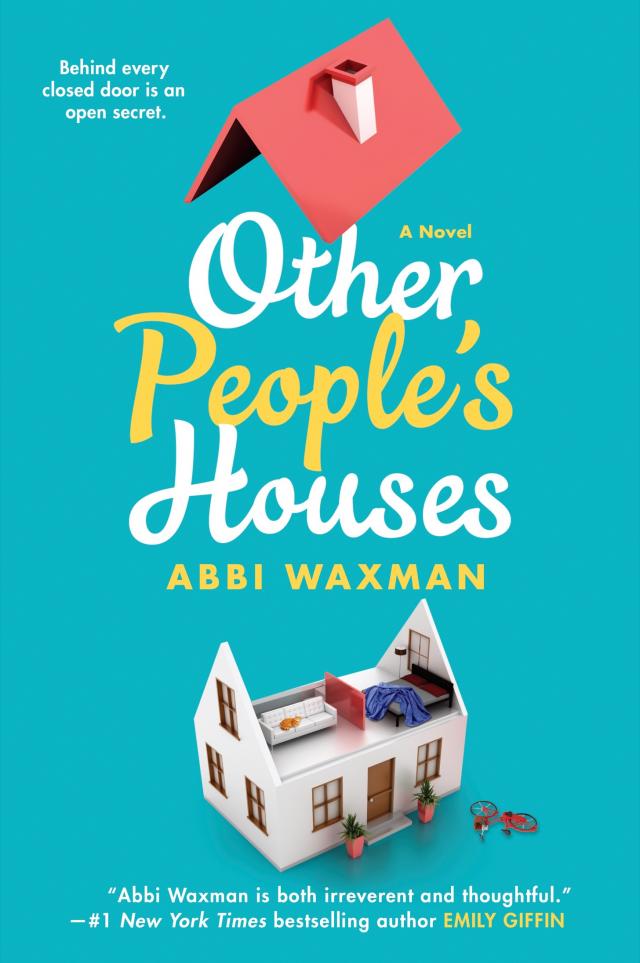
9. The title, Other People’s Houses, alludes to the impression one gets of someone just by looking at them. How much can you really tell about someone based on their home, or the way they dress? Is appearance an expression of character, or armor?
10. Bill and Julie Horton are dealing with a challenging time in a very private way. What do you think are the advantages and disadvantages of approaching it this way?
About the Author
Photo by Leanna Creel
Abbi Waxman, the author of The Garden of Small Beginnings, is a chocolate-loving, dog-loving woman who lives in Los Angeles and lies down as much as possible. She worked in advertising for many years, which is how she learned to write fiction. She has three daughters, three dogs, three cats, and one very patient husband. Visit her online at abbiwaxman.com, facebook.com/abbiwaxmanbooks, and twitter.com/amplecat.
What’s next on
your reading list?
Discover your next
great read!
* * *
Get personalized book picks and up-to-date news about this author.
Sign up now.
Abbi Waxman, Other People's Houses