

The Dark Crystal, page 1


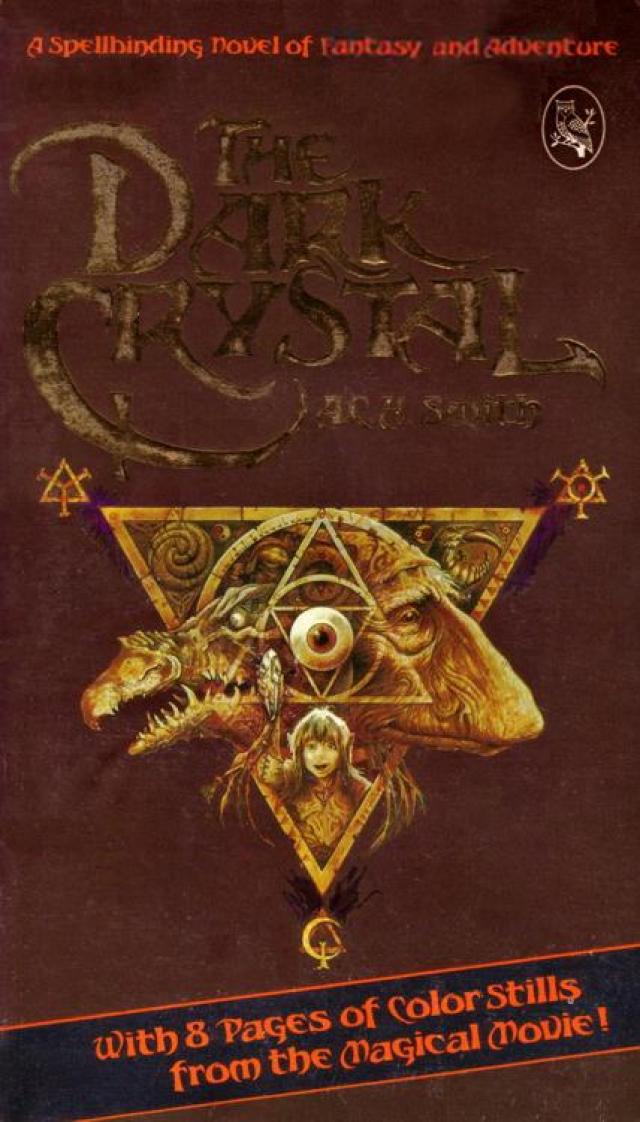
The Dark Crystal is based on the movie produced by
Jim Henson and Gary Kurtz, directed by Jim Henson
and Frank Oz, with David Lazer as executive producer,
screenplay by David Odell, and conceptual design
by Brian Froud.
Copyright © 1982 by Henson Associates, Inc.
Photographs by Murray Close and John Lawrence-Jones.
All rights reserved, including the right to reproduce
this book or portions thereof in any form.
Published by Holt, Rinehart and Winston,
383 Madison Avenue, New York, New York 10017.
Published simultaneously in Canada by Holt, Rinehart
and Winston of Canada, Limited.
Library of Congress Cataloging in Publication Data
Smith, A. C. H. (Anthony Charles H.), 1935-
The dark crystal.
"An owl book."
I. Title.
PR6069.M42D3 1982 823'.914 82-3101
ISBN: 0-03-062436-3
First Edition
Printed in the United States of America
3579 10 8642
There was only Jen. Jen alone.
His favorite game was to blow his flute and imagine other Gelfling, from just beyond the first trees, summoned by his music, creeping up behind him as he sat beside the waterfalls. They would be smiling because they would think they were hidden from Jen by the rocks. And when he stopped playing his flute and quickly turned around and caught sight of them moving, they would be obliged to stay with him then, and live with him forever, in the valley of the urRu.
It was only a game he played, on his own.
Below the waterfalls were green pools in which he swam. He dived down to the weeds, then turned face-upward and floated very slowly back to the surface, watching the sunlight above him dance and shatter and dance again, like hot metals in the pans urTih the Alchemist used. The creatures of the pools swam past him, unafraid, knowing him: the yellow and brown Myrrhie, the long, wriggling Krikids. Jen had always swum with them in their pools, ever since the urRu had brought him to their valley to live with them. He pretended that the creatures in the pool, and those on the land and of the air, were his friends. As they were, indeed, but friends with whom he could not converse. Only the urRu could speak Gelfling to him, and they always did, because their own language was too difficult for him to learn. The urRu were his real friends, of course, but it was difficult to think of them as friends: they were so immensely old and slow and huge and abstracted from everyday things.
Jen squinted at the sky. It was behaving strangely today.
They were kind to him, the urRu, even though they never cooked food he liked. He could not remember what Gelfling meals were, could only remember his mother as a shadow over his small body, but he was convinced that somewhere there was food he would relish. It did not grow in the valley, the urRu would answer if he questioned them. When he pointed to berries he would have liked to eat, they forbade him to, in fear he might be poisoned.
“Wise Ones,” Jen would say – that was what their name meant, urRu, the old and wise ones – “won’t your wisdom tell you if these purple berries are poisonous or not?”
They would shake their great mournful heads, thin grey hair brushing over their ears. “Wisdom is not for knowing but for understanding” was their answer. “Our food is good for you. It will suffice. We cannot know what is bad for a Gelfling. Eat up, and grow strong.”
The urRu loved him, Jen knew that.
Outside the valley, with its rocks and cascading pools, its trees, berrybushes, flowers, and grasses, outside, beyond the boundary of the outer Standing Stones, there must be, he thought, a place where Gelfling food grew; a place where Gelfling had once lived, where he had lived when his mother and father were alive. He thought he could remember being among many Gelfling. Where had they all gone? He would ask, “Why may I not explore outside this valley?”
“You might lose your way,” the urRu would reply.
“One of you could come with me.”
“No, little one, we cannot leave the valley.”
“Not ever?”
“Not yet.”
“When, then?”
“Not yet.”
“One day, will you? And may I come with you?”
“One day,” they would say, “yes, one day you will leave here.”
“When?”
At that they would raise their old, lined faces, look pensively at the sky, and walk slowly away.
Oh, how sad they seemed to Jen, those weary, kind faces of theirs.
“I would take my flute with me,” he offered. “I would play it all the time I was outside the valley so that you could always come and find me again.”
“Not yet, little one.”
And so he stayed in the valley and played his flute. It was a double flute, and he had learned to play harmonies on it. The urRu encouraged him to practice, and he thought they must have given him the flute in the beginning. Anyway, he could not remember a time when he did not have it. Sometimes urSol the Chanter sang while Jen played. He was a fine musician, urSol, and could sing a third row of harmony, holding Jen cupped in his hand, by his head. The only difficulty they had was that urSol’s voice was loud and deep, sufficient to make the rocks vibrate. To accompany quietly enough so that Jen’s flute could be heard, he had to keep his mouth almost closed, in a sort of humming, and that, he said, was hard work.
The sky today disquieted Jen. The wind kept changing its direction, as he could easily tell from the different patterns of ripples fleeting across the surface of the pools. He had been woken up by thunder, although it was far away, and all day the sky had been rumbling. The Krikids were agitated in the pools. Once Jen had thought he felt the ground move, and had glimpsed something like a spark traveling across the valley and over the rim of rocks above it. It had gone so fast he could not be sure what it was. He had run along the spiral path, past the eighteen caves halfway up the cliff, to survey the valley. He thought he saw two or three more sparks flash across the land.
He wanted to ask his Master, urSu, what it all was. But urSu had not yet come out of the cave they shared, and Jen did not want to go in and disturb him if he was thinking.
The sky was turning black. Jen had seen storms before but none as dark as this. He remembered the day his mother had died. He was frightened of the darkness.
The ripples had altered again, and the thunder was getting louder. Only one sun was visible, and that was hazed by cloud. Jen decided that he would play on his flute. Harmony is the sound that goodness makes, urSol the Chanter said. Jen had to do something to answer the storm.
In a distant land, the storm raged across the sky above a brooding castle. Clouds boiled, purple, yellow, grey, black. Eerie lights glinted and vanished in momentary cloud caverns, lightning concussed the ground, and stray beams of sunlight swept across it like moving spokes. To the bleak crag on which the castle stood, now and then a pulse, a flash, surged across deserts, forests, ravines, craters, rivers, and mountains, along ley-lines of energy from the Standing Stones in the valley of the urRu. It was as though the castle were sucking up the land’s power to withstand the storm overhead.
Some borrowed or stolen force might have accounted for the persistence, in that furious sky, of one vent in the clouds directly above the central tower. Through the vent steadily shone one strong beam from the sun, at noon. The beam penetrated the castle tower through a triangular portal at its highest point.
Within the tower it directly struck a huge crystal, wine dark in color, suspended in midair by its own gravity. The Crystal was quartzlike, with threefold symmetry, rhombohedral at its top and base. But what had once had a mineral magnificence was now cracked, decaying. Near the top was a cavity where a sliver of the Crystal, a shard, was missing altogether.
From the Crystal, the light was refracted into separate beams, which slanted sharply downward. The beams nearest to vertical traveled on down a shaft cut in the living rock, at the foot of which, deep beneath the Crystal, they met a lake of fire. Around the shaft opened a vast ceremonial chamber, triangular in shape, and there the Crystal’s refracted beams created a circle of pools of dark radiance on the floor.
Nine of the pools of light were vacant. In each of the other nine beams stood the sinister, reptilian figure of a Skeksis. All of them, with hooded eyes uneasy above their beaklike jaws, were surreptitiously watching the door. In the thick layers of robes with which they had draped their skinny, scaly bodies over eons, never removing a layer but adding another as one decayed, they stood bulky and almost motionless, imbibing the cosmic radiance from the Dark Crystal above them with a kind of thirst; but their unblinking eyes were not still, and their talons twitched as they watched for their Emperor.
Had he the strength to join them in the ceremony? If so, the sun’s rays, enriched and vibrant from the Crystal, might revive him for the brief period until the Great Conjunction; and the power he would take on then would sustain him for eons more. If he was unable to join them now, he would not live long. In that event, one of the nine would become the new Emperor.
The design of the floor where the Skeksis stood was a spiral maze. An eye tracing it would eventually return to the point of the pattern from which it had started, except that the maze, being spiral, would appear to flow into a third dimension. It had no end and therefore no beginning, yet it progressed. Thus it was timeless, infinitely present, and so could be taken to be a representation of time, which cannot be pict ured by those who imagine themselves linear subjects to it. The pattern of the spiral maze, subtly varied, connected the floors of all the ceremonial chambers in the castle.
The triangular walls of the Crystal Chamber, rising to meet at the open portal high above the crystal, had been fashioned by fine masons, honest to their craft. Throughout the reign of the Skeksis in that place, ugly embossments had been added, grotesque carvings made in the stone, symbols defaced, gaudy cloths and painted insignia hung, all emblems of power: the pentacle, the nine-pointed star, the four phases of the secret moon of Thra, the tetraktys, hexagrams, pyramids, tetrahedrons, double helices, left-handed and right-handed spiral swastikas, the alchemical symbols of the four elements and the three principles of nature, and, most obsessively pictured, a triangle containing three concentric circles, the icon of the Great Conjunction. Throughout the castle, along its dark passages, through arches and aisles, in chambers large and small, in the filthy dungeons and cells drenched in death, that triangular icon was to be seen, a pilgrim’s talisman, a hunter’s supplication, a prisoner’s reckoning.
In the ceremonial chamber, the pools of light lost their radiance. The sun had passed over. The Skeksis began to stir their swaddled bodies again, walking on their hind legs, forelegs poised in the air, talons arched, their heads, protruding from humped cowls, thrust out as if to strike. They watched each other closely.
The Emperor had not appeared.
SkekNa the Slave-Master nodded a signal to a balcony built into the rock high up beside the Crystal. A cover was slowly closed across the triangular portal at the summit of the tower.
Outside the castle, the storm started to intensify. A creature that might have been a bird or a bat rose into the air from the battlements. In its claws it clutched a small piece of crystal, as it flew away across the landscape, its wings beating with slow deliberation. Another creature of the same breed followed it, and others still heading off in different directions, each grasping a piece of crystal.
The storm was closer to the valley now. Jen looked up at the sky. Its colors were reflected on the shivering pool. Soon he would have to find shelter in one of the vacant caves along the spiral pathway. For the time being, he willed himself to stay beside the pool, above the waterfall, playing his flute, until the last possible moment. His quiet, secure life among the urRu seldom presented him with the opportunity to be a little brave.
He leaned forward and gazed directly down into the pool. “Is that a brave face?” he asked himself aloud.
Although the water was not still, he knew his face well enough to see it plainly reflected on the shifting surface. Under the fringe of thick, dark hair was a countenance made almost triangular by the wide cheekbones tapering to a small chin. His large eyes were set well apart, on either side of a flattish nose. His Gelfling face was framed by long hair, through which his pointed ears protruded.
“A brave face?” He had asked that question often enough, and others. A handsome face, was it? An intelligent one? Sad? Stern? Was it even memorable?
All he had for comparison were the lugubrious faces of the urRu. Their aged, wrinkled eyes were so different from his bright ones. The skin on their faces was old, deeply lined in runic patterns. Their faces were not even in the same place as was Jen’s but thrust forward on long, thick necks that were covered with manes of gray hair. When they walked, with their heavy, slightly swaying gait, on their two powerful legs, their massive long tails were not heavy enough to counterbalance the weight of their heads. They had to lean on walking sticks, which they held in front of them with one of their pairs of forearms, while their hind arms hung down toward the ground. Their heads were ponderous with wisdom, perhaps, or with memory, or with listening.
Their immensely slow and considered movements were made weightier yet by the garment each of them wore, something between a coat and a saddle blanket.
These garments had been made for them by urUtt the Weaver and were fashioned to the individual by the system of knotting threads that he used. The complex pattern of knots formed a cybernetic store for each wearer’s thoughts, be they the medicinal knowledge of urNol the Herbalist, the astronomic records of urYod the Numerologist, the macrobiotic balances of urAmaj the Cook, or any other of the bodies of erudition that the urRu had been collecting for many eons. The garments were dusty and worn with age, but the colors had remained fast and the threads had not frayed because urUtt had used no scissors.
How could Jen ever have learned about himself by comparison with creatures so entirely different and so much larger – a hundred times heavier, quite probably? Everything they had taught him, which was a great deal, had been taught by precept. They could give no examples, not only because of their different physical beings, but also because the knowledge they had was absolutely conceptual. Nothing happened, nothing was apprehended, but it was instantly translated by the urRu into an idea and matched with all the other ideas accreted over the eons like the dust on their garments. The spirals and runes in the skin of their heads were the grooves of coded thought, representing a symbolic interpretation of each urRu’s total past, from which, at any moment, the future might have been projected by one who could systematically construe the signs. The habitual sadness of their expressions and the marked slowness of their low, resonant speech were evidence of their cerebral natures. Anyone who had never met the urRu might have supposed, at first, that they labored under a collective guilt, such was their lack of spontaneous action.
“A brave face?” Jen shrugged and sat down again. The storm was heading inexorably in the direction of the valley. The sky was dark now, and a chill edge in the air heralded the first rainfall.
Jen played a tune, trying to finger harmonies that might answer the thunderclouds. He double-stopped one pipe of the flute, as a kind of chanter, and on the other experimented with the quarter-tone effects he had discovered by partial stopping. He tapped his foot in a slow rhythm, shut his eyes, and improvised a sinuous melody. Da da da datta da datta da da.
When lightning cracked nearby, Jen opened his eyes again. Someone was behind him and towering over him, someone he had not heard approaching. He turned around quickly.
It was urZah the Ritual-Guardian, standing up straight on his haunched legs, his four arms spread-eagled, with his cane pointing to the sky.
“Pardon, Ancient One,” Jen said, fearing his flute had interrupted urZah’s thinking. “I did not mean to disturb you.” Although, Jen reasoned, surely even an urRu’s contemplation must be penetrated by a storm such as this.
UrZah answered in the fashion of the urRu, very slowly, with long pauses. “To mean is not to do,” he said. “To make a sound” – he reflected for a long time – “is to trouble the roots of silence. To play the flute is … to make a slave of air.”
Jen turned away impatiently. “I know,” he replied. “You’ve told me that before.”
At once he wished he had not sounded the note of rudeness. It was not that he had any fear of punishment. In all his time with the urRu, none of them had ever chastised him, however subtly.
Whenever he had spoken or behaved badly, the worst that had ensued, after a long meditative pause, was a somber sentence of philosophical correction. He doubted, in fact, that it was possible to upset one of them. No, he regretted what he had said only because it muffled the genuine respect he felt for urZah and all the others. Still, as the urRu themselves quite often said, a word spoken is a step taken.


